






If you’re reading this, it’s because you want to learn how to write a nonfiction book. There’s a specific way you to writing nonfiction that you need to learn if you want to write and sell well.
I remember learning how to write a nonfiction book and publishing it. Toward the end of my book launch week, I decided to take my mind off my book and go snowboarding with friends.
On the slopes, I got a notification from my co-author that our book had hit number one in Amazon’s “Time Management” category. While riding the chairlift up the for another run, my friend, who had seen my celebration, asked how my book was selling.
He’d heard books don’t make money and wanted to know how mine was doing. I told him I’d just found out that while we’d been snowboarding all day, my book had made $400.
Whether you’re looking to write and publish a book to grow your business, or if you just want to write a book to make an impact, doing it well the first time makes a major difference. I’m going to share the steps I learned, and teach, to set you up to achieve your publishing goals.
Do you want to learn how to write a nonfiction book that sells? Follow this system to help you become a nonfiction author.
How to write a nonfiction book: what’s covered
- How do you write your first nonfiction book?
- What are the 7 elements of nonfiction?
- What are the 5 R’s of non fiction?
- Is 20,000 words enough for a nonfiction book?
Book Outline Generator
Choose your Fiction or Nonfiction book type below to get your free chapter by chapter outline!
Book Outline Generator
Enter your details below and get your pre-formatted outline in your inbox and start writing today!
CONGRATULATIONS
Thanks for submitting! Check your email for your book outline template.
In the meantime, check out our Book Outline Challenge.
How do you write your first nonfiction book?
You write your first nonfiction book by sitting down and typing. Seriously. The biggest reason most people don’t write a book is because they think they’re not a good writer. But as a C- English student who used to hate writing… Trust me, you can do it.
Even though I didn’t have the best English skills, I still wrote and published 6 bestselling books. That’s why I started Self-Publishing School and our Become a Bestseller program.
I figured out how to write a high-quality book despite my writing skills, and that’s what I want you to know: You don’t need to be a good writer to produce a good book. All you need is a book idea.
Here at Self-Publishing School, believe that everyone has a book in them. We just specialize in getting it out and published to its best form. Ultimately, it’s a learning curve, but if a C- English student can learn how to write a nonfiction book, you can too.
I’ve been through this several times and am breaking it down to the essential steps only. Save some time and stick to these basic principles of writing a nonfiction book, no matter your nonfiction genre.
1. Choose your nonfiction book idea
Choosing how to write a nonfiction book can be really difficult if you have more than one idea you think is important.
Here’s what we tell our students in terms of choosing which book idea to tackle first:
- Write the one that will be the easiest for you
- Write the one that you can finish the quickest
This helps make sure you get your book written, which, if you want to learn how to write a nonfiction book that sells, really matters. You have to write the book to be able to sell it.
But if you need to generate ideas, here are a few tips:
- Use some writing prompts or check out this post on things to write about
- Sit down with a sheet of paper and jot down subjects you consider yourself an authority on
- Write down a few things people often ask you questions about (I originally wrote The Productive Person because many people wanted to know how I got so much done)
- Think about the topics that make you talk a bunch during get-togethers/gatherings
- What are you crazy passionate about?
This is a great start and you’ll likely even have a few ideas pop up as you read this. Make sure to write them down and choose the one that falls into the above two criteria I mentioned.
Choosing your book idea is the foundation for learning how to write a nonfiction book.
2. Conduct market research
One thing we do a little differently here at Self-Publishing School is teach our students how to ensure your book is hot in the market. While this isn’t necessarily “writing to market,” it does ensure you’ll bring in some income from learning how to write a nonfiction book.
If you’re not worried about that, then this isn’t necessarily something you need to do, but we still recommend it so you title your book appropriately for your genre.
Here’s my process for researching how to write a nonfiction book that will make a dent in the market:
- Go on Amazon
- Choose “Books” from the search dropdown departments
- Search keywords in the subject area of your book idea (publishing, paleo recipes, mental health, self-help, etc.)
- Save some titles/topics that are close to your book idea
- Click on a book that is similar to your idea
- Scroll down to “Product Details” and view the categories they’re ranking in under “Amazon Best Sellers Rank”
Repeat that exercise with various categories related to your idea. The reason we do this is to see what’s working so you can build off of an already stable foundation. Additionally, if you want to know more about Amazon Categories, check out Dave Chesson’s PublisherRocket service.
3. Pinpoint your target audience
This is one of the most crucial steps for how to write a nonfiction book that continues to sell. The more you can create a clear picture of who your avatar is, the better your book will perform and the better Amazon reviews you’ll get.
This is something that’s really special about our programs. Every one has 1-on-1 coaching with a highly experienced bestseller, and they go through a deep dive on your target audience, before you even start your outline.
Ultimately, you want to get to the point where you’re speaking to one person when you learn how to write a nonfiction book. This person is your ideal audience member.
This helps the book be concise and highly targeted. It will be received better by people who need it. As a result, those who do read it will review it highly because it’s made for them.
Questions to ask to help you learn how to write a nonfiction book for your target audience:
- How old are they?
- What do they do for fun?
- What’s their financial status?
- Are they aware of their problem?
- What have they done already to try to solve the problem and why did their attempts fail?
- Where have they been looking for help with this problem?
- What type of style do they have?
- What’s their vocabulary like?
- What will their name be (for your own reference)?
These questions can help you get started so you know exactly who you’re writing for, what type of writing style they respond to, and what problems and objections you’ll have to face when writing your nonfiction book.
4. Develop your mind map and outline
When it comes to this tactic, you have to sit down with no distractions and jot down everything and anything you can think of in your mind map. Go nuts! This is not the time for thoughts like, “Is this necessary here?”
The idea is to get out every piece of knowledge you have on the main topic that’s in the middle of your mind map. When that’s done, move on to filling out your outline in order of what topics you think should go in what order.
Once your book outline is done, it’s (mostly) smooth sailing from there. You can learn how to mind map a book right here, and download your free printable mind map here.
This is the system we follow because when your mind map is complete, you can just pull over each topic into an orderly outline.
5. Schedule time to write your book
Even if you learn how to write a nonfiction book, if you don’t put writing time on the calendar somewhere, it probably won’t get done.
Learning how to write a nonfiction book isn’t something you can just shrug at and say, “I’ll get to it when I get to it.” You and I both know there are a million things that could get in the way of that—like watching hours of Netflix.
But if you give it space in your calendar, you’re announcing to you and everyone else that it’s a priority. It’s something you’re committed to. Check out this great video about building a writing habit if you want to get this down better:
6. Create a strong book introduction
What you’re doing with a book introduction is selling your book. It’s more in line with copywriting than anything else (copywriting meaning salesmanship in writing).
This is what you need your introduction to be. Otherwise, why would they buy the book? Why else would they read the whole thing?
This is how to write a nonfiction book with a great introduction:
- Identify the problem you’re going to solve
- Present the solution you have to that problem
- Reassert your credibility and why you can solve this
- Show them the benefits of solving this issue
- Give your reader proof as to how and why this works
- Give them a huge, major, bold promise
- Warn them against waiting to start/reading
- Prompt them to start the first chapter (if someone’s only peeking at the Amazon “Look Inside” this can prompt them to buy!)
Check out this video I filmed for y’all for more details:
Further resources: We actually have a blog post completely dedicated to how to write an introduction for a book. You can also download our book outline template if you haven’t already, which has an introduction detailed and outlined (developed by one of our coaches who has 30 self-published books).
7. Follow a chronological writing process
Once you know the order you’ll keep your book in from the outline, learn how to write a nonfiction book in exactly that order. This is really important because there needs to be a sense of progression.
If your book reads like it skips around, people will be put off by the lack of consistency. That’s why we always recommend writing it in order and not just writing whatever you want first. Trust us on this one.
It seems simple, but being able to mention previous parts of the book for reference is super important for refreshing a reader’s memory and pulling them back into that same frame of mind.
This step is really important for learning how to write a nonfiction book that keeps your readers engaged.
8. Forgo editing in draft one
This means no stopping to research or edit. Nope. We write our drafts completely through because this is the fastest way to make sure your draft gets done.
We’ve found that the biggest obstacle between someone who has a book idea and someone who becomes an author is finishing that first draft.
Too many writers get caught up in making the first draft perfect. They throw in the towel and never finish. Don’t be that person. Don’t be someone who just wanted to write a book…be the person who did, and then published it successfully.
If you have places where you need to do some factual research, put the letters TK in place of data you need, and move on. You can later do a Command/Ctrl+F in order to search each of these places and provide the right information.
This video has some additional hacks for finishing your book faster, so it actually gets done at all:
9. Commit to your nonfiction book research
After you complete your draft and put that TK in place of research, do a Command/Ctrl+F and search those letters. You’ll find all the areas of research you need to complete.
You can go through in order, same as you did when writing. This is the best way to do research because you’ll only spend time finding exactly what you need to find instead of spending hours digging through information you don’t need for your book.
10. Self-edit your book
You’ll both love and hate this part. Going back over your first draft can be a little emotionally troubling because you’ll want it to be perfect the first time. But perfect isn’t how you learn to write a nonfiction book’s first draft.
First, you got out what you needed to. Now, you chisel away the excess, sharpen the message, and drill your solution home. This is the part where you make everything merge together.
We have a full blog post on how to self-edit your book you can read to learn more about the process and what specifically you should be looking for. Self-editing is a skill. The more you learn to self-edit, the better chance you have of making it as a writer.
11. Choose a nonfiction book title
You might be wondering why this is so far down on the list. Most people come up with the title before they even write…don’t they?
If they do, it’s likely not a fitting title. When students go through our Become a Bestseller program, they’re shocked that our coaches instruct them to not title their book until they’re finished and have edited it.
The main reason for this is because so much can change from your idea to your outline to the finished product itself. Instead of trying to fit your book to a title that just might not work, write the book and then craft a compelling title that will actually encompass and sell the book’s content.
Here are our overall tips for choosing a book title:
- Make your title searchable.
- Make it clear and concise: your reader should know exactly what they’re getting.
- Write 5-10 main titles and then narrow it down to your favorite 5.
- Push those out for feedback in writing groups or to your friends/family.
- Craft your subtitle only after you have the main title.
- Make sure this goes deeper into what content your book will cover (using keywords people search is also highly encouraged).
Here’s an example of what a strong title would be: The Mental Health Mindshift: How to Take Control of Your Mental Health, Manage it Easily, & Shift Your Point of View. Do you have any special tactics for coming up with great titles? Drop a comment below with your own process!
Here’s another great video overview of the process with more tips:
12 . Send to betas for feedback (optional)
Learning how to write a nonfiction book that will sell often involves beta readers. Not all books need this, and it’s certainly more important for fiction than a nonfiction book. However, if you have a few weeks to spare, it can help level up your book significantly.
What you really want here is a group of people who fit your target audience, can read through your book, answer questions, and give feedback.
They people read your book before the professional edit and give you feedback as someone reading it for the first time.
This helps you see your book through the eyes of a “fresh” reader because as much as we wish we could, we just can’t read our book as if we’ve never seen its contents before.
Making sure it all makes sense, is clear, and there isn’t any confusion goes a long way in learning how to write a nonfiction book that is high-quality.
13. Go through the production process or query agents
This is mainly about how to write the book, but here are our best resources covering the production process:
- How to self-edit a book
- How to hire a book editor
- How to work with a book editor effectively
- All about book cover design
- What makes a good book cover
- How to format a book
- How to make an audiobook (if that’s your next direction)
- What makes for a good audiobook
If you’re self-publishing, you’ll have to go through all of these yourself before publishing. If you’re someone who wants to go the traditional publishing route, you’d bypass this stage, write a book proposal, and then query agents until you land one (this could take months to years).
What are the 7 elements of nonfiction?
The 7 elements to consider when learning how to write a nonfiction book are premise, process, supporting statements, structure, visuals, references, and takeaway.
I covered a lot of this above, but to really drive home how to write a nonfiction book, make sure you have a great premise. This is your big idea and something that you should discover when you mind map.
Your process isn’t about you, but about the journey you take your reader on. How are you helping them fix their problem or overcome something difficult?
You can find supporting statements when you do your research. It’s good to have evidence that supports your claims. Your structure is how you organize your book. This is why I say it’s so important to write chronologically.
Visuals and references are optional (you’ll want to site your sources for research you include) but can really level up your book and make it more engaging for your reader. Your takeaway is what you call the reader to do. It’s their “next step” after reading your book.
What are the 5 R’s of non fiction?
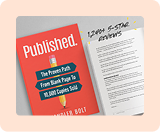
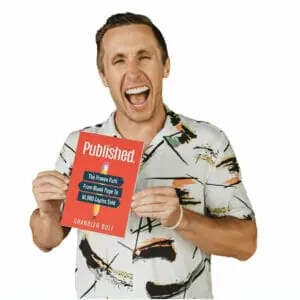
Your 5 R’s are real life, reflection, research, reading, and (w)riting. When you learn how to write a nonfiction book, it helps to use personal, real-life examples. I do this in my book Published. You can reflect on your experiences so the reader can learn from your experience. You’re their guide in this case.
How to write a nonfiction book also includes reading bestsellers in your genre, and of course, learning how to write a nonfiction book…the point of this whole post.
Further resources: Access my book, Published., for free here. Or, use the Amazon link here.
Is 20,000 words enough for a nonfiction book?
The word count you choose when learning how to write a nonfiction book really depends on your genre. A self-help book can be 30,000 to 70,000 words long, but a memoir might be 45,000 to 80,000. You can find how many words in different genres here.
How to write a nonfiction book: take your next step
Now that I’ve taught you how to write a nonfiction book, it’s time to write your draft. Learning how to write a nonfiction book won’t make you an author. It’s writing, and finishing, that makes you an author.
Ready to change your life and put everything you’ve learned about how to write a nonfiction book into practice? Then take your next step today and use our free resource below!
This is Part 2 in our 5 Part Book Writing Series. Find Part 3, How To Edit A Book, here!
Book Outline Generator
Choose your Fiction or Nonfiction book type below to get your free chapter by chapter outline!
Book Outline Generator
Enter your details below and get your pre-formatted outline in your inbox and start writing today!
CONGRATULATIONS
Thanks for submitting! Check your email for your book outline template.
In the meantime, check out our Book Outline Challenge.