




















If you are a homeschool parent or teacher, now is a great time to consider various ways to teach homeschool critical thinking. Did you know you can teach homeschool critical thinking skills via walking your student through the self-publishing process?
One of the best ways to learn this skill is by practice, such as via publishing a book. Self-publishing is a fantastic way to share a message with the world, but it also brings added bonuses, such as teaching stamina, collaboration, and yes, critical thinking skills.
Homeschool critical thinking: what’s covered
- What does it mean to have critical thinking?
- How to teach critical thinking in homeschool?
- What is an example of critical thinking?


Book Outline Generator
Choose your Fiction or Nonfiction book type below to get your free chapter by chapter outline!
Book Outline Generator
Enter your details below and get your pre-formatted outline in your inbox and start writing today!
CONGRATULATIONS
Thanks for submitting! Check your email for your book outline template.
In the meantime, check out our Book Outline Challenge.
What does it mean to have critical thinking?
Merriam-Webster describes someone with critical thinking skills as one who can apply reason and question assumptions in order to solve problems, evaluate information, and discern biases.
When you engage in critical thinking, or in this case, homeschool critical thinking, you learn to assess problems and situations in a methodical and logical way.
Everyone brings some form of bias to problems. To critically evaluate information often means to engage with issues through empathy, question the foundations bias is formed on, properly evaluate information, and then act accordingly.
Teaching homeschool critical thinking is vital for the overall growth of your student. Critical thinking is simply the skill to judge and discern. In fact, the term itself comes from the Greek word kritikos (κριτικός) which simply means, “able to judge or discern.”
Your student will soon have to discern what is the best course of action as they apply to colleges, or start their first job, or strive to achieve their long-term dreams. In each area, critical thinking plays a tremendous role.
How to teach critical thinking in homeschool?
Teaching homeschool critical thinking means creating environments for your student to analyze, evaluate, and make judgments about a particular situation. Homeschool critical thinking is a character trait students should most assuredly learn to embody. But how do you, the teacher, effectively teach this valuable trait?
Well, just as fiction carries the protagonist through various plot points that result in positive character development, you can lead your student through self-publishing a book, which results in using this vital skill. Self-publishing teaches many aspects of critical thinking, but here are some to get you started.
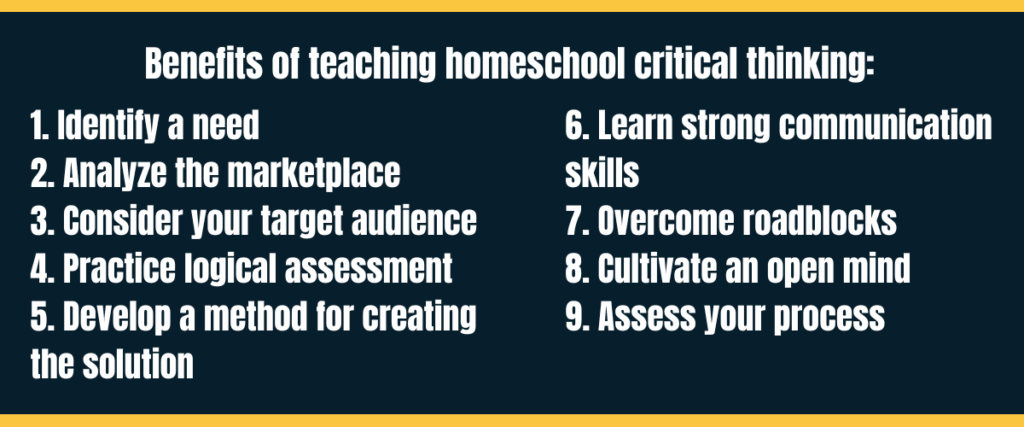
1. Identify a need
Self-publishing centers on knowing your target audience, their specific needs, and how a book can help meet this need. When you assign self-publishing as the next assignment in your student’s education, you create space for them to identify readers’ needs. This by itself employs the art of critical thinking.
Whether they choose to write fiction or nonfiction, books focus on the readers. For nonfiction, what need might your student’s audience have that your student can meet? For example, your student could write to other homeschool students about study habits that work.
For fiction, your student could craft a compelling story about a protagonist who must overcome a difficulty they know their audience also struggles with. Identifying a need uses homeschool critical thinking skills to get the brain working and thinking in a new way.
2. Analyze the marketplace
Teaching homeschool critical thinking skills in a way that is truly effective means starting at the base level. This means that after your student settles on the need, they must analyze books that already cover this topic or theme.
Encourage them to ask questions such as:
- What books already exist?
- What is their audience already buying?
- Is there a place for their book to stand out?
Analyzing the current marketplace will also set your student up for success in their future book marketing as they bring something new to the table.
3. Consider your target audience
Your student has identified a need and where their book fits, but now it’s time to ask what result their audience is looking for. Much of critical thinking, and homeschool critical thinking for our purposes, involves an openness to empathy. To truly assess a situation without personal bias means putting yourself in another’s shoes.
Many writers say they simply wrote the book they wanted to read. Critical thinking, as applied to writing, means writing the book the author knows their audience wants to read.
4. Practice logical assessment
Now it’s time to take those homeschool critical thinking skills a step deeper by assessing the best way to write the book. Who should star as the protagonist? What should be the central plot? What message does your student find most important to share?
Rather than simply choose what feels good at a gut level, probe your student to follow Simon Sinek’s advice and ask, why? Logically assessing the reasoning behind their plan will make their critical thinking skills come alive.
4. Develop a method for creating the solution
Your student now has their plot structure and it’s almost time to get to writing. Before jumping into the actual writing process, however, they must create a method for finishing their book.
Solutions do not manifest without some form of strategy. The same is true for creating a book. While you, the teacher, likely set a deadline, it’s up to the student to determine how to meet this deadline. How many words will their book be? How many words must they write each day to meet this goal?
This process will train your student in homeschool critical thinking skills by helping them think ahead and take into consideration weekends, sick days, time off, etc.
5. Learn strong communication skills
The actual writing process is training in perseverance, but it also teaches communication skills. The ability to effectively communicate can make or break someone’s critical thinking. If one knows the issue and can identify the solution, but is unable to communicate, there is a big roadblock to fixing the problem.
Writing teaches how to communicate via the written word, but it subliminally teaches how to communicate cohesively as well. A book, after all, takes thousands of words to tell a story or explain an idea. These communication skills matter.
6. Overcome roadblocks
Speaking of roadblocks, homeschool critical thinking matters greatly due to its ability to help a student work with issues rather than feel bound by them.
What happens when a plot point doesn’t seem to be working? How do they respond when they get a day behind in their writing? What happens when they don’t feel inspired to write? These are all roadblocks writers face, and ones that demand homeschool critical thinking skills to overcome.
7. Cultivate an open mind
Roadblocks necessitate an open mind, and an open mind is crucial for truly learning homeschool critical thinking skills. Roadblocks can be worked with, but it’s an open mind that helps identify the best solution.
For example, what if your student creates a book cover design they love but everyone else does not seem to resonate with it? Their response relies on their ability to put their newfound critical thinking skills to work and adequately assess why they received this response.
The same can be applied to working with a developmental editor. To build a healthy editor/author relationship means cultivating an open mindset, assessing edits, and ultimately going with the edit that works best for the reader.
Additionally, as your student uploads their book to Amazon KDP and clicks publish, it’s important for them to be open-minded about the marketing efforts they choose to engage in. Encourage them to logically assess their strengths and in what ways they could best market their book. Social media posts? Going live? Appearing as a guest on podcasts?
8. Assess your process
Once your student identifies the readers’ need and creates a solution via self-publishing a book, learning those homeschool critical thinking skills is not quite over. Now it’s time to go back and assess the process itself.
Consider offering your student these reflective questions after they complete their self-publishing book assignment:
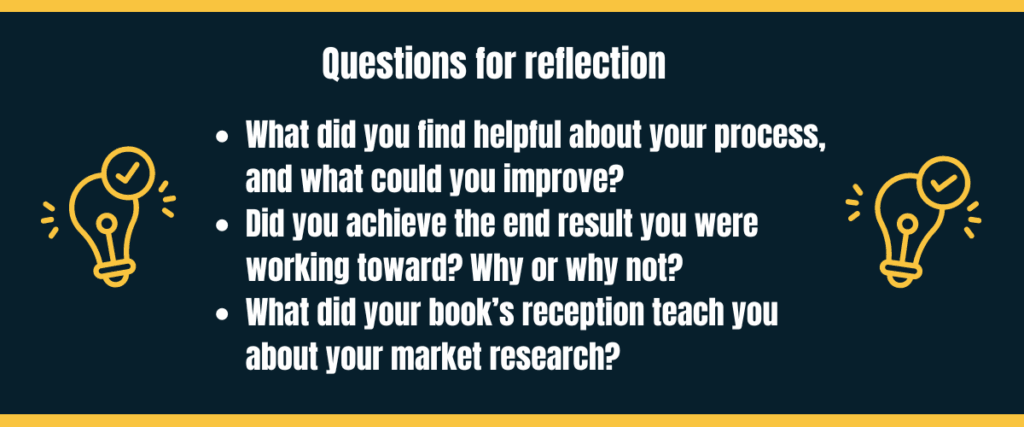
- What did you find helpful about your process, and what could you improve?
- Did you achieve the end result you were working toward? Why or why not?
- What did your book’s reception teach you about your market research?
These questions are not meant to discourage or necessarily encourage, but simply prompt your student to think deeply.
What is an example of critical thinking?
A great example of homeschool critical thinking is your student self-publishing their book, and regardless of their success, pivoting appropriately the next time. Even authors with the top self-publishing success stories know the importance of making small changes over time.
The ability to logically assess a situation is vital to life-long flourishing. This is one reason why teaching homeschool critical thinking is so important. Teaching this skill by allowing your student the opportunity to self-publish a book is a double win.
Not only does your student now have the tools necessary to think critically, but they have physical proof that they can employ this skill to a massive project. Imagine how this type of success will benefit them as they graduate and move on to the next stage of life!
Homeschool critical thinking: take your next step
You are equipped to walk your student through the writing and self-publishing process and while doing so, help them learn critical thinking skills. Now it’s time to get to work.
Use our free Book Outline Generator to help them get started on their outline. They can fine-tune the details and then get straight into writing!
Book Outline Generator
Choose your Fiction or Nonfiction book type below to get your free chapter by chapter outline!
Book Outline Generator
Enter your details below and get your pre-formatted outline in your inbox and start writing today!
CONGRATULATIONS
Thanks for submitting! Check your email for your book outline template.
In the meantime, check out our Book Outline Challenge.