


















Are you a writer wondering how to write a myth that connects with readers and leaves them aching for more?
We’ve taught over 8,000 authors how to write, publish, and market their books over the last 10 years and today, it’s time to help you learn how to write a myth!
The way you craft your myth can draw in readers you may have otherwise missed. We cover just how to do so. Let’s get straight into it.
How to write a myth: what you learn
- What is a myth?
- What are the 5 elements of a myth?
- How to format a myth?
- What is an example of a myth?
What is a myth?
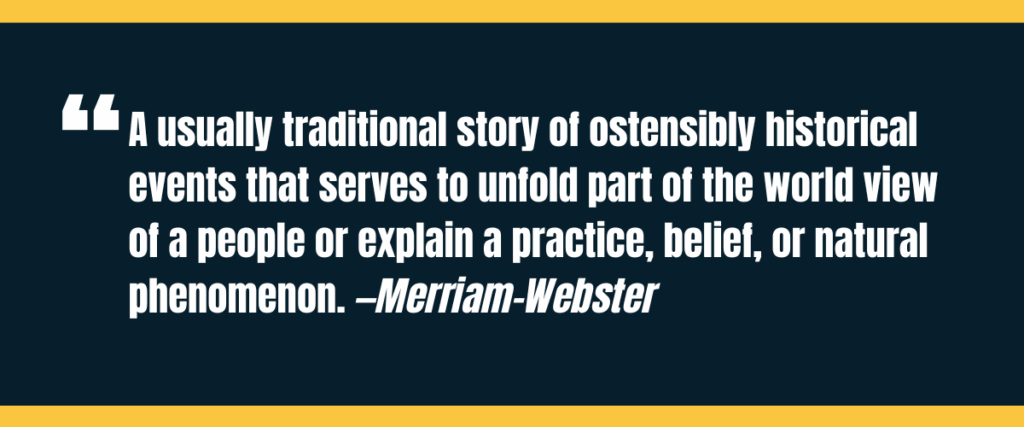
Merriam-Webster defines a myth as, “A usually traditional story of ostensibly historical events that serves to unfold part of the world view of a people or explain a practice, belief, or natural phenomenon.”
Learning how to write a myth can open you up to an entirely new readership, reach your current readership in fresh ways, and serve as a great asset in your book marketing. I mean, who doesn’t love a great myth?
It is important to note that learning how to write a myth takes a different focus than learning how to write a legend, folktale, or fairytale.
While a myth does share the world view and values of a particular culture or people group, myths are often rooted in fantastical elements to give explanation to origin stories or natural phenomena.
Legends are rooted in historical heroes, such as the legends surrounding Robin Hood or King Arthur. Folktales are fiction and shared through oral tradition rather than through the written word.
Fairytales are written down, passed through generations, and often focus on imaginary people and places. For our purposes today, it’s time to talk about the plot structure and themes you may want to incorporate into your myth.


Book Outline Generator
Choose your Fiction or Nonfiction book type below to get your free chapter by chapter outline!
Book Outline Generator
Enter your details below and get your pre-formatted outline in your inbox and start writing today!
CONGRATULATIONS
Thanks for submitting! Check your email for your book outline template.
In the meantime, check out our Book Outline Challenge.
What are the 5 elements of a myth?
There are five key elements to a myth: characters, setting, conflict, plot, and resolution. Learning how to write a myth often includes incorporating literary conflicts you can find across fiction, but with a specific angle. Let’s break each one down.
1. Character
When learning how to write a myth, it’s crucial to cast your main character as non-human. Of course, there can be exceptions to this, but myths frequently focus on a non-human character.
You may want to choose a god, a demigod, or even some kind of animal. Consider the myth of Thor, found in Norse mythology. Thor is the god of thunder, and being cast as the central figure in this myth, the origin of thunder is explained.
Hack: Choose a non-human protagonist to explain a supernatural element, practice, or belief.
2. Setting
Part of how to write a myth entails creating a setting that fits your other-worldly protagonist. Your main character has an origin story, and you may start by forming a setting for this story.
While the Marvel films send Thor to Earth, Thor comes from the setting of Asgard, a mythical place outside of Earth.
Hack: Use setting to highlight the origin of your protagonist.
3. Conflict
Your conflict will drive your character’s development and story setting, so spend the appropriate time to get this part right.
Popular conflicts in literary storytelling include:
- Man versus man
- Man versus self
- Man versus nature
You may find that you have several of these conflicts intertwined. To reference the Marvel Universe again, Thor battles himself in his quest to hold the hammer, battles man in his relational tensions with Loki, and battles nature as the god of thunder.
Hack: Choose a conflict worthy of your otherworldly protagonist.
4. Plot
A great protagonist, strong setting, and curated tension will feel like a chaotic storm without a concrete plot to focus the conflict. Myths often follow a linear plot to showcase the rise of the mythological character it’s built around.
However, you can also include flashbacks, although we recommend doing so sparingly. Whatever plot points your myth includes, be sure to focus on show, don’t tell writing to really draw in your reader!
Hack: Build out a plot that drives the tension and focuses on your protagonist’s personal journey.
5. Resolution
Making it as a writer means writing until you reach the end of your manuscript! After all, no matter your book genre, you can’t publish if you don’t finish the draft.
Your resolution should include a clear ending, one that wraps up loose ends and satisfies the reader. Whether your ending is tragic or ends on a high note, make it as compelling as possible. This is your chance to entice the reader to come back for more…and purchase your next book!
Hack: Write an ending that fits the arc of your protagonist. You may want to write several endings before settling on the right one!

How to format a myth?
Now that you know the five elements for how to write a myth, format your myth by breaking it down into the same sections as you would when writing a novel or short story.
Your myth needs to have a strong beginning, middle, and end. A myth is often used as a way to explain natural phenomena, beliefs, or origin stories, so your beginning must grab the reader. Use the five elements discussed above to support your beginning, middle, and end.
Your beginning
Learning where to start your plot is crucial to great mythical storytelling. We encourage writers to start in medias res—in other words, right when the action starts. This jump starts your plot, draws in a readership, and therefore, helps you write a book that sells!
Plus, great myths are usually far from slow: it’s gods fighting gods and the immortal against the mortal. Start with some form of action or tension. Start out strong.
Your middle
The middle of your myth is a vital element to understand because it directly relates to learning how to write a myth that actually keeps readers reading.
The midpoint of your myth should include high tension or action that propels readers toward the climax. How is your protagonist changing or growing? What powers are they learning to wield well?
Your ending
Of course, your ending must be worthy of your beginning and middle, as well as satisfy the reader. What did you set out to explain? Natural phenomena? An origin story?
If you seek to explain the natural phenomenon of earthquakes, does your protagonist create a compelling answer? If you wanted to provide answers for a belief or practice, have you done so with a concise, memorable ending?
The ending is what sticks with readers, so make sure you craft a myth so compelling that it could turn into actual mythology surrounding the topic you sought to explain.
I don’t know about you, but Thor’s story is so strong it feels like it could be real. Yours should reflect the same!
What is an example of a myth?
There are many great examples of myths, from the myth of Thor to stories with mythological elements woven throughout. To inspire your own writing, let’s take a look at a few examples of stories that use mythology.
Percy Jackson
The Percy Jackson series draws heavily from Greek mythology, although its protagonist, Percy, is fictitious. Rick Riordan’s fantasy series combines traditional storytelling techniques with mythology.
Combined, these steps led him to bestseller success and the books were adapted into both a film and television series.
Circe
Madeline Miller authored The Song of Achilles and went on to publish Circe, a retelling of the goddess’s story (Zeus banishes her from the house of Helios to an island).
Miller knew how to write a myth that resonated with her audience. By combining the myths we all know and love with a new twist, Circe became a bestseller.
This Woven Kingdom
Tahereh Mafi, author of This Woven Kingdom, also knows how to write a myth that engages readers. Her novel was an instant New York Times bestseller. In it, Mafia shares the story of a long-lost heir to an ancient Jinn kingdom.
Using this mythology in her story helped her take her plot to the next level and follow her dreams all the way up to bestselling author.
Stone Blind
Natalie Haynes’ novel stars Medusa, the only mortal in her family of gods, and the names we all associate with the classical myths: Poseidon and Athene’s temple.
Haynes takes a nuanced look at this legendary myth, drawing from the myth itself to inspire her own story and thereby, “Breathing warm life into some of our oldest stories,” Telegraph, UK.
Troy
Stephen Fry is known as an author who reimagines the Greek myths. His novel, Troy, takes on the Trojan War.
Starring a cast of mythical characters Achilles, Hector, Odysseus, Helen, their lovers, and their mortal enemies, Fry weaves the myths we know with his prose to create the final installment of his series, The Greek Myths Reimagined.
The Lord of the Rings
We would be remiss to discuss how to write a myth without mentioning J.R.R. Tolkien’s classic series, The Lord of the Rings.
A brilliant storyteller, Tolkien drew from a myriad of mythologies to create his compelling Middle-earth and all the stories it holds. This series is a great one to draw inspiration from as you practice how to write a myth that fits your unique storytelling desires.
How to write a myth: take your next step
Whether you focus on the gods of the natural phenomena or bring your myths back down to earth as Tolkien did, you now know how to write a myth. Use our free Book Outline Generator to launch you into writing your own myth!
Book Outline Generator
Choose your Fiction or Nonfiction book type below to get your free chapter by chapter outline!
Book Outline Generator
Enter your details below and get your pre-formatted outline in your inbox and start writing today!
CONGRATULATIONS
Thanks for submitting! Check your email for your book outline template.
In the meantime, check out our Book Outline Challenge.