




















If you ask ten authors how long it took them to publish their books, you’ll hear ten different answers. Some people carry a book around in their head for years and chip away at it when they can, working on it a few minutes at a time or in hours-long sprints and then not touching it for weeks. Others write quickly, finish a draft in a few months, and then get bogged down in editing or publishing.
In our experience working with thousands of authors, the answer is actually simpler than it looks. You’re not dealing with one single timeline; you’re dealing with three:
- Writing the rough draft
- Editing and revising
- Publishing and production
That first stage varies the most. Your habits, daily word count, book length, and life circumstances all affect how long it takes you to finish your draft. Once that draft is done, the rest of the timeline is much more predictable.
Over the last decade, Self-Publishing School has helped more than 8,000 authors write and publish their books. Here’s what we’ve learned from first-hand experience:
Across more than 1,000 of our most recently published books, the average time from finished rough draft to live, published book is 65.5 days.
That window includes editing, formatting, cover design, and the technical work of getting the book onto platforms like Amazon.
The draft, on the other hand, is completely on you. We encourage authors to treat writing like a practice, not a one-time push. With a clear plan and a realistic daily word count, most writers are much closer to a finished draft than they think. Understanding what drives each stage of the timeline will help you set expectations, build a plan, and finish your book.
What we’ll cover


Book Outline Generator
Choose your Fiction or Nonfiction book type below to get your free chapter by chapter outline!
Book Outline Generator
Enter your details below and get your pre-formatted outline in your inbox and start writing today!
CONGRATULATIONS
Thanks for submitting! Check your email for your book outline template.
In the meantime, check out our Book Outline Challenge.
What affects how long it takes to write and publish a book
Every book moves through writing, editing, and production. How long each stage takes depends on a few key variables. Some are within your control, and others come from the book itself or the publishing path you choose.
Your daily writing habits
How you show up to the page is the single biggest factor in your overall timeline.
Authors who write a small, steady number of words most days finish much faster than those who write in irregular bursts. Someone who hits a clear daily goal keeps stacking progress. Someone who waits for inspiration tends to restart the same chapter over and over again.
You do not need to write full time. A consistent, realistic daily word count will do more for your draft than the occasional “perfect” writing day.
Word count and genre expectations
Different types of books land at different lengths, and that has a direct impact on time.
As a rough guide, most books fall into these ranges:
- Shorter or highly focused nonfiction: about 30,000 to 50,000 words
- Standard nonfiction: about 50,000 to 80,000 words
- Young adult and adult fiction: about 70,000 to 100,000 words
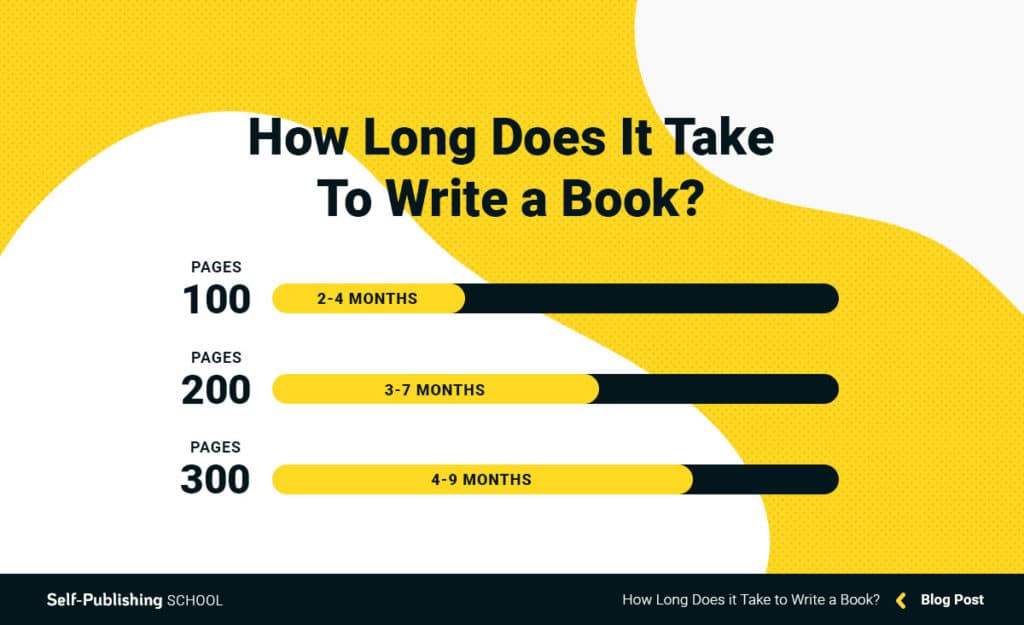
At 500 words a day, a 30,000 word project takes two to three months. A 100,000 word novel takes closer to six to seven months. If you only write a few days a week, those ranges often stretch to four to twelve months. But still, if you finish your rough draft in 12 months, you’re way ahead of most other people who never manage to write their book at all.
Thinking about it in terms of page count often helps our authors picture it. A 100-page book (around 30,000 words, about 300 words per page) tends to take two to four months at a moderate weekly pace. A 300-page book can easily take most of a year if you’re writing part time.
The complexity of your manuscript
Some books are simple and straightforward. Others are layered and complex.
Fiction authors spend more time solving problems with character arcs, timeline, or worldbuilding, where nonfiction authors often need more passes to clarify ideas, tighten a framework, or organize research. The more complex the material, the more time you’re likely to spend in revision.
The depth and stages of editing
Editing is not a one-step process. It’s a series of passes that each handle a different job:
- Developmental editing looks at the big picture.
- Structural editing focuses on order and pacing.
- Line editing works at the sentence level to improve clarity and style.
- Copyediting checks grammar, spelling, and consistency.
- Proofreading catches final errors before printing or upload.
You probably don’t need every possible pass in a formal way, but your book will move through these layers in some form. Developmental and structural work often take the longest. Copyediting and proofreading are faster, but they still require focused attention.
Because these steps are known and repeatable, editing is usually more predictable than drafting, even though it takes a while.
Your publishing path
Your choice between self-publishing and traditional publishing changes the shape of your timeline more than almost anything else.
If you self-publish, you control the schedule. You decide when to finish edits, when to start production, and when to hit “publish.” The bottlenecks are your own time and the availability of your team.
If you follow a traditional path, you add two major phases before the book ever lands on a production schedule: querying agents, and going through a publisher’s acquisitions process. Even after a contract is signed, most traditionally published books spend about two years in the pipeline before release.
For authors who want flexibility or who are working toward a specific launch window, self-publishing is usually the more predictable option.
How long it takes to write a book
Writing the rough draft is the most personal stage of the process. It’s also the one that feels the most mysterious from the outside. In practice, the timeline depends on two simple things: how long your book is, and how often you write.
Daily word count and realistic drafting timelines
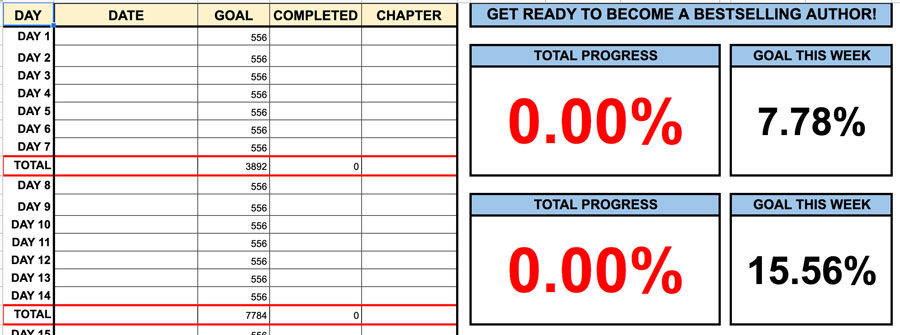
A clear daily word count target makes the drafting stage much easier to manage. For most writers we work with, 1,000 words per day is a realistic and effective goal, even with a full time job or family.
We also recommend planning to write about 25% more than your final target (or rather, that you can expect to trim down your rough draft word count by about 25% before publishing). That buffer gives you room to cut, tighten, and refine during edits without starving the book.
If we apply that to typical ranges, the math looks like this:
- Nonfiction books average between 50,000 and 80,000 words. With the extra buffer, that puts your draft in the range of about 62,500 to 100,000 words. At 1,000 words per day, you’re looking at roughly 62.5 to 100 days of drafting.
- Fiction books average between 70,000 and 100,000 words. With the buffer, that becomes about 87,500 to 125,000 words. At 1,000 words per day, that’s about 87.5 to 125 days of drafting.
That’s the clean, math-only version. Real life will adjust it a bit. You’ll have days you write less and days you write more, or times when you skip a day and make it up later. What matters is that you can see where you’re headed and how each writing session moves you closer.
If you prefer a slower pace, the same logic still applies. At 500 words a day, or maybe three writing sessions a week instead of seven, you can expect your timeline to stretch into the four-to-12-month range, depending on total length and how consistently you show up.
How writing habits influence completion
The difference between the author who finishes a draft in a few months and the author who takes years is almost never raw talent. It is habit.
Writers who treat their book like an ongoing project, with scheduled sessions and clear targets, finish far more often than those who wait for large blocks of free time. A sustainable writing routine usually includes:
- A target word daily count that fits your life
- Specific times on your calendar for writing
- A simple way to track progress
- A plan for what to work on each session
That structure keeps the draft from turning into an endless “work in progress” and makes it much easier to recover from the inevitable interruptions of real life.
The role of accountability
We’ve seen over and over that accountability is one of the strongest predictors of whether a draft gets finished.
When you write by yourself, it’s easy to put the book aside for a week, then a month, then a year. When you have a coach, a writing partner, or a community checking in, the project stays present in your mind. You feel a gentle pressure to keep moving.
That pressure doesn’t need to be harsh. It just needs to be consistent. Regular check-ins, shared word count goals, and even scheduled group writing sessions can make the difference between a draft that stalls out and a draft that reaches “The End.”
When our authors finish our full 12-month course, “coaching” and “community” are the two things we hear about over and over from our rave reviewers. It can’t be overstated how much it improves your chances of success if you have these two things on your side when you’re writing your own book.
How long it takes to edit a book
If the draft is where you discover the book, editing is where you shape it into something ready for readers. It’s also where many of our authors are surprised by how long real quality takes.
The time you spend in editing depends on the state of your draft and how polished you want the final book to be, but the main stages are fairly standard.
Developmental and structural editing
Developmental editing looks at the book from the top down. For nonfiction, this means the overall argument, chapter flow, and how well the book delivers on its promise to the reader. For fiction, it means plot, character arcs, pacing, and worldbuilding.
Structural editing is closely related. It focuses on how the material is organized and how information unfolds on the page. In practice, many drafts go through these two layers together.
Because you’re working on the foundation of the book, these stages can take several weeks to several months, especially if the changes are significant. It’s common to revise full chapters or rearrange major sections based on this feedback.
Line editing
Once the structure is solid, you can turn your attention to how the book reads line by line.
Line editing focuses on:
- Clarity
- Tone
- Rhythm
- Reducing repetition or clutter
A line editor may suggest new phrasing, condense sentences, or rearrange information inside a paragraph. For a full-length book, this pass often takes four to seven weeks.
Copyediting
Copyediting checks the technical quality of your prose. This includes grammar, spelling, punctuation, and consistency in things like capitalization, numbers, and style.
Even a clean draft benefits from a copyedit. Most manuscripts move through this stage in another four to seven weeks, depending on length and complexity.
Proofreading
Proofreading is the final quality check before you move to print or upload. The goal here is to catch any remaining typos, formatting glitches, or small errors that slipped through previous passes.
A typical proofread for a book length manuscript takes two to three weeks. It’s short compared to the earlier stages, but it matters. Your readers will forgive one or two mistakes. A pattern of errors pulls them out of the experience.
How length and complexity change editing time
A 100-page book will of course move through editing faster than a 300-page one. A tightly focused structure will be easier to revise than a sprawling draft. Genre, density of research, number of characters, and even your own comfort with revision all play a role.
This is also where we see the value of outside guidance. Authors who try to handle everything alone often spend months circling the same issues without a clear plan. Authors who work with a professional editor or coach move more purposefully through each stage and get to the finish line sooner.
How long it takes to publish a book
Once your manuscript is fully edited, you move into publishing and production. For self-published authors, the core publishing workflow looks like this:
- Finalizing edits
- Interior formatting
- Cover design
- Metadata and positioning
- Uploading files to platforms
- Reviewing proofs and making final corrections
That may sound like a lot, and it is if you try to go it alone, but as a reminder: Across more than 1,000 books in our recent data set, the average time from finished draft to live, published book is 65.5 days. That figure includes the editorial work that happens after the draft, design, formatting, and final technical setup.
Self-publishing timelines
If you self-publish, your total time in this stage depends on:
- How quickly you approve edits (our team can’t move forward until you approve our changes!)
- How many rounds of cover design you request
- How complex your interior layout is
- How fast you respond to proofs and revisions
Authors who plan ahead and respond quickly will move through production close to or ahead of that 65.5-day average. Authors who go back and forth on major decisions or pause between steps will take longer, even with the same underlying process.
Traditional publishing timelines
Traditional publishing follows a very different rhythm.
Even if you have a finished manuscript, you’ll typically spend months or years querying agents. Once an agent signs you and submits your work, your book enters an acquisitions process that involves multiple readers, meetings, and internal discussions.
If your book is acquired, it joins a seasonal catalog, and the publisher assigns it a slot in their lineup. It’s common for two or more years to pass between acquisition and publication.
There are benefits to that longer runway, though. You have more time to build your platform. You may have a larger in-house team working on your launch. But the tradeoff is control and speed. You’ll be working on the publisher’s timeline, not your own.
How long it takes from idea to a finished, published book
When you put all three stages together, the full timeline looks like this:
For a self-published author following a steady writing habit, a typical path (based on data from our 8,000+ authors) looks like this:
- Rough draft at 1,000 words per day: 2 to 4 months
- Editing: several weeks to several months
- Publishing and production: about 2 months on average
In other words, a disciplined author with a clear plan can reasonably expect to go from first words to a published book in under a year.
For authors who write less frequently, prefer slower revision, or are experimenting with their voice for the first time, the drafting stage alone can easily fill most of a year, and the full journey will take longer than that. The process still works. It just moves at a different pace.
If you choose a traditional publishing path, you’ll also layer the agent search and publisher schedule on top of this. That can stretch the total timeline to several years, even if your draft was finished before you started querying.
The important thing to remember is that there’s nothing mysterious about the stages themselves. Once you know what they are and how they fit together, you can plan around them.
How to speed up the process of writing and publishing a book
Speed without structure leads to a rushed, uneven book. Structure without speed leads to a project that never ends. The goal is to move efficiently without cutting corners.
From what we’ve seen, these are the levers that make the biggest difference.
Plan the book before you write it
A solid outline doesn’t kill creativity. It protects your time.
When you begin with a clear sense of your topic, your reader, your promise, and the sequence of chapters or scenes, you spend far less time rewriting entire sections later. You still have room to discover ideas as you go. You’re just discovering them inside a container that already points toward a useful result.
Check out our recommendations for how to outline your book.
Book Outline Generator
Choose your Fiction or Nonfiction book type below to get your free chapter by chapter outline!
Book Outline Generator
Enter your details below and get your pre-formatted outline in your inbox and start writing today!
CONGRATULATIONS
Thanks for submitting! Check your email for your book outline template.
In the meantime, check out our Book Outline Challenge.
Separate drafting from editing
Trying to polish every sentence while you’re still figuring out the story is one of the fastest ways to stall.
We encourage authors to treat the first draft as raw material. Get the ideas and scenes down. Just write. Nothing else matters until you finish your draft. Resist the urge to tinker endlessly on chapter one. Once the draft exists, you can move into editing with a complete view of the book and make better decisions about what to keep and what to cut.
Follow the right editing order
When you edit out of sequence, you end up doing the same work twice. If you line edit pages that may be removed in a later structural change, you waste time.
A smoother sequence looks like what we discussed above:
- Developmental and structural work
- Line editing
- Copyediting
- Proofreading
You make the big changes first, then you refine the language, then you clean up the details. Each step prepares the manuscript for the next one.
Start production tasks earlier than you think
You don’t need to wait until every edit is locked in before you think about your cover, interior layout, or metadata.
You can:
- Explore cover concepts while editing is underway
- Decide on trim size and format before formatting begins
- Draft possible titles, subtitles, and descriptions early
This parallel work means that once the edited manuscript is ready, your design and positioning decisions are not starting from zero. Having our production team behind you will of course make it easier to do this parallel work, since they handle most of it for you.
Stay responsive during key stages
We see a lot of delays that come from silence rather than difficulty.
If you can respond quickly to editor questions, design proofs, and technical reviews, you keep the project moving. If every round sits in your inbox for two weeks, the calendar expands fast.
Use expert guidance
There are as many ways to write and publish a book as there are authors, but there is no award for reinventing the entire process on your own.
Working with people who have already guided thousands of books from idea to publication gives you a tested roadmap. It also gives you a place to ask questions, avoid common mistakes, and choose a path that fits your goals.
A book takes time, but a clear plan makes all the difference
Writing and publishing a book is a significant commitment. There’s no getting around that. Your habits, your choices, and your support system all shape how long it takes.
What we have seen, again and again, is that the process feels much more manageable once you know what to expect. A clear drafting plan makes writing less overwhelming; a thoughtful editing sequence turns revision into a series of concrete steps instead of a vague cloud of “fix the book;” a simple production checklist moves you from final manuscript to live book without constant second guessing.
If you’re serious about getting your book out of your head and into your readers’ hands, start by building that plan. Decide how and when you’ll write, how you’ll handle editing, and whether you want to move on a self-publishing timeline or aim for a traditional route (you know which one we recommend!).
We’ve built our programs, tools, and training around these exact questions. Our job is to give you the structure and support you need to bring the idea and keep showing up.
You don’t have to rush. But you don’t have to wait forever, either. With the right plan, your book can move from first draft to finished product in a timeframe that fits your life and your goals.
If you want to finally finish that book you’ve been dreaming about, feel free to contact our team! You can schedule a free consultation with one of our publishing strategists to take the first step toward getting your book published within a year.
Book Outline Generator
Choose your Fiction or Nonfiction book type below to get your free chapter by chapter outline!
Book Outline Generator
Enter your details below and get your pre-formatted outline in your inbox and start writing today!
CONGRATULATIONS
Thanks for submitting! Check your email for your book outline template.
In the meantime, check out our Book Outline Challenge.