

















When I first started writing, I had no idea there was such a thing as the easiest book outlining methods for first-time authors. I knew I had a story I wanted to share but what I didn’t know was how to do so in a way that would resonate with readers.
The good news is, you can use different outlining methods whether you want to learn how to write a novel or even a nonfiction book.
In fact, we’ve taught over 8,000 authors how to write, publish, and market their books over the last 10 years, which means we’ve guided students through outlining hundreds and thousands of books.
Ready to find an outline method that works for you? Let’s take a look at three of the easiest book outlining methods for first-time authors.
I’m even going to show you the outlining method I found most natural when I was first starting out and why it works. Ready to go?
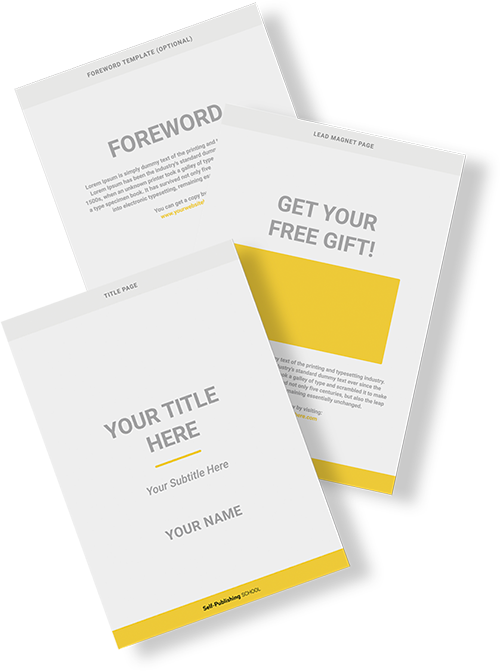

Book Outline Generator
Choose your Fiction or Nonfiction book type below to get your free chapter by chapter outline!
Book Outline Generator
Enter your details below and get your pre-formatted outline in your inbox and start writing today!
CONGRATULATIONS
Thanks for submitting! Check your email for your book outline template.
In the meantime, check out our Book Outline Challenge.
Easiest book outlining methods for first-time authors
The brain dump
One of the easiest book outlining methods for first-time authors is to literally write out every idea you have around any one topic. To do this in a way that will help you later plot your story or arrange the topics of your nonfiction, use the following steps.
Choose a core theme or plot point
For fiction, choose a short phrase that encapsulates the story you want to write about. For example, “A girl must choose her own destiny in a world that wants to choose for her.”
For nonfiction, choose a theme you love: gardening, business, rock climbing, travel, etc. Next, write down anything you can think of that relates to the topic or plot point.
Your fiction ideas may look like something similar to this:
- Test
- Groups
- Family
- Personality
- Dreams
- Original
- Fear
- Bravery
If you chose business for your nonfiction idea, your list might look like:
- Trial and error
- Lessons learned
- Failure
- Success
- Networking
- Investments
After you write these sub-core ideas out, expand into a paragraph on each. For a fiction example, let’s say you decide to expand on the word groups.
You write that this world separates people into five groups and a test determines who goes in what group. You can pick what group you ultimately want to be in, but once you choose, it’s a forever choice.
(If you love YA, you know I’m pulling examples from the Divergent series.)
For nonfiction, you may want to delve into lessons learned. You could talk about how watching older adults in your life taught you the importance of how you make, spend, and invest money.
You could expand into these specific lessons and how you want to apply them to your own life. If you love finance books, you know I’m drawing inspo from Rich Dad, Poor Dad.
Once you have these ideas, simply organize them into an outline and start writing! This is one of the easiest book outlining methods for first-time authors.
The bullet-point outline
The bullet-point outline is another simple way to organize your thoughts. Particularly if you’re newer to writing, finding the book outlining method that you can stick with feels really important.
You don’t want to bog yourself down on intricate ways to create plot structure or how to thread the various themes in storytelling into your nonfiction writing. You want to prove to yourself you can outline and write a book.
You can do so by simply starting a running list of what you want to include, chronologically, in your book.
For those who write by the seat of their pants (rather than plan everything ahead of the writing), this is one of the best tips for plotting a novel. It allows you to just get it all down.
Start with scene one. Then follow the through line of the plot from there. It’s helpful to ask “what would my protagonist do next” and “why” after each scene.
This helps you create logical actions your protagonist would actually take, and helps you avoid plot holes you’ll have to fix later on.
For nonfiction, focus on your audience’s pain point. Ask “how can I most benefit them,” and “what next step would be most helpful for them to know?”
Recently, I was editing a book for an author. He has a tremendous background in business culture and used each chapter to walk his audience through how to build a healthy business, step-by-step.
If you are a nonfiction writer, simply ask, what is the next best step my reader needs to know about?
The classic three-point method
All right, I told you I would share the method I found most natural for myself. Out of the easiest book outlining methods, this one just felt organic to me. Here’s what I mean by the classic three-point method.
Every story starts somewhere, has a midpoint, and has an ending. As a first-time author, I knew I needed to have a beginning I loved. I also knew I needed to write “to” something.
I didn’t want to begin drafting without some kind of character development or plot point to reach later on.
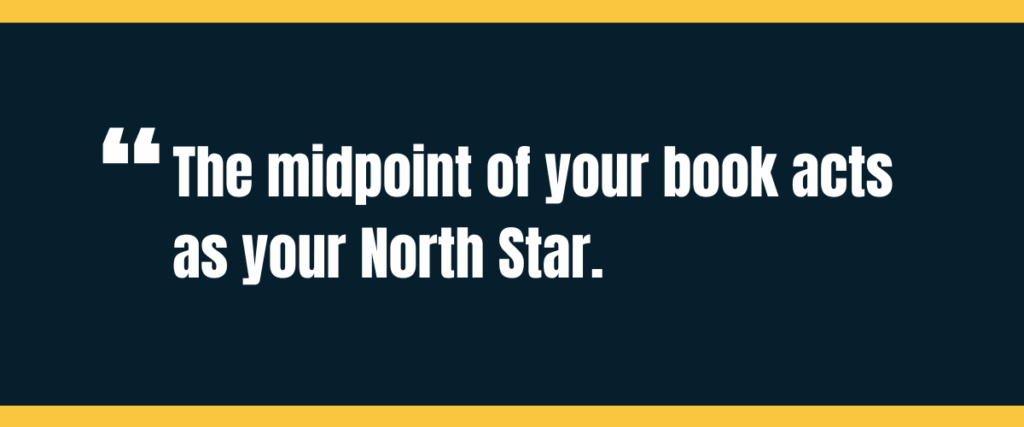
The reason it’s so important to have a midpoint is because it acts as your North Star. It guides you in your writing and keeps on the plot path, if you will. It’s also crucial to know where to end your book.
With all of this in mind, let’s take a look at the three-point method.
Know your starting point
Where a book starts, whether fiction or nonfiction, matters. Imagine if Harry Potter had started with the sorting hat. Readers wouldn’t have built up empathy for Harry.
Imagine if James Clear had started Atomic Habits several chapters in, never sharing his personal story of overcoming. He wouldn’t have built trust with his audience.
Whatever genre you choose, spend some time to find a starting point that makes sense for you, then ask the following questions:
- Should I start a day earlier in the story?
- What if I started writing from a different character’s POV?
- How might beginning in a different season change the book?
For nonfiction, ask:
- What if I started with a personal story?
- What if I shared a different personal story?
- How could I begin in a way that comes alongside the reader with more empathy?
- What if I used a case study to inspire credibility?
Once you have decided on your starting point, it’s time to move on to point two.
Identify your story goal
Almost anyone can sit down and write pages of words. The different between books that don’t sell and the popular book genres on Amazon that sell right off the shelves is where the author writes to.
Think of the climaxes of your favorite books. What made them stand out to you? What did you love about them? What do you wish the author had done differently? What, if changed, would ruin the climax for you?
These are types of questions you want to ask when identifying your story goal. If Frodo never reached Mount Doom, The Lord of the Rings would be an entirely different trilogy.
Take some time to identify the goal of your story, then write to it. For nonfiction, this can be as simple as building chapters on each other until you empower your reader to overcome their pain point.
Find the nuance in where to end
As someone born and raised in the state of Michigan, I know the awkwardness of the “Michigan goodbye.” Here in the Mitten state, I guess we just really love hanging out, because our goodbyes can last an hour. We don’t seem to know when to end the night.
As much as I love my state, as a writer, I need to know when it’s time for my readers to say goodbye to my characters. If I end too soon, readers will feel cheated and unsatisfied. If I end too late, I risk losing them to boredom.
When finding the perfect ending, it’s important to strike the balance that leaves your readers satisfied, but always wanting to return to the story world for more.
Once again, consider your favorite books, including nonfiction:
- Where did they end?
- Did you want them to end there?
- Did you wish they had ended earlier?
- Later?
For fiction, I find it’s helpful to have wrapped up your character’s arc, while also establishing the character traits they have established and hint at how they will continue to live into them.
You want the reader to feel satisfied with the resolution, but also allow the characters to go on living rent free in your readers’ minds.
For nonfiction, don’t belabor your teaching point. You’ve spent 50-80 thousand words teaching. Now it’s time to step back so they can step forward.
Nonfiction endings often include a call to action. This is particularly true for authors who use their books to support their business and as a side hustle and want to make money publishing.
The key to a great ending is: Don’t end too early but don’t end too late.
Embark on your own book outline!
Now that you’ve learned three of the easiest book outlining methods for first-time authors, it’s time to get to work by using our free resource below!
Book Outline Generator
Choose your Fiction or Nonfiction book type below to get your free chapter by chapter outline!
Book Outline Generator
Enter your details below and get your pre-formatted outline in your inbox and start writing today!
CONGRATULATIONS
Thanks for submitting! Check your email for your book outline template.
In the meantime, check out our Book Outline Challenge.