



















Whenever there are terms written on paper, it’s a big deal. As is the case with book publishing contracts.
Usually, lawyers will be involved, and for traditionally published authors, a literary agent will also be dictated in the contract. It can seem like an overwhelming and confusing process, because it is!
Contracts are big deals. You don’t want to end up on the wrong side of a bad deal, or sign a contract you don’t fully understand. To help you out, I’m detailing what you must know about book publishing contracts so you can navigate this with a bit more ease.
Here’s what you’ll learn:
- What they do
- Do self-published authors need them?
- Who needs book publishing contracts
- Necessary terms
- How to get a contract
- Examples


Book Outline Generator
Choose your Fiction or Nonfiction book type below to get your free chapter by chapter outline!
Book Outline Generator
Enter your details below and get your pre-formatted outline in your inbox and start writing today!
CONGRATULATIONS
Thanks for submitting! Check your email for your book outline template.
In the meantime, check out our Book Outline Challenge.
What do book publishing contracts do?
Book publishing contracts are a legal agreement between an author and a publisher. It outlines the terms and conditions under which the publisher will publish the author’s work. Primarily, it’s a protection mechanism for both the author and the party the deal is being made with (usually the publisher).
As you can imagine, book publishing contracts are typically made for traditionally published authors who got a book deal. But keep an eye out for scams and bad deals from vanity presses.
In short, book publishing contracts should do the following:
- Rights Assignment: Specifies which rights the author is granting to the publisher, such as print, digital, translation, and adaptation rights.
- Payment Terms: Details the financial arrangement, including advances, royalties, and payment schedules.
- Publication Details: Includes the publication timeline, formats, and distribution plans.
- Author Responsibilities: Outlines the author’s obligations, such as deadlines for manuscript delivery and participation in marketing efforts.
- Publisher Responsibilities: Defines the publisher’s duties, including editing, cover design, marketing, and distribution.
Do Self-Published Authors Need Book Publishing Contracts?
No, self-published authors don’t typically need book publishing contracts. Not in the way you’re thinking. Because they’re a sole entity, there aren’t really any “deals” to be made with other individuals. So the contract would be useless because you get to maintain all the rights to your book! Full creative freedom.
Keep in mind, though, that you do still sign away rights and agree to terms and conditions, even when you publish through Amazon or the like. Make sure to read anything that requires you to check a box that reads “I understand the terms & conditions.”
Instead, what you might run into when it comes to contracts looks more like agreements with editors, cover designers, and formatters.
These can look like:
- NDAs: Non-disclosure agreements just keep people quiet. Those who read your book won’t be able to blab about it, or give away spoilers. This is great for editors, and also beta readers.
- Copyright agreements: Technically, so long as you can prove ownership over the content, it’s copyrighted. But you can also learn how to copyright your book for peace of mind.
- Work payment agreements: You will have contracts for paying someone for a service. These are standard and you shouldn’t be alarmed. Mostly, this protects the person you’re paying so they can, indeed, get paid.
- Rights: For works of art like covers, you’ll want to make sure your artist signs over all rights to the cover to you. Meaning, they won’t be able to claim any amount of your royalties or success for using the cover in promotional materials and the like.
Who needs book publishing contracts?
Traditionally, well, traditionally published authors would need book publishing contracts. But really, anyone who is engaging in the publishing process of a book—so long as there’s more than one person—will need a book contract.
A book publishing contract is essential for:
- Authors: Ensures that their rights and interests are protected and that they receive fair compensation for their work.
- Publishers: Provides a clear framework for the publication process and protects their investment in the book.
- Agents: Helps literary agents secure favorable terms for their clients and manage the contractual relationship between the author and the publisher.
Because there are often three parties involved in a publishing contract, you’ll want to be aware of common, and very important, terms that go into the contract for each party involved.
9 Crucial Terms of a Book Publishing Contract
Of course, if you’re the author, you want to make sure you’ll get paid and get your money’s worth. This is often where bad contracts fall short, and bad “publishing houses” try to slip in bad details. So keep an eye out for the important details.
Comprehensive book publishing contracts should include the following key terms:
- Grant of Rights: Specifies which rights are being transferred to the publisher and which remain with the author. Some authors negotiate to have more control over art concepts—like final cover approval—while others never get such rights.
- Advance and Royalties: Details any advance payment the author will receive and the royalty rate for book sales.
- Manuscript Delivery and Acceptance: Sets deadlines for manuscript submission and the criteria for acceptance by the publisher. You’ll want to make sure there are conditions for emergencies and wiggle-room for delays.
- Editing and Proofreading: Outlines the publisher’s responsibility for editing and the author’s involvement in the process.
- Publication Schedule: Provides a timeline for the book’s release and any associated milestones.
- Marketing and Promotion: Details the marketing efforts the publisher will undertake and any promotional activities expected from the author.
- Termination and Reversion of Rights: Defines the circumstances under which the contract can be terminated and how rights revert to the author.
- Subsidiary Rights: Covers the handling of additional rights such as foreign translations, film adaptations, and merchandising.
- Warranties and Indemnities: Includes assurances from the author that the work is original and does not infringe on third-party rights.
It’s best to have a lawyer involved in this entire process, and in fact, you should never sign something this binding about something as important as publishing a book without one present.
Getting a Contract With a Publisher, Simplified
Securing book publishing contracts can be a competitive process. And yes, it will take a lot of time. This is why self-publishing is such a strong option for many. You can do all of the below steps correctly, have an amazing book, and still never land a deal.
But, there are steps you can take to increase the odds, and here they are:
1. Write a Strong Manuscript
Ensure your manuscript is polished, engaging, and professionally edited.
Yes, before you even between pitching agents (an entire step), you have to write a whole book. This is because if and when you get a full manuscript request, you have to have a clean, strong manuscript to send over to them right away.
Here’s what this means:
- Polish your manuscript: Your manuscript should be the best version it can be before you submit it to publishers or agents. This means paying attention to grammar, spelling, and punctuation, as well as ensuring that the narrative flows smoothly and the characters are well-developed.
- Create an engaging story: Your story should captivate readers from the first page. Focus on creating a compelling opening, maintaining tension and interest throughout the book, and providing a satisfying conclusion.
- Get your book professionally edited: Consider hiring a professional editor to review your manuscript. An editor can provide valuable feedback on structure, pacing, and character development, as well as catch any errors you might have missed.
It can take years to do this well! Never skimp on the story. The story has to be first.
2. Research Agents
Identify agents that specialize in your genre and accept unsolicited submissions or have open submission periods. You can find a lot of these people on X (formerly Twitter) using the hashtag #PitchWars to drum up interest.
You’ll also want to pick your agents carefully. You can’t pitch a thriller to a romance novel agent, for example, and expect to get book publishing contracts.
Sometimes this looks like cracking open your favorite books (that are similar to yours) and looking at who the author thanked. Many times, this person is an agent. Or you can just use our friend Google to search “who is _____’s agent” to find the answer.
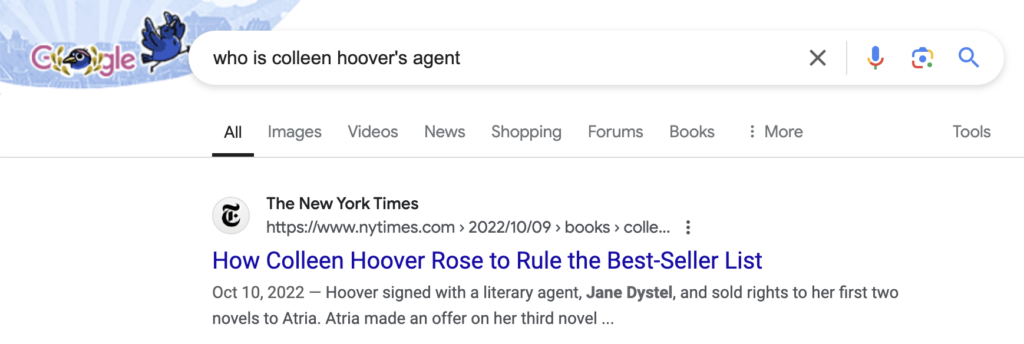
Always back this up with your own research! Find the agent’s website or their agency’s website and see if the agent is open to submissions. This would look like the agent clearly stating—whether on the agency’s website, their own, or on their social platforms—that they’re OPEN to submissions.

From there, it’s time to query.
3. Craft a Compelling Query Letter
Write a persuasive query letter that summarizes your book, highlights its unique aspects, and provides a brief author bio.
In short, a query letter will have:
- Book Summary: Your query letter should include a concise and engaging summary of your book. This should cover the main plot points, the genre, and the target audience.
- Unique Selling Points: Highlight what makes your book unique. This could be an intriguing premise, a unique setting, a strong voice, or relevant themes. Framing the book as a version of 2 popular stories helps agents understand a bit more quickly, which is important since you only have 1 page to pitch them. What makes it different? And what makes it marketable?
- Author Bio: Provide a brief bio that includes any relevant writing experience, previous publications, and any personal background that relates to your book. This helps to establish your credibility as an author.
Make sure to submit your letter the preferred way to the agent. They will have instructions! Never go around these, as it’ll put a bad taste in their mouth right away.
4. Attend Writing Conferences
Participate in writing conferences and pitch sessions to network with publishers and agents. Editors, agents, and publishers attend these conferences to network. They also want to find the “next big author” and seek them out at these conferences.
Of course, this doesn’t guarantee you’ll get book publishing contracts. It just means you’ll get a little face time with key people, which can go a long way to getting that full manuscript request.
This is a great resource for finding writing conferences.
5. Self-Publish Your Book
Self-publishing can serve as a powerful stepping stone towards securing a traditional book deal. By self-publishing, authors gain valuable experience in the publishing process, including editing, marketing, and distribution. Plus, if you have a flourishing author platform and your books are selling well, it takes the guesswork (AKA the risk) out of an agent representing you.
A successful self-published book can demonstrate to traditional publishers that there is a market for the author’s work, showing strong sales numbers and a dedicated readership. Self-publishing also allows authors to build their personal brand and establish a platform, which can make them more attractive to publishers looking for authors with proven marketability.
By proving their ability to engage and grow an audience, you can significantly enhance their chances of attracting a traditional book publishing contracts.
Brief Examples of What’s In Types of Book Publishing Contracts
Not all contracts are the same, of course. Depending on the publisher and agent, along with the medium you’re publishing under, the contract will look a bit differently.
Here are a few examples of book publishing contracts to give you an idea of what to expect:
- Standard Trade Publishing Contract: A comprehensive agreement used by major publishing houses. It typically includes detailed clauses on rights, royalties, and the publication process.
- Small Press Contract: A simpler version of a trade publishing contract, used by smaller independent publishers. It may offer more flexibility but fewer marketing resources. You’ll also likely have more marketing responsibilities in a contract like this.
- Self-Publishing Contract: An agreement between an author and a self-publishing platform. It often focuses on service fees, distribution channels, and the author’s control over the publishing process. Some of these might not be full contracts you see, but rather a box you check that says “I’ve read the terms and conditions”. So keep an eye out!
- Hybrid Book Publishing Contracts: Combines elements of traditional and self-publishing contracts, offering shared costs and profits. It includes terms for both parties’ responsibilities and financial arrangements. Be aware! These can be completely legitimate, but they can also be scammy. Do your research and read thoroughly.
If you want to see more, here’s a great book publishing contracts examples.
Book publishing contracts can be confusing pieces of paper. If you know what to look for, it’ll set you up for success in the long run. Either way, you do have to focus on writing your book first. So get to it!
Book Outline Generator
Choose your Fiction or Nonfiction book type below to get your free chapter by chapter outline!
Book Outline Generator
Enter your details below and get your pre-formatted outline in your inbox and start writing today!
CONGRATULATIONS
Thanks for submitting! Check your email for your book outline template.
In the meantime, check out our Book Outline Challenge.