

















If you’re a self-published author looking for more ways to get your book into readers’ hands—especially physical copies—you may have stumbled across something called Amazon Advantage. But is it a helpful tool or just another complicated program with hidden downsides?
Having helped over 8,000 authors over the past decade, we know the value of staying on top of the latest inventions in the book world. This one is no different.
Let’s break it down in five simple steps to see whether Amazon Advantage is a friend or foe to indie authors.
Table of Contents
What is Amazon Advantage?
Amazon Advantage is a consignment-based vendor program that allows content creators—like publishers, record labels, studios, and yes, authors—to sell physical media directly through Amazon. Think print books, CDs, DVDs, and more.
Unlike Kindle Direct Publishing (KDP), which prints books on demand, Amazon Advantage requires you to provide physical copies up front, which Amazon then stores, ships, and sells on your behalf.
In short: you print the book elsewhere, Amazon sells it.
One of the advantages (haha! get it?) is that you can print your book copies elsewhere (potentially for cheaper) and still sell through Amazon. But more on this later.
How Amazon Advantage works
It’s a pretty straightforward process, and Amazon Advantage makes it easy to start.
Here’s how the process goes:
- Step 1: You apply for an Advantage account and submit your product info (title, ISBN, cover image, etc.).
- Step 2: Amazon lists your product on its marketplace as “Ships from and sold by Amazon.com.”
- Step 3: Amazon places orders with you based on customer demand. You ship the books to them.
- Step 4: Amazon handles storage, shipping, and customer service.
- Step 5: You get paid a percentage (usually around 45% of the list price, since Amazon takes about 55%).
While it might sound similar to Seller Central or Fulfillment by Amazon (FBA), there are key differences.
Amazon Advantage VS other seller programs
There’s a reason Amazon offers multiple avenues to sell products—including books. Here’s a breakdown of what you need to know to make the right choice for your publishing path.
Amazon Advantage vs. KDP (Kindle Direct Publishing):
KDP is for POD (print-on-demand) and eBooks. This means Amazon will both print and ship the books if and when there is a sale. So you don’t have to maintain a stock of books yourself.
Here’s a bit more information on this comparison:
- You keep 60% of the list price (for paperbacks), minus printing costs, which will get you your royalties.
- For eBooks, royalty options are 35% or 70% (depending on price and region).
- Great for indie authors who want low-risk distribution and global reach without managing inventory.
For Example: Let’s say your print book is priced at $14.99.
Amazon takes 40%, leaving you with 60% = $8.99
Printing cost is $4.25 → Your profit = $4.74 per book
Amazon Advantage, on the other hand, is a vendor program designed for publishers and content creators who already have pre-printed books and want Amazon to fulfill orders from that inventory.
- You send Amazon your books in bulk (at your own cost).
- Amazon lists and ships them as if they were Amazon stock (Prime-eligible, “Sold by Amazon”).
- You receive 45% of the retail list price, regardless of what price Amazon actually sells it for.
- Amazon may discount the book heavily, but your earnings won’t increase—and you can’t stop it.
For Example: Same book listed at $14.99. Amazon discounts it to $9.99.
You still only get 45% of $14.99 = $6.75, regardless of sale price.
Printing + shipping cost = $5.00 → Your profit = $1.75 per book
Amazon Advantage vs. Amazon Seller Central:
Amazon Seller Central is similar to Amazon Advantage but has a few differences to consider. Amazon Seller Central gives you the option to fulfill the order (fulfillment by Merchant, FBM), while still allowing you to control the price of your products.
Here’s what Amazon Seller Central does:
- Lets you sell products directly to customers on Amazon
- Offers two fulfillment options:
- Fulfilled by Merchant (FBM): you handle your own shipping
- Fulfilled by Amazon (FBA): you send inventory to Amazon, they ship and handle customer service
- Allows you to set your own retail price and manage your product listings
- Pays you revenue after deducting Amazon’s referral fees (typically around 15% for books)
- Supports sales of books, merchandise, bundles, and more
- Enables Prime eligibility only if using FBA
- Includes tools for sales tracking, inventory management, and advertising
- Provides more flexibility and control than vendor programs like Amazon Advantage
Here’s a side-by-side comparison:
| Feature | Seller Central (FBM/FBA) | Amazon Advantage |
|---|---|---|
| Who sells the book? | You | Amazon (you’re a vendor) |
| Prime eligibility | Only with FBA | Yes (built-in) |
| Pricing control | * You control pricing | * Amazon can discount freely |
| Payout structure | 85% of retail price (minus FBA/FBM fees) | 45% of list price |
| Inventory model | Print-on-demand or stock yourself | Must send pre-printed books |
| Listing control | Full control | Limited input, Amazon controls listing |
| Royalty margin (typical) | Medium to high | Low |
| Ideal for… | Entrepreneurs, indie sellers, authors w/ bundles | Publishers or authors w/ bulk print runs |
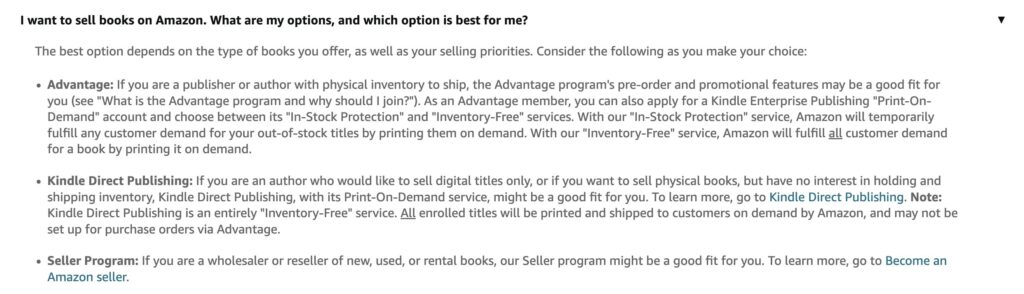
Here’s what Amazon has to say about it themselves:
Should self-published authors use Amazon Advantage?
Amazon Advantage isn’t the one-size-fits-all solution that KDP offers. But it can be an incredibly useful ally for authors who have physical stock and a strategy behind their distribution. This might mean pre-orders, or authors who know they can move a lot of inventory quickly.
Think of it as a tool in your author toolkit—not your entire publishing plan. If you’ve got a marketing push coming up, or a special edition you want to offer through Amazon Prime, Advantage might just be the right move.
Just be sure to run the numbers first.
Here’s a couple lists you can use to decide.
Why it can benefit you:
- Gives your book the “Sold by Amazon” badge, which boosts trust and visibility
- Eligible for Amazon Prime shipping, which can increase sales
- Works well for authors printing in bulk or using offset printing for special editions
- deal for media kits, book signings, or running press outreach campaigns
Where to keep caution:
- Low profit margins due to Amazon’s 55% cut
- Amazon controls pricing, and will often discount without notice
- No guarantee of reorders. You send inventory, but Amazon won’t keep restocking unless sales justify it
- You’re responsible for upfront printing and shipping costs
What to keep an eye out for with Amazon Advantage as an author
While Amazon Advantage can offer visibility and Prime shipping, it comes with a few important caveats that authors should understand before diving in:
1. Pricing control is out of your hands
Amazon can (and often will) discount your book’s retail price—but your payout stays the same. You’ll still only receive 45% of the list price, not the discounted price. If they drop your $20 book to $14.99, you still earn just $9, which may not cover your printing and shipping costs.
2. You cover all production and shipping costs
Unlike KDP, which prints on demand, Amazon Advantage requires you to send pre-printed books in bulk to their warehouse. That means upfront printing costs, shipping fees, and storage risk if your books don’t sell.
3. Inventory must stay stocked
If your inventory runs out or isn’t replenished quickly enough, Amazon may suppress your listing or reduce visibility. This can affect your sales momentum and hurt discoverability.
4. Longer payment cycles
Payments are made monthly, and there can be delays. You might wait several weeks after a sale to receive funds, making cash flow planning more challenging.
5. Limited control over your book’s page
With Amazon listed as the seller, you may have limited influence over how your book appears on the product page. Edits to descriptions, categories, or images may require more time or go through Amazon’s approval process.
The truth is that whether or not Amazon Advantage is for you as a self-published author depends. For most authors, you’re better off going the KDP route and worrying about less.