



















Creating a believable dystopian world is foundational to successful dystopian storytelling. While we’ve already covered the foundational elements of this unique genre, this post will build upon that knowledge and give you the tools to capture your readers’ attention and pull them into your world.
Dystopian books like Fahrenheit 451 by Ray Bradbury have grabbed readers attention for decades. More recent ones like Margaret Atwood’s The Handmaid’s Tale and Veronica Roth’s Divergent series are poised to become classics. Dystopian world books sell, and if you want to make money publishing dystopia, it’s vital to master the art of world-building.
Dystopian world: what you learn
- What is in a dystopian world?
- What is an example of a dystopia?
- What does it mean to live in a dystopian society?
- Examples of dystopian worlds
What is in a dystopian world?
Aspects that mark a dystopian world are injustice, suffering, lack of resources, living under a power-hungry ruler, and many more tropes. A dystopian world is a created reality where characters live in a chronic state of injustice and suffering. Because of this, an easy way to think about building a dystopian world is to consider anything in opposition to a utopia.
There are five key areas to consider when creating a dystopian world that gets your book noticed and draws in eager readers. As you work through the following list, be sure to view these tips from the viewpoint of your plot or protagonist.
How might your characters engage with the following? While dystopian worlds often share similarities, you want to create an environment that feels fresh and new to your readers.
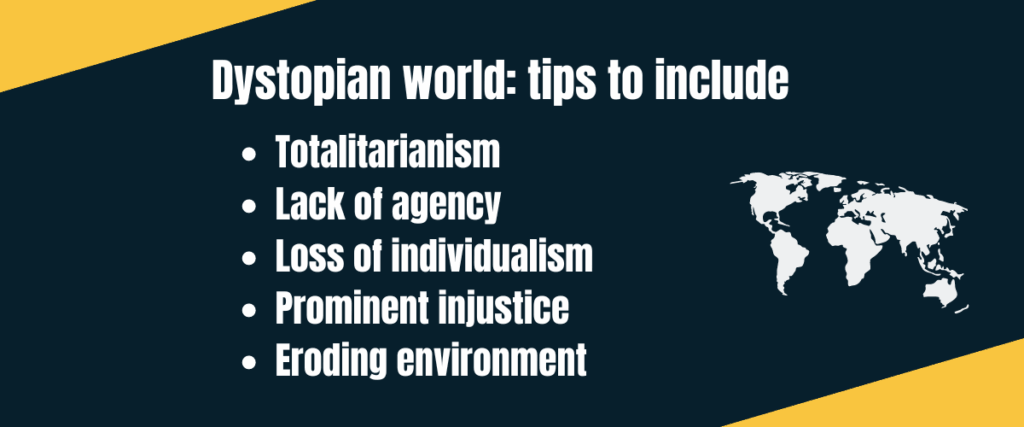
1. Totalitarianism
When it comes to world-building, start at the base level. How is it run? Dystopian worlds frequently exhibit a totalitarian government focused on the good of the many over the care for the one. A great example of this is Margaret Atwood’s work, The Handmaid’s Tale. In the book, the world has been taken over, there is a completely new method of living, and women are oppressed under the iron fist of the government.
When a government totally controls the world (hence the term totalitarian), your characters will experience a lack of agency that manifests in a myriad of ways.
When world-building for your dystopia, be sure to delve into the nuances of your totalitarian government. How did the ruler (often the villain) rise to power? What rules does he or she force the citizens to abide by? What are the consequences if they do not obey?
2. Lack of agency
Moving up from the base level, how does how your world runs impact your characters? Dystopian worlds host a variety of characters who experience the degradation of their dignity via the loss of agency.
Katniss Everdeen, protagonist in The Hunger Games trilogy, is a prime example of a character living in a world where she cannot make her own decisions—or lacks agency.
Whether it’s blindly being chosen at the Reaping or starving in the districts, the characters in the book have lost their agency to the totalitarian government ruling them. Much of dystopian plots stem from one individual rising up to save those impacted by such a rule.
To build a great dystopian world, take time to look into the type of agency your characters have lost. Do they recognize what they have lost, or is a lack of agency simply a way of life for them?
3. Loss of individualism
Similar to a lack of agency, dystopian worlds often portray a loss of individuality in favor of conformity. For example, in Divergent, all characters are separated into Factions. If they do not fit into one of these categories, they are deemed outcasts.
Individuality is sacrificed. According to the rules of dystopian living, to be a success story, you must blend in or conform. Protagonist tropes of dystopia often question the status quo and refuse to conform.
As you create your world, ask the following questions:
- What unique qualities does my character have to hide?
- Why does this world desire cookie-cutter citizens?
- What are the origins of the world?
- What sparked this desire for conformity?
Much of what goes into building dystopian worlds is a deep understanding of the world’s origins.
4. Prominent injustice
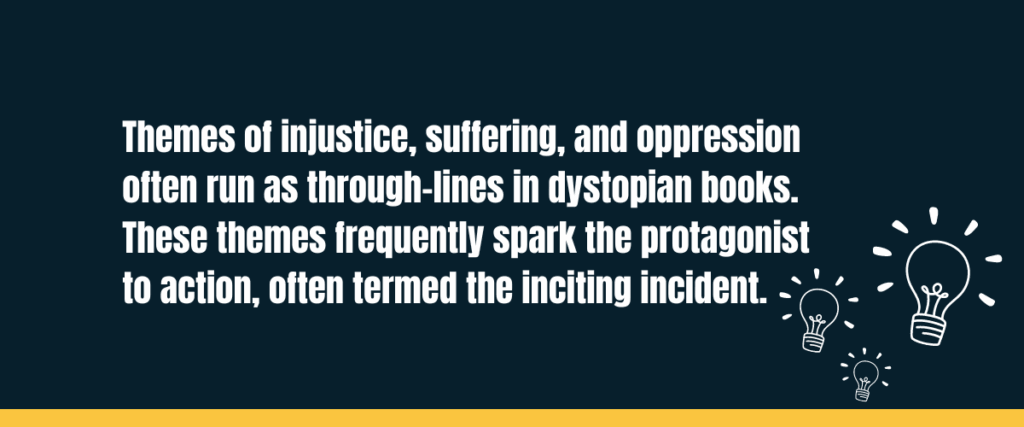
Dystopian worlds do not emerge overnight. They take time and usually form when injustice thrives and is allowed to rule. As previously mentioned, themes of injustice, suffering, and oppression often run as throughlines in dystopian books.
These themes frequently spark the protagonist to action. Something happens, the protagonist can no longer handle the injustice, and he or she decides to take action (this is usually the inciting incident).
One of the popular book that reveals a protagonist who won’t conform to the standards of injustice in his world is Wade, in Ready Player One by Ernest Cline. He constantly questions the various dynamics of his world that’s shadowed by corporate greed and elitism prompting profound questions in the in the reader’s mind.
Worldbuilding should include a look at the morality of your world: what is justice and injustice defined? Why is this the case?
5. Eroding environment
Once you establish the origins of your world and its impact on your characters, what does the physicality of your environment look like? Eroding environments, lack of resources, or even a devastated earth are great fodder for dystopian worlds.
Consider the Netflix series The 100. Doomed to live in space, a select group makes it to Earth, where they encounter life and a flourishing world for the first time. The state of the world, and the belief about the state of the world, form the crux of this show, based on the story by Kass Morgan.
Part of what makes dystopian worlds so fun to build is the ability to bring in climate and themes, almost as if they are supporting characters. Preparing to worldbuild can look like asking yourself a simple question: what aspect makes my story dystopian, and why can’t I write my story without it?
What is an example of a dystopia?
Practically speaking, a dystopia could be as simple as a family living in a world ruined by war. However, it could also be as in-depth as building an entirely new world that has been destroyed by external elements.
Consider James Dashner’s books. Characters must decipher how to exit a maze only to then enter a world scorched by sun flares. With the powers that be bearing down on them and their lives on the line, there’s a reason why his books did so well.
However, if you don’t want to delve too deep into dystopian worlds you can always follow the example of Lois Lowry, author of The Giver. Lowry’s book appears like a story set in a utopian setting where everything is perfect. Slowly, the reader discovers it is actually a dystopia and normal life is not what it appears. Writing great dystopian worlds does not always mean revealing the world as a dystopia on page one.
What does it mean to live in a dystopian society?
Living in a dystopian society or world is one where oppression is central and suffering is viewed as a constant in life. As you’ll see in the coming examples, a dystopian setting is usually run by those spreading lies, propaganda, and hiding a private agenda.
Creating a society means that you have to ask yourself very specific questions when writing. Once the base level of your world is established you have to get into the details. Knowing the answers to how your characters live their daily lives will make your world come alive for your readers.
Consider the following questions as you brainstorm for your dystopian world. How do characters:
- Earn a living?
- Travel, and can they?
- Engage with those around them?
Furthermore, you may want to delve into more interpersonal questions, such as:
- What defines a successful family life?
- How do individuals meet friends or significant others?
- Is self-disclosure encouraged or frowned upon?
- How does one’s social status impact relationships?
The more questions you can answer with concrete facts, the more believable your world will become.
Examples of dystopian worlds
There are countless examples of dystopian worlds to choose from, but you may want to start with the classics and books that have brought in substantial sales in the last decade or so.
Remember that if you want to create dystopian worlds that dominate Amazon book categories, you need to know what has sold well and why, especially if you are a new author. Reading all you can in the genre will tremendously help you as you endeavor to write your own.
With that said, here is a list to get you started:
- Fourth Wing, Rebecca Yarros
- Wool, Hugh Howey (Silo TV show)
- Divergent, Veronica Roth
- The Hunger Games, Suzanne Collins
- Maze Runner, James Dashner
- The Handmaid’s Tale, Margaret Atwood
- The Giver, Lois Lowry
- To Kill a Mockingbird, Harper Lee
- Brave New World, Aldous Huxley
- Fahrenheit 451, Ray Bradbury
- 1984, George Orwell
Reading through these titles will also familiarize you with the dystopian style of writing. Of course, you need to stay true to your own unique author voice and tone but notice the tropes that reappear from book to book.
You may be surprised at the tropes you don’t expect to find and do or the ones you expect to re-occur that don’t. Dystopia is a fun genre to write because it can fluctuate so much, while at the same time still adhering to specific genre expectations.
Dystopian world: take your next step
To help you begin world-building, use our free Book Outline Generator to create the plot for your story. Once you have a rough outline you can brainstorm the various aspects of your dystopian world. Have fun creating!

Book Outline Generator
Choose your Fiction or Nonfiction book type below to get your free chapter by chapter outline!
Book Outline Generator
Enter your details below and get your pre-formatted outline in your inbox and start writing today!
CONGRATULATIONS
Thanks for submitting! Check your email for your book outline template.
In the meantime, check out our Book Outline Challenge.