


















If you’re wondering what every first book needs to be profitable, you’re already thinking how you should go about it. I’ve collaborated with multiple bestselling authors whose combined book sales and following are in the 70M+ and 10M+ range.
They know what every first book needs to succeed, and I’ve learned a lot from them. In addition though, I’ve written a handful of books myself, both fiction and nonfiction. On top of this, we’ve taught over 8,000 authors how to write, publish, and market their books over the last 10 years.
That’s a lot of first books. Today, we break down all of this knowledge to share what every first book needs to be profitable…not just in sales, but in how they connect with their readers.
What every first book needs and tips to consider:
What every first book needs
Every first book needs something that differentiates it from the roughly 4 million books published each year.
Whether or not you want to make money publishing books on Amazon, if you want your book to be profitable for your readers, you need to engage them.
There are several specific ways to do so. Trust me, while some of these points may feel skippable, I learned the hard way that they aren’t. I’ll share why later, but for now, let’s take a look at what every first book needs to engage your readers.
Spend time on your hook
Your hook is a technique writers use in the opening of their story to grab (or hook) their reader’s attention and inspire them to keep reading. Much of your hook can come from your elevator pitch: the sentence that describes the core idea of your book.
Even if you write nonfiction, you still need a hook. James Clear does this expertly in his bestseller, Atomic Habits, by sharing one of the most traumatic events of his life.
But your hook does not need to be traumatic, just engaging enough to grab your reader. The hook of your story sets the tone of your story as well as your reader’s expectations.
The Great Gatsby by F. Scott Fitzgerald, begins with the following hook: “In my younger and more vulnerable years, my father gave me some advice that I’ve been turning over in my mind ever since.”
His prose is contemplative, reveals that this story will be a bit reflective, but also prepares the reader for what’s ahead…something worth reflection.
Your hook matters because without it, you can’t grab hold of your reader. My writing mentor says openers should “grab the reader by the throat and never let him go.”
What every first book needs is a hook that will do this in a way that aligns with your story genre and tone.
Carefully reveal your protagonist
One of my novels, a dystopian, starts with my protagonist imprisoned and wanting to escape. Because of her personality, I knew I had to introduce her in a way that allowed her to stay relatively silent.
This silence meant that whatever she said first would mean a great deal. How you introduce your protagonist sets the stage for their character arc. Consider the following introductions for the children’s book/Disney princess character, Cinderella.
How might audiences understand her character differently if she was introduced:
- Mourning her parents’ deaths?
- Waking up at the crack of dawn to make her stepmother/sisters breakfast?
- Enjoying a quiet walk in the woods after completing her chores for the day?
- Longing to meet a prince who would sweep her away to a new home and life?
- Playing with the wild animals near where she lives?
Each of these introductions create a lens in which we view the character. Allow yourself to get creative and have fun with this. This applies to nonfiction as well. How you introduce the protagonist of a book about your life or a memoir you help someone write, matters.
(If you want the chance to read my protagonist’s first line of dialogue, you can do so here.)
Introduce your key theme or plot
Next up, what every first book needs is a key theme or plot established early in the story.
Every first book, and really every book, should be forthright with the reader on what they are getting into. I don’t mean you can’t create intrigue or mysticism, but readers need to have some sort of expectation that orients them to the story.
J.R.R. Tolkien does this phenomenally well (what a surprise) in his novel, The Hobbit. He introduces his protagonist, Bilbo, what a hobbit is, and what is happening. This quickly leads into the key plot that will carry the entirety of The Lord of the Rings series.
To reference our above example, Atomic Habits does this expertly as well. Clear showcases how he himself had to establish small, micro habits and repeat them over time to re-enter life after his accident.
Build empathy for the hero
Speaking of James Clear, his story balances the line of empathy versus pity in a thoughtful way. This is what we want to do with our stories or our characters’ stories as well.
Clear shares what he overcomes, but he does so in a way that instills empathy, not pity, and creates in his readers a desire to use their own agency to better their lives. This is a fantastic use of empathy.
For fiction, the same should be true. I once wrote an entire manuscript with a protagonist one of my beta readers didn’t like. The protagonist didn’t inspire him to empathy. (Thankfully, he told me so and I did a massive re-write.)
One classic way to build empathy is through a pet-the-dog moment. While you likely don’t want to use a literal dog, this type of moment is when your protagonist does something kind for someone (sometimes this is someone who can’t repay them).
A good example of this is Katniss Everdeen taking her sister’s place at The Reaping. But, a smaller, less plot-focused example could be something as simple as your character holding the door for someone or looking their bus driver in the eye and saying thank you before exiting.
Layer in emotional resonance
Without some form of emotional resonance, books fall flat. What every first book needs is this fundamental piece. Compelling characters, whether fictional, historical, or inspired by you, the author, need some form of emotional resonance.
You don’t need to write characters that are deeply emotional, but it is crucial to showcase the different layers of their character.
For example, one of the characters we most love to hate and hate to love is Professor Snape, a deeply nuanced character with his own set of emotional pains.
In the classic Christmas story by Charles Dickens, Tiny Tim instills emotional resonance simply because of the specific difficulties Dickens wrote into the character, as well as how the character handled those difficulties.
If you’ve read the 1976 historical novel, Roll of Thunder, Hear My Cry, you introduced yourself to a plethora of emotionally resonant characters, spanning both heroes and villains.
A timely and timeless quality
New York Literary Agent Lucinda Halpern says that books should have two qualities: timely and timeless. While these may seem like a dichotomy, they create books that can become frontlist titles as well as backlist titles that continue selling for decades.
If you want to self-publish a book on Amazon, it’s important to consider both of these qualities:
- What is a current event or cultural trend you have authority to write to?
- What perspective do you have on the world that presents a fresh angle?
- What theme could you include in your book that will resonate with readers two decades from now?
- What type of character could you craft that will speak to readers across social and economic barriers?
When you combine elements that are both timely and timeless, you create a title that can be read both now and for years and decades to come.
Write to the bone
This is a phrase my writing mentor uses to encourage writers to craft their manuscripts in a way that cuts the fluff and distills the story into the most important elements.
I’ve used this example before, and it works because it is such a strong visual. The 1995 Pride and Prejudice film is a classic, but also has a runtime of nearly six hours.
The 2005 edition had big shoes to fill, but did so in about one-third of the runtime. How? They cut the scenes to the bone. Rather than belabor dialogue and drive the point home through extended scenes, they showed what needed to be shown and cut the cameras.
This resulted in a tight, emotionally resonant story that left viewers both satisfied and wanting to rewatch time and time again. This is writing to the bone.
Mark Twain is said to have written, “I didn’t have time to write a short letter, so I wrote a long one instead.”
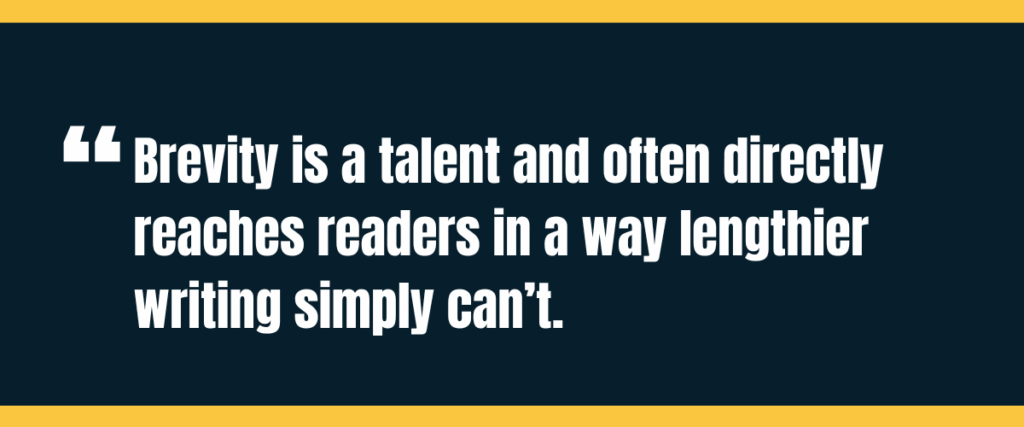
Brevity is a talent and often directly reaches readers in a way lengthier writing simply can’t.
What are good story openers?
Good story openers are ones that grab the reader by the throat and clearly communicate the tone of the story. Early in my writing career, I didn’t yet grasp this idea.
As a result, I didn’t spend enough time on my hook and simply started writing. I learned the hard way the importance of distilling my novel into a single sentence through many, many rewrites of drafts where I had written around the central theme.
Read any of the titles I mentioned above to get you started on great story openers. If you’re open to reading the classics, try Jane Austen’s Pride and Prejudice.
What every first book needs…you to write it!
Now that you have a grasp on what every first book needs, it’s time to get to work. Use our free resource below to get started writing your book!

Book Outline Generator
Choose your Fiction or Nonfiction book type below to get your free chapter by chapter outline!
Book Outline Generator
Enter your details below and get your pre-formatted outline in your inbox and start writing today!
CONGRATULATIONS
Thanks for submitting! Check your email for your book outline template.
In the meantime, check out our Book Outline Challenge.