












Want to self-publish a book of your own but don’t know how? You’re not alone, and you’re in the right place. Self-publishing has taken over the internet in the last few years. Anyone who wants to be anyone has thought about doing it. But which self-publishing platforms that have risen in recent years are worth it?
I’ve watched plenty of people start their self-publishing process so excited to get their book written, only to lose that excitement when they’re hit with a flood of choices and feeling stuck because they don’t know which one is right for them. I don’t want that to be you!
At Self-Publishing School, we’ve helped over 8,000 authors navigate the publishing process, from blank page to bestseller. So we’d like to think we know a thing or two about the best self-publishing platforms in our space.
I’ll walk you through the most popular self-publishing platforms right now, ordered by popularity and reach, and break down the pros, cons, pricing, and best use cases for each one so you can make an informed decision and get your book into the hands of readers.
Self-publishing platforms and their pros and cons
Types of publishing platforms
Before we get into the bulk of what’s what, let’s first go over the types of self-publishing platforms out there.
You might not need certain ones. So don’t waste your time!
These platforms fall into categories like direct retailers, aggregators, print-on-demand services, and full-service publishing providers.
- Direct Retailers: they allow you to publish directly to their specific storefronts, often offering better royalty rates and more control.
- Aggregators: distribute your book to multiple retailers and libraries through one dashboard, saving time and expanding reach.
- Print-on-Demand: these focus on printing and distributing physical books only when orders come in, reducing overhead costs.
- Full-Service Publishing Providers: they offer professional-level services such as editing, design, and marketing—ideal for authors seeking a polished final product without managing every step themselves.
Some publishing platforms are all of these in one. Some only handle pieces of the publishing process.
Understanding these categories will help you choose the right mix of platforms based on your publishing goals, budget, and goals as an author.
Self-Publishing Platforms to Choose From
Choosing the right one from this group of self-publishing platforms can make a huge difference in your journey as an author. Research these, and really think about what you want from publishing a book.
Amazon Kindle Direct Publishing (KDP)
Platform Type: Direct-to-retailer
Main Focus: Ebooks and print-on-demand paperbacks
Amazon KDP remains the most dominant self-publishing platform, thanks to its massive global reach and user-friendly interface. It allows authors to publish both ebooks and paperbacks directly to Amazon’s marketplace. Obviously, you’ve probably heard a bunch about how to self-publish on Amazon.
But it’s not necessarily right for everyone!
Pros:
- Free to publish
- High royalties (70% for ebooks priced between $2.99 and $9.99)
- Access to Kindle Unlimited and promotional tools through KDP Select
- Print-on-demand paperbacks (no work on your end!)
Cons:
- Exclusivity requirement for KDP Select (for ebooks)
- Limited distribution outside Amazon
- Some authors find Amazon’s policies restrictive
Best for: Authors seeking maximum exposure and sales through Amazon’s vast customer base. But specifically authors who have a highly searchable topic (nonfiction) or those who can write fiction to market to gain visibility.
The truth is that your results on Amazon will vary widely.
Going in alone, without much knowledge, on a book you slapped together with a DIY cover? It’s not recommended. We’ve been in this industry for a decade and our attention to detail when it comes to cover and marketing are one of the reasons why our authors’ books sell.
Some authors can make nothing after years and years. Others make well more than a comfortable living, like this example below who made over $500,000 (total) on Amazon since 2022.
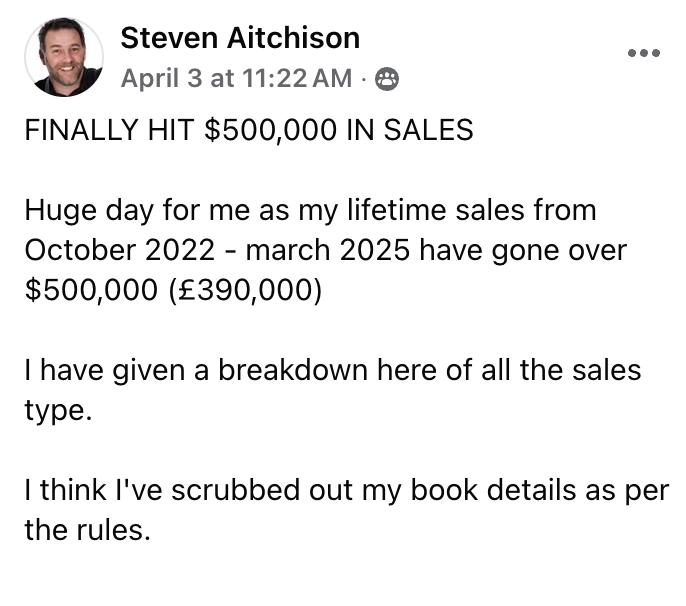
How much money you make on Amazon is still likely to be higher than many other self-publishing platforms.
IngramSpark
Platform Type: Distributor
Main Focus: High-quality print books and ebooks with global reach
IngramSpark offers a robust distribution network, making books available to bookstores, libraries, and major online retailers. It’s known for high-quality print options and global reach. Notably, just because you go through IngramSpark doesn’t guarantee you’ll be in every book store.
Pros:
- Wide distribution beyond Amazon (Barnes & Noble, indie bookstores, libraries, etc.)
- High-quality print options
- Supports both ebooks and print books
Cons:
- Setup fees ($49 for print and ebook combo, though sometimes waived via promo codes)
- Lower royalties compared to KDP
- Complex interface for beginners
Best for: Authors aiming for bookstore and library placement with professional-grade print books.
While getting in bookstores is often a big draw of IngramSpark, it’s not the biggest selling leverage. That said, if you want to use this self-publishing platform, here’s how it works to get additional retailers for your books.
This happens primarily through its connection to Ingram Book Company, one of the largest book distributors in the world.
- Distribution via Ingram’s network: When you publish with IngramSpark, your book is automatically made available in the Ingram catalog. Retailers, libraries, and bookstores regularly order from this catalog because they already trust and work with Ingram for their inventory.
- Availability to retailers: Your book can be ordered by major online retailers like Amazon, Barnes & Noble, Bookshop.org, and independent bookstores. It appears in their systems just like traditionally published books.
- Wholesale terms and returns: IngramSpark allows you to set wholesale discounts (e.g., 40–55%) and returnability. Bookstores are more likely to stock your book if:
- It’s discounted at the standard wholesale rate.
- It’s returnable, which lowers their risk.
Draft2Digital (D2D)
Platform Type: Aggregator
Main Focus: Ebook distribution across multiple platforms
Draft2Digital is an aggregator that simplifies the publishing process for indie authors, distributing ebooks to multiple self-publishing platforms like Apple Books, Barnes & Noble, and Kobo. They also distribute to Apple Books, Kobo, Barnes & Noble, Tolino, Bibliotheca, and more.
Plus, it offers automated back matter tools and sales tracking dashboard, which can ultimately help you sell more books. But keep in mind that many self-publishing platforms offer this.
Pros:
- Wide reach through multiple retailers
- User-friendly interface
- Automated formatting tools
- Universal book links for easy sharing
Cons:
- No print options (though integration with print services is available)
- Takes a small percentage of royalties
Best for: Authors seeking broad ebook distribution without managing multiple retailer accounts.
They do, however, take a cut of your royalties. It’s small in comparison to many at 10%. However, when it comes to deductions from other retailers and printing, 10% can be a lot.

Apple Books
Platform Type: Direct-to-retailer
Main Focus: Ebooks tailored to iOS/macOS devices
Apple’s direct publishing platform caters to iOS readers around the world, offering high-quality ebook formatting tailored to Apple devices. It used to be iBooks, if you remember that. And it does require an Apple ID and Mac-only software (iTunes Connect + Pages or third-party aggregator) to set up, which some people obviously aren’t here for.
It’s like only Apple users can get your book then.
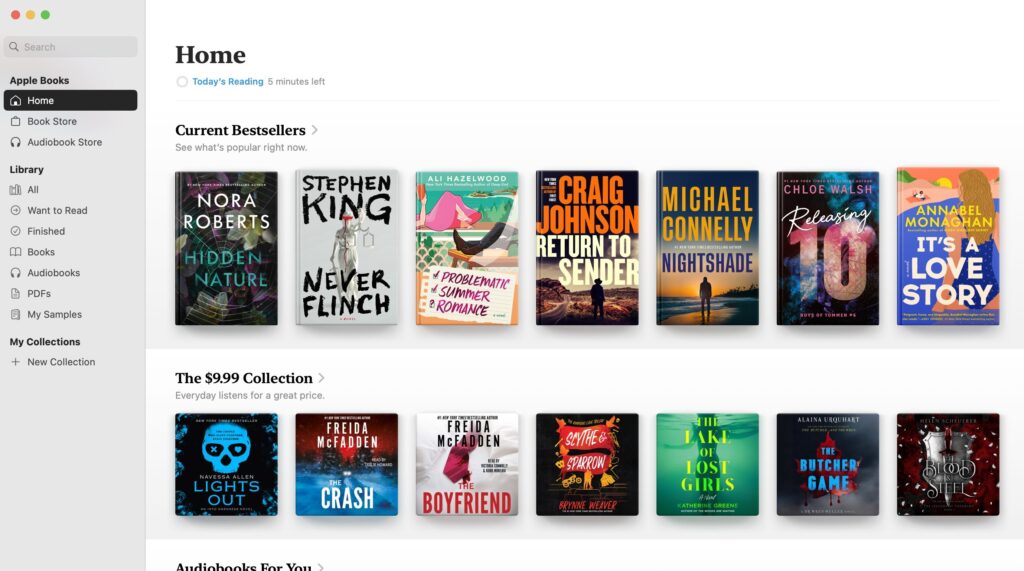
But to make up for it, it does offer up to 70% royalties on all price points, no delivery fees. And because they’re on Apple, they’re often highlighted on Apple devices with some extra visual polish.
User feedback is a bit mixed. Some love the seamless display and integration on Apple devices. Others just hate that it requires a mac and has limited promotion tools compared to other self-publishing platforms like Amazon.
You have to admit, though, the books do look attractive:
Pros:
- High-quality formatting for Apple devices
- Competitive royalty rates
- Access to Apple’s strong user base
Cons:
- Limited to Apple ecosystem
- Requires a Mac to publish directly
Best for: Tech-savvy authors or those with a strong fanbase among Apple users.
Kobo Writing Life
Platform Type: Direct-to-retailer
Main Focus: International ebook sales
Kobo reaches readers in over 190 countries, making it a strong choice for international ebook distribution and a solid choice among the self-publishing platforms. So if you really want to reach a wide audience, give Kobo consideration. it’s a most dominant ebook player in Canada, Europe, and parts of Asia, specifically.
Offers promotional opportunities via Kobo’s curated deals. Plus, they support multiple languages and regional pricing. So if you do have audiences in various languages and get your books translated, it’s a solid option.
Pros:
- Generous royalty rates of up to 70%
- Detailed sales tracking and reporting tools
- Extensive global reach
Cons:
- Smaller market share compared to Amazon
- Less promotional support
Best for: Authors keen on reaching international audiences, especially in Canada and Europe.
Barnes & Noble Press
Platform Type: Direct-to-retailer
Main Focus: Ebooks and print-on-demand for B&N’s website and Nook
Barnes & Noble Press (previously Nook) allows authors to publish ebooks and print books directly to the Barnes & Noble online store. They offer both print and ebook publishing with no upfront fees and a 70% royalty rate on ebooks above $0.99. For print books, the royalties depend on format and price.
But just because you go through Barnes & Noble doesn’t mean you get into the stores, as it may seem. In-store placement possible for top-performing titles, but rare. It depends on if they find it worth their while.
Pros:
- Free to upload
- 70% royalties on ebooks priced above $0.99
- No exclusivity required
Cons:
- Limited to Barnes & Noble’s customer base
- Less intuitive interface compared to other platforms
Best for: Authors targeting the U.S. market, particularly Barnes & Noble customers.
Here’s what some authors have to say about B&N Press:
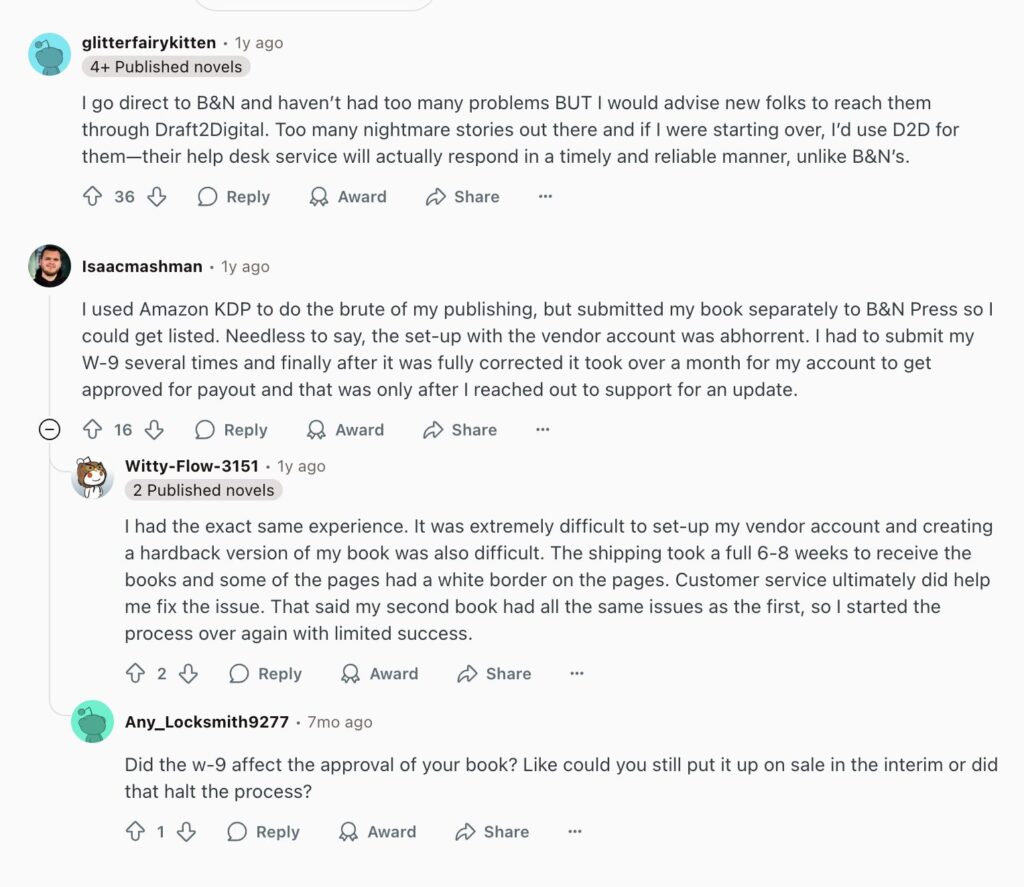
Obviously, this is just a few folks on the internet, but you can view more of the feedback here.
Lulu
Platform Type: Direct-to-customer and distribution network
Main Focus: Customizable print books and some ebook support
Lulu is a unique one among the self-publishing platforms. It’s known for its print-on-demand services, offering a wide range of customization options for both print and ebooks. But it’s not just novels or longer works of writing. Lulu has capabilities for specialty formatting, like spiral binding, hardcover with dust jacket, and more. So if you want to run a special edition of your book, Lulu is a great option in addition to other retailers like Amazon.
Because they distribute via Amazon, Ingram, Barnes & Noble, and Lulu’s own store. Plus, they offer bulk printing options and calendar/photo book templates, which broaden the options for authors of certain genres.
Even in its cover image on the website, they promote printing things like calendars and journals, not just fiction or nonfiction books.

Pros:
- Customizable print formats, including hardcover and spiral-bound
- No upfront costs
- Global distribution to online retailers
Cons:
- Limited retail reach compared to IngramSpark
- Complex formatting can be challenging for new users
Best for: Authors seeking unique print options and customization with their self-publishing platforms.
BookBaby
Platform Type: Full-service publishing platform
Main Focus: Professional-grade publishing services
BookBaby offers a comprehensive suite of services, including editing, cover design, and marketing, focusing on quality and professional standards. As far as self-publishing platforms go, this one is known pretty well.
Pros:
- High royalties (up to 85% for ebooks)
- Professional editing and design services
- Global ebook distribution
Cons:
- Higher upfront costs for services
- Potential bottlenecks due to outsourcing projects
Best for: Authors willing to invest in professional services for a polished final product.
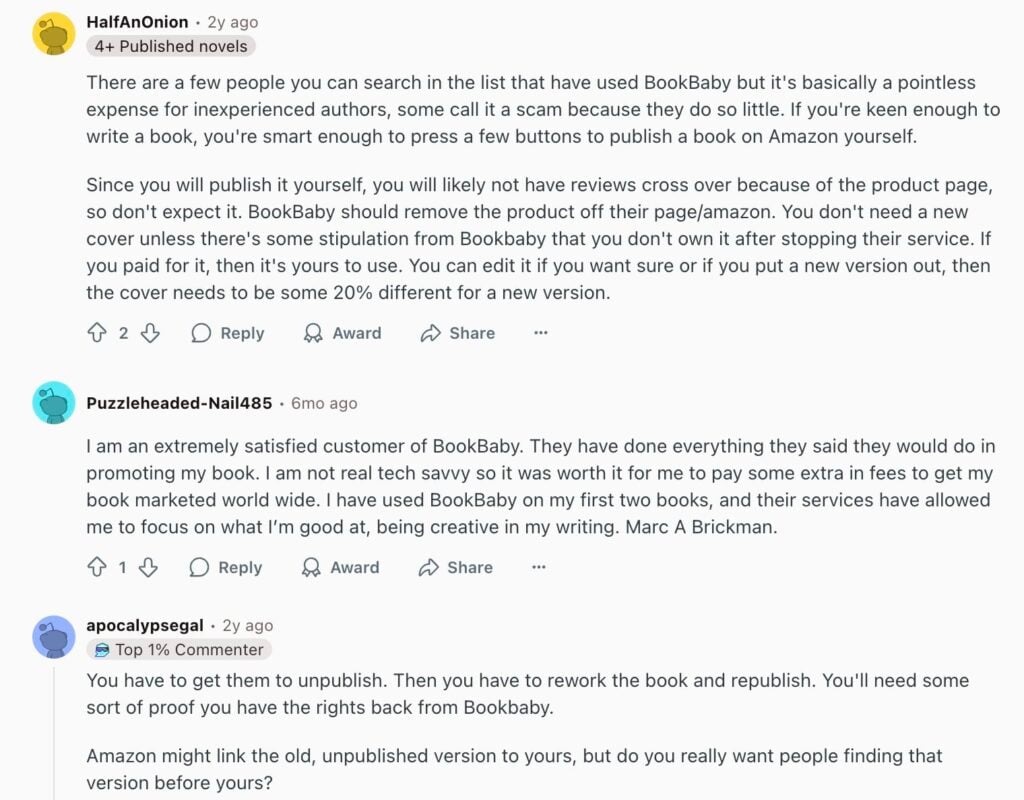
In general, people who have gone with BookBaby praise the professional polish and support, but often criticize the high upfront costs and occasional delays when using design or editing services.
Here are a few things people have to say about using BookBaby among the other self-publishing platforms:
Blurb
Platform Type: Direct-to-customer and distributor
Main Focus: Photo books, art books, and print-focused projects
Blurb is known for its high-quality printing, making it a favorite among photographers and visual artists. It’s another that’s great for specialty books, featuring things like integrating with Adobe InDesign, Lightroom, and its own BookWright software. This visual piece makes it stand apart as far as self-publishing platforms goes. It’s more about visuals.
This makes it ideal for coffee table books, portfolios, and photography-heavy content. So if you’re writing a nature book and have the photography to back it up, Blurb might be your platform of choice. Take a look at its featured options here:
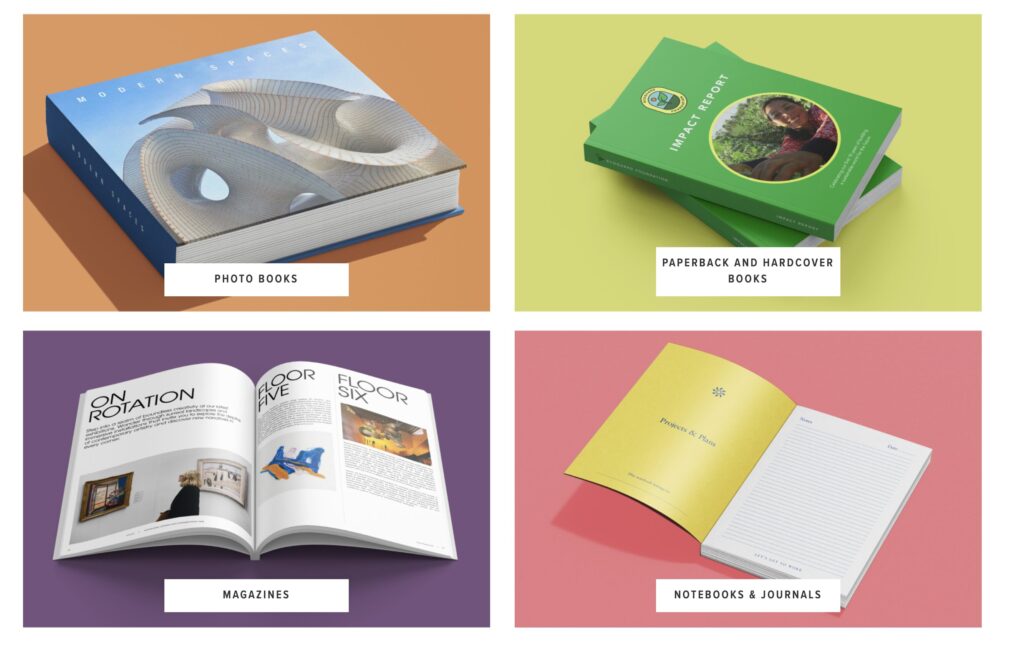
Plus, it has distribution via Amazon, Ingram, and Blurb’s own store.
Pros:
- Range of print options, from trade books to professional photo books
- User-friendly design software (BookWright)
- Distribution options include Amazon, Ingram, and Blurb’s own bookstore
Cons:
- Less suited for traditional text-heavy books
- Limited marketing and promotional tools
Best for: Authors creating visually rich content, such as photo books or art portfolios.
PublishDrive
Platform Type: Aggregator
Main Focus: Ebook distribution with tech-forward tools
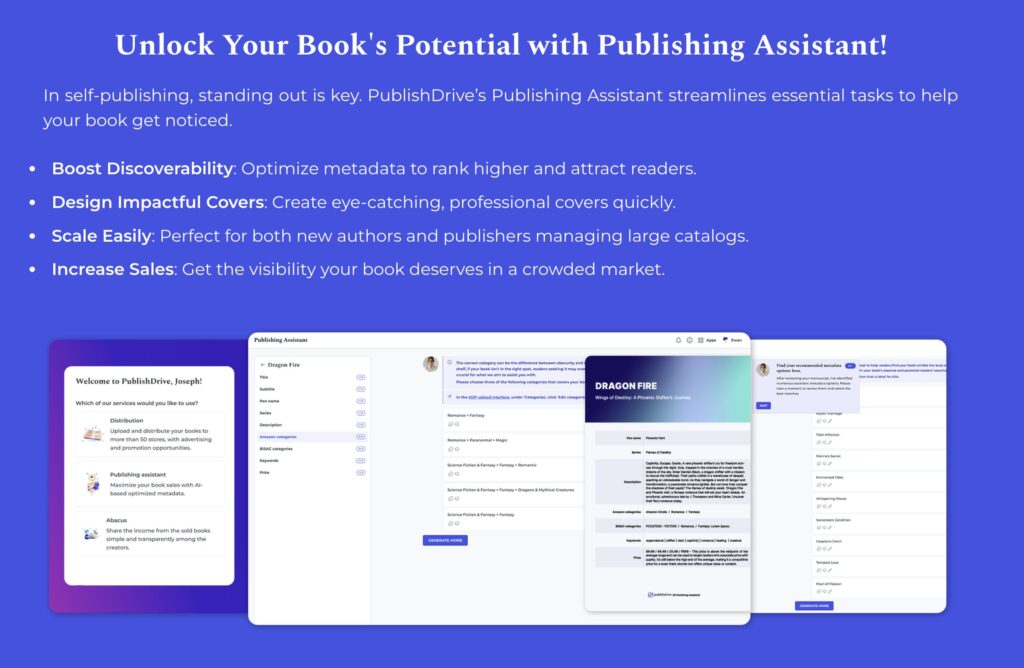
PublishDrive enables wide ebook distribution across 400+ digital stores, including niche markets, and offers AI-driven marketing features. Obviously, this is one of the platforms embracing AI, but for its marketing potential instead of writing. Which is a great thing, because there are enough AI companies pushing writing, and our feelings on that are…well.
It promotes this as your “Publishing Assistant”.
Pros:
- Extensive distribution network
- AI-driven marketing tools
- Subscription-based pricing for frequent publishers
Cons:
- Monthly subscription fees
- May be complex for beginners
Best for: High-output authors or those seeking niche platforms.
Choosing the right option among the many legitimate self-publishing platforms depends on your specific goals, budget, and the type of book you’re publishing. Whether you’re aiming for maximum reach, professional services, or unique print options, there’s a platform tailored to your needs.
At Self-Publishing School, we’ve guided over 8,000 authors through the self-publishing journey. If you’re ready to take the next step and want expert guidance instead of rolling the dice, we’re here to help.
Ready to self-publish your book? Schedule your free consultation now and join the thousands of authors we’ve helped achieve publishing success.