


















When I started writing fiction, I struggled to give my characters depth and to place them within the vivid world I could see in my mind. I didn’t have the language or experience to develop the character layers I could feel because I was still learning the craft. It was frustrating when my characters fell flat. I wanted them to sing.
My writing aha moment came when I picked up The Emotion Thesaurus by Angela Ackerman and Becca Puglisi, followed by their other thesauruses, The Rural Setting Thesaurus and The Urban Setting Thesaurus, all part of their Writers Helping Writers series.
The feelings and emotions that I didn’t have the words for were packed into these author-friendly reference books. They prompted me to explore the depths of my characters with abandon, while giving me a soft, structured place for my thoughts to land. Woo! Hoo!
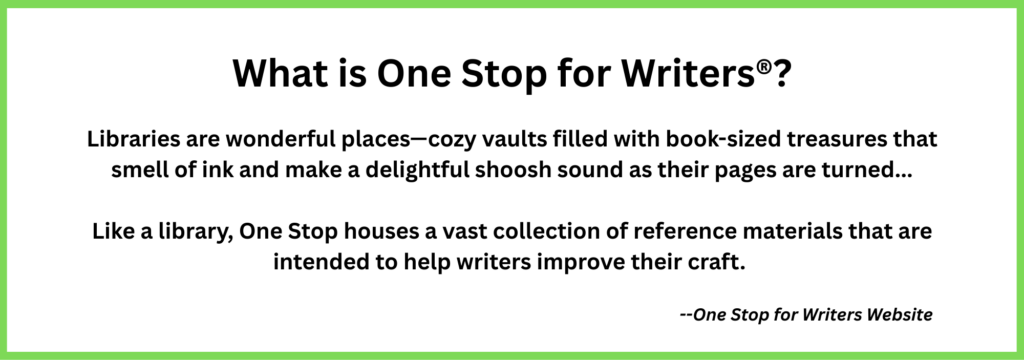
Ackerman and Puglisi have co-authored 11 bestselling titles to help writers write better fiction. When they launched One Stop For Writers, they took all of their successful books and merged them into a user-friendly platform along with other useful resources, where authors could develop their characters and stories in one place with direct access to story-building tools.
Below, I’ll share some more of my thoughts about the platform. As you can guess, this review is going to lean heavily on the positive side, but I’ll make sure it’s a grounded review you can trust.
If you are an aspiring author, a seasoned one, or just curious about One Stop For Writers, keep reading to learn more.
Below you’ll find information on:
Book Outline Generator
Choose your Fiction or Nonfiction book type below to get your free chapter by chapter outline!
Book Outline Generator
Enter your details below and get your pre-formatted outline in your inbox and start writing today!
CONGRATULATIONS
Thanks for submitting! Check your email for your book outline template.
In the meantime, check out our Book Outline Challenge.
The website
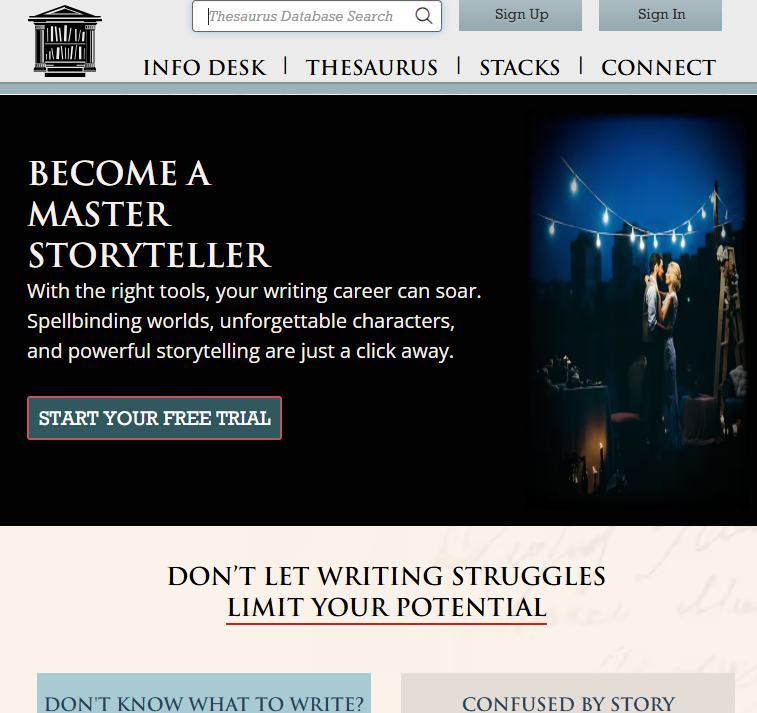
The main features and tools of the website include the Thesaurus Collection, Character Builder, Story maps, Scene Maps and Timelines, Worldbuilding Surveys, Idea Generator, Templates and Worksheets, and Tutorials.
Thesaurus collection
- Contains 23 thesauruses, including tropes, relationships, positive and negative traits, emotions, and more. Although there are MANY valuable tools on the website, the thesaurus resource alone is worth the price of the subscription. As I mentioned in the introduction, writer’s block is real, and when you are a new fiction writer, finding the best descriptions doesn’t always flow as easily as you’d like. The thesauruses provide a nice springboard for brainstorming ideas and developing characters.
- Help with “show, don’t tell” descriptions. “Show, don’t tell” is a common phrase that refers to providing descriptions of what a character is doing rather than a step-by-step narration of their actions. The first pulls the reader into the story, and the latter keeps them at a distance and can come across as stale and unnecessary. Readers are smart and appreciate the opportunity to use their imaginations.
- A cost savings from buying each individual book. I purchased a few of the thesaurus eBooks before One Stop for Writers launched. It’s nice to have them as a reference, but you can really save money by accessing the full collection on the website.
Character builder
- Drawing from the site’s thesaurus collection, this tool helps generate ideas to “build deeply layered characters in a fraction of the time.”Building layered characters takes time. Having a character builder makes character development easier, so you can write more efficiently and not get stuck in the weeds of character building.
- Profiles can be exported to third-party software. Being able to print the profiles or export them to whichever writing software you use is a useful feature.
- Explores backstory, personality, behavior, and other features to enhance a character’s profile.
Story maps
- Provides an interactive template for Michael Hauge’s 6-State Plot Structure. There are several story structures to choose from, but in my experience, they all basically lead to the same outcome. Having Hauge’s structure as a guide makes mapping out your story smoother.
- Uses the film A Few Good Men as a mapped example. Whether you’ve watched the popular film, A Few Good Men, or not, having it as an example is a great way to fully understand how story maps work.
- Allows for the development of outer and internal story (character arcs) events. Inner and outer story development is critical to a story’s 360-degree experience.
Scene maps and timelines
If you’ve written a story before, then you know that there’s more to developing a great story than the overarching plot that takes place from the beginning, middle, and end. The best stories take the reader on a journey at the scene level. With the scene maps and timelines, you get:
- Formal Scene Maps. A detailed scene map that allows you to plot character development through a series of questions.
- Informal Scene Maps. A “do-it-yourself” scene builder where you can pick how you want to build the scene by selecting what to include and what to leave off.
- Timelines. An interactive drag ‘n’ drop timeline builder.
Worldbuilding surveys
Doing worldbuilding well takes time. The One Stop for Writers survey gives you the tools to build an authentic, living, breathing world that jumps off the page without starting from scratch.
- Develop your story’s world
- Use real or imagined details
- Offer a variety of surveys from solar systems and planets to cities, villages, and more
Idea generator
- Customized ideas to fit your story
- Easily bookmark ideas for use later
Templates, worksheets, and tutorials
- Build relatable characters
- Create settings that jump off the page and engage readers
- Create informative graphics to help you develop your story
Pricing
Two-Week Trial: Free. The 14-day trial gives you access to its description database, idea generator, character, worldbuilding, and structure tools.
Month-to-month: $11.00. Full access to the entire collection of tools and resources, including the StoryTeller’s Roadmap.
6-Month: $60. Full access plus a 10% savings off the month-to-month price.
12-month: $105. Full access plus a 21% savings off the month-to-month price
Pros and cons
Pros
- Author-friendly educational content from best-selling authors
- Unique thesaurus database
- Character and scene development tools
- Tutorials and tip sheets for self-guided learning
Cons
- It may take first-time users some time to get acclimated to the site’s setup.
- Plotting tools may feel limited for complex stories
- Plotters may find the site more useful than pantsers.
Alternatives
While I found the site to be a useful resource for my writing needs and believe that it provides value for authors of all skill levels, it may not be the best choice for everyone. Here are a few comparable options to consider:
- Dabble (dabblewriter.com) offers built-in plot grids and story notes. Drag and drop options for scenes allow you to reorder narrative beats to adjust your story’s flow. Dabble also offers daily word count targets to accelerate your progress.
- The Novel Factory (novel-software.com) provides a planning roadmap for novel writing that includes a character builder and research repository.
- Fictionary (fictionary.co) offers story structure software as well as free classes, workshops, and courses, along with editorial services.
- Story Planner (storyplanner.com) helps writers plan their novel, screenplay, or short story using fillable templates. beat sheets and story cards.
- Plottr (plottr.com) is a writing productivity platform that offers prebuilt templates for different story structures, a visual timeline for characters, settings, and plot points. It also integrates with third-party platforms like Word, Scrivener, and Google Docs.
- Campfire is also a one-stop shop that provides story planner software for genre fiction, including a character creator, image map maker, and world-building tools. There’s also genre-specific software like fantasy and sci-fi writing software.
- World Anvil (worldanvil.com) is a deep worldbuilding platform. You’ll find libraries dedicated to geographies, species, and culture development. It includes an interactive map and timeline widgets. Collaboration options are available.
Is One Stop For Writers for you?
There are many online resources for writers, not to mention a ton of books. It can be a challenge to sift through all of the noise. If you are looking for quality tools and an easy-to-use platform in one place, One Stop For Writers is a great place to start.
Although plotters will likely gain the most from the plotting tools and story maps, pantsers (like me) will find a treasure trove of resources for developing layered characters and deep dives into the various aspects of creating a memorable story.
It’s easy to see in this One Stop For Writers review that I recommend this resource. It’s one of my favorite go-to writer websites, one that I continue to recommend to authors regardless of the level of experience.
If you’re ready to take your writing skills to the next level without having to search across the universe for resources, give One Stop for Writers a try. With a two-week free trial and everything accessible online, you have a perfect opportunity to test the waters and see if it’s a good fit for you.

Book Outline Generator
Choose your Fiction or Nonfiction book type below to get your free chapter by chapter outline!
Book Outline Generator
Enter your details below and get your pre-formatted outline in your inbox and start writing today!
CONGRATULATIONS
Thanks for submitting! Check your email for your book outline template.
In the meantime, check out our Book Outline Challenge.