




















The publishing industry is always changing. If you need evidence of that, just look at the new adult book genre—which some argue isn’t a “real” genre at all.
The market will always meet the demand. Romantasy is another great example of what happens when readers make their preferences known.
But what does “new adult” even mean? How can an adult be new? The rules for this genre can be a little confusing, and not all authors are playing by them fairly. But I’m getting ahead of myself.
Here’s what we’ll cover about new adult fiction:


Book Outline Generator
Choose your Fiction or Nonfiction book type below to get your free chapter by chapter outline!
Book Outline Generator
Enter your details below and get your pre-formatted outline in your inbox and start writing today!
CONGRATULATIONS
Thanks for submitting! Check your email for your book outline template.
In the meantime, check out our Book Outline Challenge.
What is new adult fiction?
New Adult (NA) fiction is a category of literature that bridges the gap between Young Adult (YA) fiction and Adult fiction. Often focusing on characters aged 18–25, this genre delves into the challenges and milestones of early adulthood, like leaving home, starting college, navigating first serious relationships, or entering the workforce.
The tone and themes are more mature than YA, often addressing complex, raw, and emotional experiences, and notably often has more explicit content. If new adult fiction was a TV rating, it would get a M or R where young adult is a PG-13.
NA books are also known for their focus on self-discovery, personal growth, and the exhilarating but uncertain transition into independence. They often feature content a YA audience isn’t quite ready for, including mature themes like mental health struggles, sexual relationships, and moral dilemmas.
However, what’s important to remember is that even on Amazon, you’ll find young adult listed in “Literature and Fiction” category when searching for books, but not new adult. Conversely, you can find a “New Adult & College” subgenre within the “Romance” parent genre on Amazon:

Because Amazon is so good at catering its filtration to what’s selling most, we can infer that readers who want new adult books are reading more romance than other book genres.
New adult tends to serve an audience who loves the structure and flow of young adult stories, but want the characters and content to relate to them more, particularly in the romance genre.
Difference between young adult and new adult
While both genres appeal to readers seeking stories about self-discovery and growth, their key distinctions lie in their audience, tone, and themes, as well as an audience age that can relate to them more.
It’s worth nothing, however, that adult can read young adult stories and still relate to the less mature content simply because they’ve been there before. They’re more nostalgic, in a way, than they are discovery the way NA is.
Here are the primary differences between young and new adult fiction:
- Young Adult Fiction:
- Target Audience: Readers aged 12–18.
- Main Characters: Usually aged 15–18.
- Themes: Coming-of-age, first loves, identity formation, peer pressure, high school experiences.
- Examples:
- The Hunger Games by Suzanne Collins
- To All the Boys I’ve Loved Before by Jenny Han
- Divergent by Veronica Roth
- New Adult Fiction:
- Target Audience: Readers aged 18–30.
- Main Characters: Usually aged 18–25.
- Themes: Starting college, living independently, exploring sexuality, career struggles, building meaningful relationships, finding direction in life, determining values and morals.
- Examples:
- Beautiful Disaster by Jamie McGuire
- A Court of Thorns and Roses by Sarah J. Maas
- Red Queen by Victoria Aveyard
| Aspect | Young Adult | New Adult |
| Age Range | 12-18 (15-17 is most common) | 18-25 |
| Settings | High school, family homes | College, workplaces, cities |
| Themes | Self-discovery, first love, identity | Independence, first careers, life direction |
| Tone | Hopeful, emotional, uplifting | Introspective, nuanced |
| Mature Content | Limited | Explicit, darker |
While distinctly different, there are authors (and publishers) who will take a young adult themed book and simply age the characters up in order to cater to the new adult audience either on purpose or unintentionally. They call the book new adult due to age only, but that’s not correct, and readers are often left upset because the book doesn’t fulfill genre expectations.
Why did the new adult genre get created?
The rise of the new adult genre can be traced back to the early 2010s, when authors, publishers, and readers noticed a gap in the market. Many young adults in their late teens and twenties wanted stories that reflected their experiences.
It’s clear there’s been a desire for something that stretches beyond YA, as many readers were getting bored or burned out on that genre.
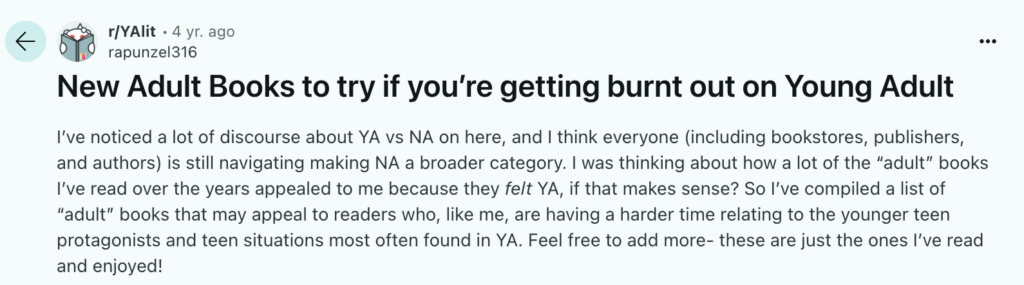
Initially, NA was a hard sell to traditional publishers who struggled with marketing the genre, but the boom in self-publishing allowed writers to directly reach an audience that craved these stories. NA has since grown in popularity, especially through platforms like Wattpad and Goodreads.
There’s also a healthy portion of the NA audience who still love young adult books, but are actually embarrassed to say they’re reading something meant for teenagers. This is where it’s believed a lot of NA books maintain the same themes as YA but with the characters aged up, contributing to the confusion and inconsistency in the NA genre as a whole.
Is your book new adult or should it be young adult?
If you’re writing a novel right now and aren’t sure where to place your book in the market, we can help.
Ultimately, this depends on several factors of the story, your goals, the target audience, and more.
Ask yourself:
- How old are the protagonists?
- YA characters: 15–18 years old.
- NA characters: 18–25 years old.
- What challenges are the characters facing?
- YA: High school drama, friendship struggles, first relationships.
- NA: Independence, deeper romantic relationships, career dilemmas.
- What is the tone and level of maturity?
- YA: Optimistic, accessible to teens, appropriate for readers as young as 13.
- NA: More nuanced, with darker or more mature undertones, contains explicit content that might be too much for readers as young as 13.
For example, a story about a college freshman balancing her first job and a tumultuous relationship is likely New Adult. On the other hand, a story about a high school senior prepping for prom and applying to colleges is more YA.
One story in particular that I personally struggled with calling YA (believing it has much more new adult themes and content) is Six of Crows by Leigh Bardugo. And I’m not the only one:
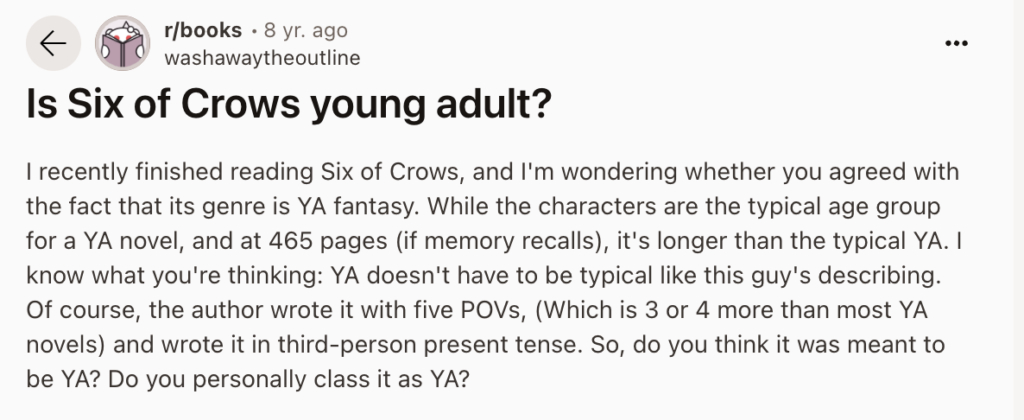
The characters in this story are younger in age (between 17-18 for the main characters) yet the book’s themes delve into independence, developing morals and values, separating from that which they’ve always known. The setting doesn’t have the opportunity for college or career, but in a way, the story does go in the direction of livelihood and finding your “tribe”.
The tricky part about finding the right genre for your story is that there are some YA books about children saving the world, facing death, and even killing other people. Books like Hunger Games, for example, has some adult themes while still being marketed as a young adult novel. A book like this, specifically, has a certain crossover appeal in which the characters are young by circumstance (those who enter the games can be any age, it just so happens these ones were teenagers), which makes it more acceptable as they also explore YA themes while inside of a story that has more mature connotations.
How to write new adult books that actually fit the genre
It’s not enough to just age up your characters and call it new adult, the same way you can’t start with an adult concept and make the main characters teenagers and expect it to be a young adult book.
If you want to do the genre justice and keep readers happy, here’s how to write new adult books.
Authentic character development
NA protagonists are figuring out who they are as individuals. They’re independent yet vulnerable, often making mistakes as they learn to balance freedom with responsibility. It’s likely that they’re on their own for the first time and navigating challenges that go with that.
Here’s how you can focus on character development for new adult books:
- Internal conflicts: Focus on inner struggles, such as the fear of failure, imposter syndrome, or the pressure to conform to societal expectations.
- Growth arcs: Show realistic character evolution, with growth that feels earned rather than convenient. For example, a college student might start the story indecisive about their future and gradually gain clarity through personal challenges. The character arc itself is a cornerstone of new adult, so do it justice.
- Flawed yet relatable protagonists: Readers connect with characters who make mistakes. Whether it’s a bad breakup, overspending their rent money, or struggling to balance work and life, let your characters stumble as they learn.
Relatable life challenges
Explore themes like student loans, internships, balancing friendships with adult obligations, or choosing between passion and practicality. All of these themes can be matched in other-world settings if you’re writing fantasy.
No matter what type of story you choose, here are a few themes to tackle:
- Financial independence, like budgeting or dealing with debt
- Living on their own for the first time (traveling far from home)
- Juggling work, school, and social lives
- Choosing between career ambitions and personal passions
- Navigating values and morals while maintaining integrity (or developing these in the first place)
Mature relationships
NA romances often involve deeper emotional connections, personal growth, and the occasional messy breakup. It’s more mature and nuanced than the “first love” trope you find in young adult novels. Plus, the relationships in new adult often expand beyond just that of a romantic partner.
You’ll find a lot more friendship and family themes in NA. This can include a lot of found family themes, as well as what it looks like to make friends and find people who share your values and morals, which is different from many young adult novels where the main character maintains a best friend from before the story started.
Realistic dialogue
When writing dialogue, your characters should reflect their stage of life through authentic, age-appropriate language and interactions. This doesn’t mean new adult characters swear all the time, just because they’re older.
Think more about these:
- Natural speech patterns: Characters in NA fiction often speak in a way that bridges youthful slang with a more mature vocabulary. For instance, a college student might still use informal language with friends but adopt professionalism in a workplace.
- Cultural relevance: Consider incorporating current trends or references to make your characters feel grounded in their time.
- Conflict in conversations: Use dialogue to explore tensions, such as a disagreement between roommates about rent or a difficult conversation with a parent about life choices.
Emotional honesty
NA stories thrive on vulnerability. Whether your protagonist is overcoming heartbreak or tackling career uncertainty, make their struggles raw and relatable, and don’t sound like the diary of a teenager.
This is an important distinction because the way a 16 year old thinks is very different from how a 23 year old thinks. Those internal monologues have to be realistic to the age, or you’ll risk writing a book that has characters the age of NA, but with a YA maturity feel.
Your book might be a genre that you didn’t consciously choose. You might have already written a book thinking it’s NA but now finding it might not be. Don’t just stick it in the new adult category because you want the book to be new adult despite the fact that the themes don’t fit. Making your characters 25 (or inversely, reducing their age to 16) is not the sole requirement of writing NA or YA.
New adult book recommendations
Reading is the best teacher. Study those who have already written new adult in order to understand the genre. Getting a feel for what this category is about often takes a few tries, so pick out multiple and get to reading!
Contemporary NA:
- The Deal by Elle Kennedy (sports romance and college drama)
- The Edge of Never by J.A. Redmerski (road trip self-discovery)
Fantasy NA:
- A Court of Thorns and Roses by Sarah J. Maas (romantic fantasy with complex characters)
- From Blood and Ash by Jennifer L. Armentrout (action-packed romantic fantasy)
LGBTQ+ NA:
- Him by Sarina Bowen and Elle Kennedy (sports romance)
- Aristotle and Dante Discover the Secrets of the Universe by Benjamin Alire Sáenz (coming-of-age exploration)
Dark NA:
- The Shadows Between Us by Tricia Levenseller (fantasy with morally grey characters)
Read a few of these and then read some young adult novels! Try to decipher the differences yourself. You might just find that some of the books you think are YA should actually be in a different category.
Not every categorization is correct. When it comes to new adult fiction, the themes override the age of the characters. That’s why you can have a book like Game of Thrones be labeled as “adult” even though there are children main characters.
Understanding the differences, though, is important if you plan to write in any of these genres.