



















If you want to write a gripping story, understanding internal vs external conflict is a must. New writers often struggle to incorporate conflict into their opening chapter.
Conflict drives plot structure and reveals the character of your protagonist, so it’s necessary to learn everything you can about this important concept! Let’s get straight into the details of why it matters, what it is, and how to use it.
Internal vs external conflict: what’s covered
- Why does conflict matter?
- What is internal vs external conflict?
- What is an example of an external and internal conflict?
- Internal vs external conflict in literature
- How to use conflict in your writing?


Book Outline Generator
Choose your Fiction or Nonfiction book type below to get your free chapter by chapter outline!
Book Outline Generator
Enter your details below and get your pre-formatted outline in your inbox and start writing today!
CONGRATULATIONS
Thanks for submitting! Check your email for your book outline template.
In the meantime, check out our Book Outline Challenge.
Why does conflict matter?
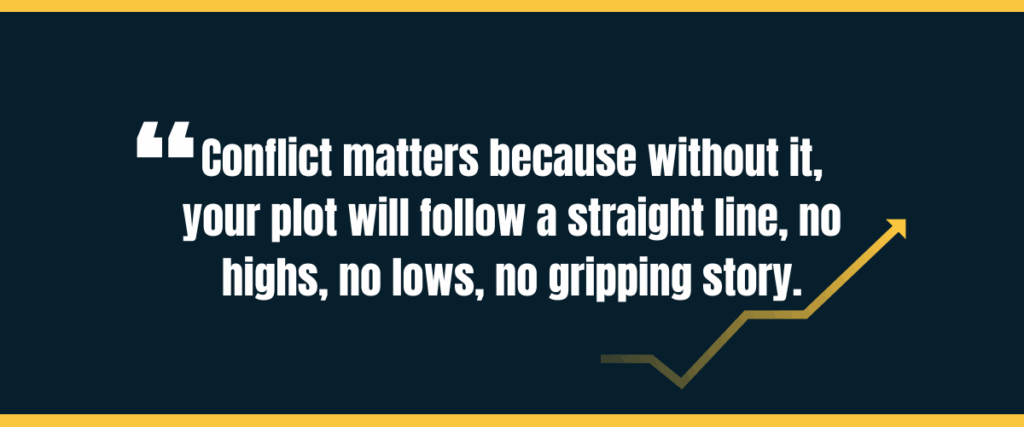
Conflict matters because without it, your plot will follow a straight line, no highs, no lows, no gripping story. You’ve likely come across the Three Act Story Structure at some point.
This structure focuses on the inciting incident (often conflict-induced), the rising action (more conflict), and falling action (the resolution of the conflict). As you can see, each step deals with conflict.
Internal vs external conflict is the key to great writing. It showcases the various character traits of your cast, heightens the importance of the themes in your storytelling, and even defines book genres.
If you’ve studied writing much, you know the dreaded cliché of starting a story with a jangling alarm, shower, breakfast, coffee, a commute to work, and then finally on the drive, something happens.
Stories without conflict are boring, lack the tension that keeps readers turning pages, and fall flat. This is where internal vs external conflict comes in. What exactly is it?
What is internal vs external conflict?
Internal conflict happens within, while external conflict happens outside of the character’s inner thoughts and is, in a word, external. However, there are types of internal vs external conflict just as there are different types of plots and ways to write dialogue.
While this list is not exhaustive, internal conflict could be any of the following conflicting desires. A characters wants to:
- Get healthy but also avoid the gym
- Find internal peace but feels nervous to leave their present circumstances
- Help their friend but also encourage their friend’s autonomy/independence
- Pursue their dream but also make financially sound choices
- Go out with friends but also stay in and catch up on chores
Some of the results of these choices may be external, but these are internal conflicts, taking place mentally within the character. Often, internal conflict comes in a pair: the character wants two opposing results.
External conflict could look like any of the following:
- Trying to get to work on time but stuck in traffic
- Eager to become a pro athlete but breaks a leg
- About to submit a final thesis when their computer crashes
- Enjoying a day hike until losing their way
External conflict often stems from a good desire with an obstacle. However, even villains can experience external conflict (often, this is what sparks their villain story). Consider He-Who-Must-Not-Be-Named being dependent in the early stories or Thanos needing all the gems to achieve full power.
What is an example of an external and internal conflict?
Ironically, internal vs external conflict can have the same end but how a character achieves that end determines the type of conflict.
Here is a quick example of interval vs external conflict:
- Smith walked through the farmer’s market and eyed the fresh pastries. Wanting to purchase one, he dug in his pocket for some cash. A twinge of hesitation filled his mind. I just started my new fitness journey, he thought. I really should hit the gym first.
- Smith walked through the farmer’s market and eyed the fresh pastries. Wanting to purchase one, he dug in his pocket for some cash, but his pockets were empty and he’d left his wallet in the car. I’ll get one later, he thought.
In the first example, Smith internally struggles with whether to purchase the pastry or not. In the second, he can’t purchase it because he doesn’t have the cash.
While the result is the same (he doesn’t obtain the pastry), his road to the result is different: one is internal (mental conflict) while one is external (he doesn’t have the cash).
With this in mind, let’s look at a few more examples of internal vs external conflict so you can write tension-filled books and become a self-publishing success story.
Internal vs external conflict in literature
There are copious examples of internal vs external conflict in literature, but let’s dive in with a classic from American literature—one many of us know and love.
Moby-Dick
Moby-Dick, otherwise known as The Whale, was published in 1851 by author Herman Melville. If you’ve seen the 2015 film, In the Heart of the Sea, featuring Chris Hemsworth, Cillian Murphy, and Tom Holland, you have a visual example of just how impactful external conflict can be.
Starring a giant white sperm whale as the villain, this plot centers around sailors fighting for their lives…in the heart of the sea.
While the sailors of course experience internal conflict (Will they survive? Will they have enough food? Will they see their families again?), the focal point of this epic novel is focused on external conflict: the conquest of the whale.
The Ballad of Songbirds and Snakes
Suzanne Collins’ enriching origin story to President Snow stands as a case study in internal conflict. While readers love hating him in The Hunger Games trilogy, reading the internal conflict that brought about his switch to villain instills an unsettling empathy for this iconic character.
We find Snow starving, struggling to maintain appearances, and eager to prove his worth so he can provide for his family. His inner monologue constantly running throughout the books centers around his desire to prove himself and succeed to provide for those he loves.
Of course, the external conflict he experiences pushes him internally. Slowly, he mentally convinces himself that it’s acceptable to make small concessions, until suddenly, he’s crossed the line from hero to villain, all while mentally convincing himself he’s in the right.
Snow started out with good goals: succeed and provide for his family. However, the means he takes to achieve them turn him from hero to villain. We see this all play out from his point of view as he struggles to excuse his own choices.
How to use conflict in your writing?
When layered into your plot and character arcs, internal vs external conflict can make your writing that much more gripping. No matter what book category your story belongs in, conflict is the engine that drives the plot. Here is a list of ways to use interval vs external conflict in your writing to stand out and connect with your readership.
Create conflict for your protagonist
No matter your genre, the stakes should always be high for your protagonist. If you write historical romance, consider the inner conflict of your protagonist falling for the “wrong” love interest, or not falling at all.
Perhaps she knows she should marry the rich gentleman, but she’s drawn to adventure and simply isn’t looking for marriage yet. She experiences inner conflict (wanting to follow her dreams) and external conflict (societal norms).
Build conflict for supporting characters
To continue with the above example, now let’s assume the rich gentleman truly loves her and longs to marry her. But, if he truly loves her, he knows he needs to let her go live the life she desires.
He experiences inner conflict as he struggles with his feelings, as well as external conflict as her parents encourage him to pursue her.
Layer conflict into your setting
Internal vs external conflict is not restricted to characters. You can use setting as an instigator for conflict as well. (Kristin Hannah’s, The Four Winds, does this exceptionally well.)
For example, let’s say the young woman mentioned above is eager to travel west to visit her aunt and uncle and get away from the pressures of home. However, winter comes early and she is snowed in.
On top of this, the roof on her father’s mercantile business collapses due to the heavy snow, and none other than the rich gentleman offers to help him rebuild. Due to external, nature-inspired circumstances, our adventurous female is now stuck with her father and would-be suitor for the remainder of winter.
Use societal norms to spark conflict
As if this weren’t enough, it’s the early 1800s and smallpox strikes the town. The local doctor has heard of a new form of medicine where infecting someone with a small dose of illness inoculates them to further danger.
When her mother falls ill, she encourages her to try this new medicine, but both her father (and his new friend, the rich gentleman), speak against the idea.
Using layers of internal vs external conflict in your story creates setups and payoffs, as well as subplots, that will keep your reader turning pages. There are many types of literary conflicts. Choose your starting point, then plunge in!
Internal vs external conflict: moving forward
Ready to take your next step? Use our resource below to get started outlining your story! Then you can layer in the various types of conflict that best fit your cast of characters and plot.
Tip: For an extra challenge, try incorporating internal vs external conflict into your nonfiction writing as well.
Book Outline Generator
Choose your Fiction or Nonfiction book type below to get your free chapter by chapter outline!
Book Outline Generator
Enter your details below and get your pre-formatted outline in your inbox and start writing today!
CONGRATULATIONS
Thanks for submitting! Check your email for your book outline template.
In the meantime, check out our Book Outline Challenge.