




















Now that we’ve entered spooky season, you’re likely wondering how to write a scary story. There are many elements to scary stories and angles you can take to best scare your audience. However, it’s important to look into the nuance behind how to write a scary story.
If you want some scary story ideas and guidance on perfecting this spooky-season genre, you’ve come to the right place. Scary stories are a special genre because they allow writers to delve into the reader’s inner fears, and even face them, all while staying between the safety of the pages.
How to write a scary story: what’s covered
- How do you start a scary story?
- What are the 10 steps in writing a scary story?
- What makes a creepy story?
- What is the formula for a horror story?


Book Outline Generator
Choose your Fiction or Nonfiction book type below to get your free chapter by chapter outline!
Book Outline Generator
Enter your details below and get your pre-formatted outline in your inbox and start writing today!
CONGRATULATIONS
Thanks for submitting! Check your email for your book outline template.
In the meantime, check out our Book Outline Challenge.

How do you start a scary story?
Learning how to write a scary story starts with identifying the specific fear you plan to target. Different scary stories tackle different fears. For example, in the new, film Beetlejuice Beetlejuice, Astrid accidentally opens the portal to the Afterlife. Imagine the chaos that breaks loose, and the fear this accident sparks.
You can learn how to write a scary story’s opening by reading the first pages of books in the genre. I still remember the visceral, page-turning commitment I had to reading one of Frank Peretti’s kid books as a child.
In his The Cooper Kids Adventure Series he sets up book four by showcasing the jumpy crew of a C-141 just before takeoff. Needless to say, Peretti plunges the reader into an ocean of trouble and I finished that book in record time.
The point is, no matter what audience you write for (kid or adult) how to write a scary story’s opening starts with layering in the appropriate fear for your target audience.
For Peretti’s kids series, opening a portal to the afterlife wouldn’t fit, but for a Tim Burton film, it’s perfect. For more on this, read our post on how to start a horror story.
What are the 10 steps in writing a scary story?
If how to begin a scary story starts with pinpointing the fear, the ten steps to writing the story tiptoe right behind. Let’s take a closer look at how to write a scary story.
1. Choose your protagonist
How to write a scary story that actually scares your readers largely depends on your main character. Imagine if the young crew of kids in It were trained assassins. The movie would still be scary, but much less so.
2. Choose your villain
While the fear factor does not necessarily have to be one and the same with your villain, it often is. However, you could use setting as a type of villain or fear factor as well.
Margaret Peterson Haddix’s novel, Running Out of Time (which is said to have inspired the film, The Village) uses time and place to instill fear, and incite shock, later on.
3. Settle on your tone
Learning how to write a scary story largely relies on tone as well as the obvious theme of fear. Do you want to write a scary comedy? A scary thriller? The words you choose when writing will create a mood for your readers to sit in.
4. Consider plotting
Many writers are pantsers—they learn how to write a scary story simply by sitting down and writing. However, to ensure every plot point ties together and you foreshadow in a way that creates truly scary scenes, consider at least loosely plotting out your story.
5. Steal from other genres
If you want to know how to write a scary story that brings your readers back for more, combine elements and plot structures of similar genres, such as thriller and suspense.
6. Master dialogue
When people are scared, they typically speak differently than when they are safe and comfortable. Learn how to write dialogue that reiterates your genre. For example, if one of Stephen King’s young characters saw the clown in It, imagine their response. First, they are young. Second, they are boys. Third, they are likely scared out of their minds.
Which line of dialogue better fits the story?
- “Hey, everyone, looks like there’s a clown over there. We should run!”
- “C-clown. Run!”
Read bestselling fiction in your genre to learn how to write a scary story with dialogue that matches the tone.
7. Never underestimate action
Suspense is often a slow drip of adrenaline. Horror infuses a build-up to a sudden shock. When learning how to write a scary story, play around with both. Readers want a healthy mix of tension and jump scares, so take your time. Don’t forget to layer in dialogue too (see above point)!
8. Use details to instill fear
Often, it’s the details of a scene that draw out that tingling sensation of fear. The show, don’t tell writing rule is crucial here. Consider Harry trying floo powder and his “diagonally” mispronunciation. He finds himself in a creepy alley. Go back and read this scene from The Chamber of Secrets for tips on how to use details to create an additional layer of fear.
9. Build up dissonance
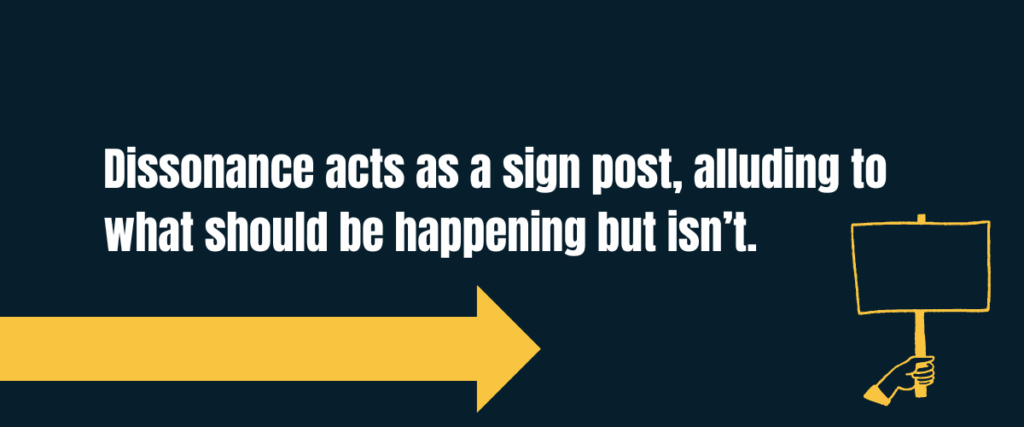
Dissonance acts as a sign post, alluding to what should be happening but isn’t. Writers often use dissonance to foreshadow a plot twist or hint at part of a character’s arc (such as a double-agent). When learning how to write a scary story, you can use dissonance to add a few extra scary feelings for your readers.
Consider these examples when deciding how to write a scary story:
- Showing up to a birthday party with no guest list.
- Joining friends on a spontaneous vacation…only to find there’s no return flight.
- Starting a new job…and all your new colleagues speak ill of your boss.
Imagine the dissonance a character would feel in these types of situations, then use these settings to inspire your own scenes.
10. Showcase scary aspects with daily life
To learn how to write a scary story that feels real, you must use details from daily life. If a reader does not feel personally connected to your story in some way, they won’t feel a part of the action. This is a recipe for disaster.
Effectively crafting a scary story means drawing your reader into the first scene and not letting them emerge until the last sentence. To do so, pull details they are likely to personally resonate with.
Amid your scary setting, characters, and plot points, add in familiar aspects such as:
- Heating up leftovers
- A difficult breakup
- A relatable fear
In the action/adventure series Divergent, the character of Four fears heights. While this does not directly relate to the plot, it does add humanity and relatable to the characters.
For a quick example, consider having your protagonist microwave leftovers, only to hear a beeping that’s not coming from the microwave. Heating up leftovers is grounding, relatable. Adding in the twist at the end makes the scary aspect that much more engaging.
What makes a creepy story?
The way you choose to use various themes in your storytelling can dramatically increase the scary level.
Similar to creating dissonance in your story, consider combining a specific theme with an unexpected (or less than ideal) partner:
- Coming of age during an apocalypse
- Example: The Quiet Place
- Discovering deception in those you thought were trustworthy
- Example: Get Out
- Experiencing a romantic relationship when the normal way of life dramatically shifts
- Example: Stranger Things
The above examples come from film and TV, allowing you to get a macro look at this type of pairing in a brief amount of time.
However, if you have a bit more time to study, delve into masters of writing scary stories. Stephen King, briefly mentioned before, is known as the king of horror. Despite his proclivity to write heart-stopping horror, you can strip down some of his tactics and apply it to scary stories that don’t cross into horror.
The Grace Year is a great example of how to combine an experience we all go through, coming of age, with the senses, to create a truly captivating scary story (don’t forget to watch out for character development in peripheral characters as well as the protagonist). Part of what makes this story so creepy is that it uses relatable themes as the foundation from which scariness grows.
What is the formula for a horror story?
If you search the above you will quickly find this formula: Underlying message + tragedy to show it + character’s perceptions + revulsion and dread = horror story. Apply this to writing your scary story by pulling back a bit on the horror and relegating it to just plain scary.
Answer the following to set you up for success in how to write a scary story:
- What message do I want to share?
- What loss does the character experience?
- What is their perception of their scary circumstance?
- What repulses them/do they want to get away from?
- How does this inspire them to action?
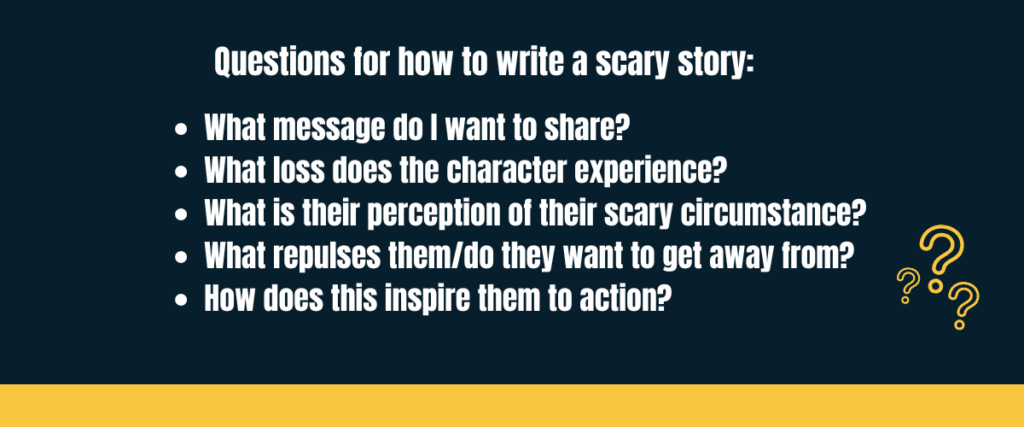
In the A Quiet Place series, a key message is the importance of family. The characters experience loss of connection as they must live in silence to survive. Despite difficult circumstances, they do their best to live normally.
However, the monsters are genuinely repulsive and they must get away from them. This inspires them to fight back and ultimately (spoilers!) discover the monsters’ weakness and how to overcome their scary environment.
How to write a scary story: take your next step
Ready to write a scary story your readers can relate to and also keeps them turning pages until the end? Use our free Book Outline Generator to get started!
Book Outline Generator
Choose your Fiction or Nonfiction book type below to get your free chapter by chapter outline!
Book Outline Generator
Enter your details below and get your pre-formatted outline in your inbox and start writing today!
CONGRATULATIONS
Thanks for submitting! Check your email for your book outline template.
In the meantime, check out our Book Outline Challenge.