



















Wondering how to find time to write a book with a full-time job that’s keeping you busy 40+ hours a week? We’re here to help. I wrote a full-length novel on deadline while attending my university nearly an hour from where I lived at the time and working on-site in a different city.
Somehow, I still hit my deadline, attended my classes, did my homework, and showed up for work, friends, and family. This is not to say I’m Wonder Woman (I’m not), but it is to say that with a proven path, you can find time to write a book with a full life as well.
In fact, over the last 10 years, we’ve taught over 8,000 authors how to write, publish, and market their books. And these students are not just sitting at home with nothing to do. They have full lives as well!
If you’re ready to learn how to write a novel or share your nonfiction, even with a full-time job, this is for you.
How to find time to write a book with a full-time job:
- How do you find time to write with a full-time job?
- Can you be a writer with a full-time job?
- How do you find time to write a book?
How do you find time to write with a full-time job?
The key to learning how to write a book while balancing a full-time job comes down to where you focus. We all have the same 24 hours in a day and 7 days in a week.
The difference between the person making money publishing books and the person who aspires to, is focus. Let’s take a look at how to make it as a writer, even working full-time.
Prioritize what matters
I have coached writers, spoken at writing conferences, led a multi-week writer’s cohort, and edited many titles. Guess what sets apart writers who go on to make it and those who stay dreamers? Prioritizing what they say matters.
Many writers say they want to write a book. Few sit down and actually finish. It’s far easier to talk about the dream than to try and live the reality of what that dream entails.
If you say you want to run a marathon, but you never start with a mile, do you really want to run a marathon? Maybe, but not badly enough to actually go out and do it. The same thought process applies to writing.
Give things up
Speaking of priorities, priorities are actually the first step in giving specific activities up. I recently heard a Simon Sinek talk where he recounted the old adage, “hope isn’t a strategy.”
He flipped the script and said, “Hope is the first step to strategy.” If you hope to be a writer, make it your priority. Then strategize what to give up to allow that hope to manifest.
Do you enjoy sleeping in on Saturdays? Get up an hour earlier and write. Do you tend to spend Friday nights out late with friends? Head home two hours early and write. Is that Netflix series calling your name? Let it. Cancel your subscription for a month and get your draft done.
When you prioritize your dream of writing enough to give certain things up, you’ll be surprised how fast your dream becomes a reality.
Commit
Perhaps one of the hardest parts of anything in life is committing. We can prioritize writing the book, giving up the late nights or sleep-ins, or watching the series, but sticking with it? That’s an entirely different challenge.
Commitment tests the dream. How badly do you actually want to find time to write that book? Assuming your full-time job is a minimum of 40 hours a week, hopefully you sleep around 8, and maybe you spend an hour or so getting to work in the morning, this leaves you roughly 65 hours to play with.
If at all possible, commit 1 or 2 of those hours to writing, every day. We can easily waste four hours on social media when we should be working on our plot structure.
Instead, commit to your priority. This is a type of self-integrity people often miss.
Can you be a writer with a full-time job?
Yes, you can most definitely be a writer with a full-time job. If you want your work to rank among the most popular book genres on Amazon, there’s a positive chance you can achieve this too.
One of my writing colleagues mastered the art of finding time to write a book with a full-time job. He hustled until he was able to sustain himself as a full-time writer.
But this is all started with prioritizing his dream, giving things up, and committing. Let’s take a look at the ultra-specifics of how to find time to write while working full-time.
When you master these specifics, you put yourself in the category of writers who could join the ranks of self-publishing success stories. We’d love to see you on that list!
How do you find time to write a book?
You find time to write a book just as you eat an elephant: one bit or step at a time. In college, I found time in the minutes between my classes, late at night, and by utilizing the Notes app on my phone.
It’s not always glamorous, but it gets the job done. If you’re working a full-time job and struggling for time as it is, these steps will help you.
1. Identify you’re why
Knowing why you want to do something will help you find time when sitting down to write is the last thing you want to do.
Just as character development is crucial in our novels, it’s vital for us as well. It may not feel like writing a book develops us as a person, but it does. This starts with pinpointing why we want to write.
Identify why you want to write and allow it to shape your commitment to the process, then move on to step two.
2. Set a time
Once we know why we want to write, we need to set a time to do so.
In life, we set times for what we prioritize:
- We routinely go to the gym
- Eat meals
- Do laundry
- Meet with friends
We set times for these activities. “See you at 7 tonight,” or “I have a gym class at 6:30.” The same should be true for our writing. I’ve mentioned this before, but in college I wrote at night (from 10 to midnight or so). That was my writing time. Homework had to be done by then.
When you make plans with a friend and something comes up, often, you plan around your previously made plans. The same goes for writing plans. If you write from 9 to 11 in the morning and someone wants to book a coffee date with you, say you already have plans. You do.
3. Turn off notifications
One of the biggest helps for finding time to write a book while you’re working full-time is protecting the writing time you set for yourself. Book coaches stress the importance of this, and when I coach writers, I do as well.
Turn your phone on Do Not Disturb. Exit your tabs. Open your Word Document (or whatever you write in) and focus.
(There are softwares that can help you succeed in this if your willpower needs a bit of help. A simple Google search will get you started. Just make sure you don’t search for help during your writing time!)
4. Consider the cost
I remember saying no to friend hang-outs or leaving early and considering the cost of my dream. Was it worth it to me?
This is a question only you can answer for yourself. Writing is a form of entrepreneurship in that it demands creative workarounds, leading yourself, and taking losses.
For me, I decided what I was willing to give up, and what I wasn’t, then committed to achieving my dream. I didn’t want to regret choices later, whether those choices were not spending enough time with people or spending enough time in pursuit of my dream. Consider the cost, then get to writing.
5. Learn mental toughness
Mental toughness is a huge part of finding time to write, especially while you’re still balancing full-time work that isn’t writing related.
Small steps can help you:
- Focus on building a growth mindset
- Take commitments one day at a time
- Look ahead
6. Remember the long term
Speaking of, when it’s hard to spend time writing before an 8-hour shift or after a long day in the office, remember what you’re pursuing.
Not everyone gets to say they wrote a book. But if you stick with it, you can. The hook of your story could be what catches a fan base of readers and launches your career.
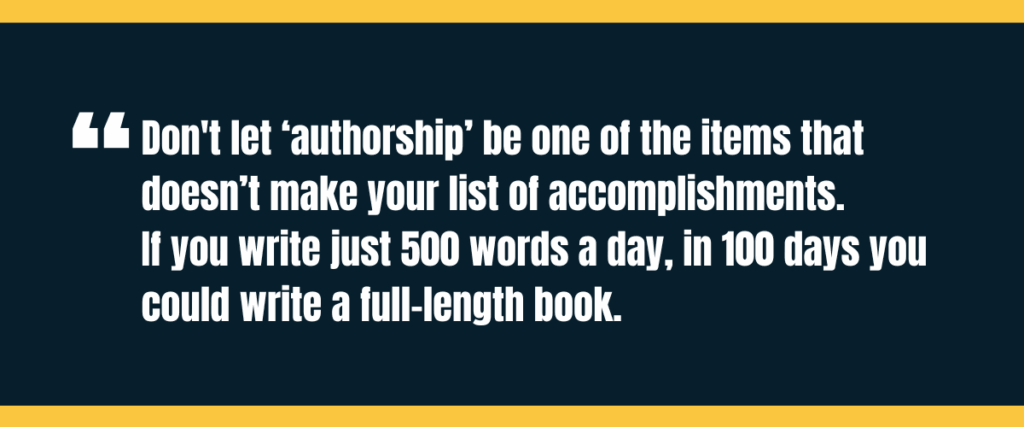
Keep at it. It’s worth it. Often, we regret what we don’t try. Don’t let “authorship” be one of the items that doesn’t make your list of accomplishments.
If you write just 500 words a day, in 100 days you could write a full-length book. Yes, it’s that easy, and that hard.
How to find time to write a book with a full-time job: take your next step
Now that you know you can write a book, even while working full-time, take our free Publishing Path Assessment to decide the next best step for you!