












Whether you’ve been writing for ten minutes or ten years, it’s a wise choice to look into Grammarly alternatives and competitors.
While some writers strictly use Microsoft Word to write, such as the legendary Alex Aster, others use writing programs for a little extra help. Depending on who I am writing for, I’ve used a variety of programs. One of them is . . . drumroll please: Grammarly.
In this post, we take a look at Grammarly alternatives and competitors so you can make an educated choice on what to use and why. Just as there are programs to help you dictate a book, you can use Grammarly to help you write a book.
We’ve taught over 8,000 authors how to write, publish, and market their books over the last 10 years. Now, we take a moment to help you choose how to best write yours. Let’s get straight into it!
Grammarly alternatives and competitors: what’s covered
- What is Grammarly?
- Is there a better alternative to Grammarly?
- Grammarly alternatives and competitors
- Which is better, Grammarly or ChatGPT?
What is Grammarly?
Grammarly is an AI-powered online writing assistant that helps you pinpoint areas to improve your writing. These areas typically focus on grammar (hence the name), spelling, punctuation, and stylistic errors.
According to their website, Grammarly is trusted by over 50 thousand organizations and 40 million people.
A few of these organizations include:
- Zoom
- Upwork
- Everlane
- Arizona State University
- Washington University in St. Louis
- Iowa State University
With this many well-known organizations and universities using the software, it stands to reason that a myriad of both Grammarly alternatives and Grammarly competitors would crop up. Brands want to jump in where sales are high, after all.
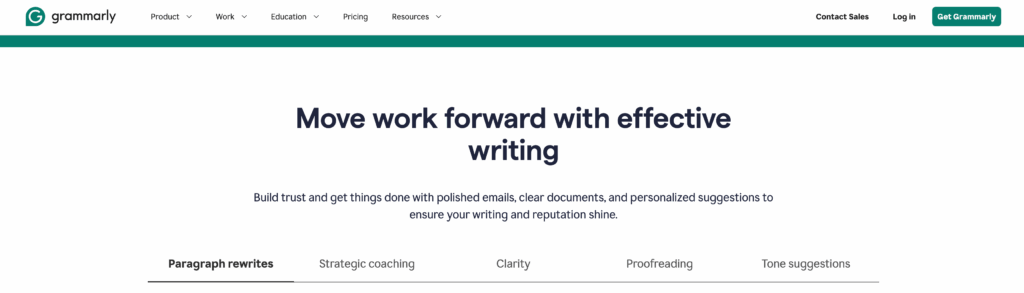
In addition to being widely known and used, Grammarly’s key features include:
- Paragraph rewrites
- Strategic coaching
- Editing for clarity and tone
- Proofreading
While you will always want to hire a professional book editor before putting your book into the world, sometimes a light edit from a software can help.
I recently began editing for an author who used AI for some early edits. While he used AI as a tool to catch some of his manuscript’s issues, he knew he still needed to hire a professional editor (in this case, myself), to help his book cross the finish line of publication ready.
If you could benefit from a software program that helps you achieve some of those early edits, you may want to consider trying Grammarly. But of course, let’s take a look at some Grammarly alternatives and competitors before you fully commit.
Grammarly spotlight
One of the benefits I most enjoy when using Grammarly is its emphasis on active voice. Active voice and passive voice are topics writers often discuss because it directly influences their writing.
Readers may not realize they want to read active writing that features proactive characters, but more often than not, we do. Think of some of the bestselling books that turned into feature films.
Consider Divergent for a moment. This book-turned-film features a proactive protagonist and a book full of active voice. Beatrice (Tris) stands as a character who drives the action and takes proactive steps that push the plot forward.
This all starts with Veronica Roth choosing active voice over passive voice.
For example, take a look at the following two sentences (written very on-the-nose to drive the point home):
- Sam took a step back from the bridge. He was discouraged. He was discovering the bridge’s foundation was shaky, which would make them have to change their exit strategy.
- Sam took a step back from the bridge. He wiped sweat from his brow and sighed. With a cracked foundation, the bridge wouldn’t support his exit plan. “We need to reconvene to create a new plan,” he said.
The first example showcases the same scene as the second, but uses passive voice to do so. As a result, Sam looks like a reactive character. In the second example, active voice takes the stage. Sam takes the lead as a proactive character, assessing the situation and stating his new plans.
How does Grammarly contribute to this type of writing? Grammarly is a standout software in how it helps writers move from writing passively to writing actively. How?
Grammarly is merciless in detecting passive voice. If you want a quick way to learn how to write actively, you may want to consider Grammarly as a valid option!
Is there a better alternative to Grammarly?
Whether or not there are better Grammarly alternatives for you depends on your specific writing needs. While there are a plethora of Grammarly competitors out there, finding the best one for you takes sitting down and assessing your writing goals.
Additionally, it’s important to ask, “What do I want to get out of a writing aid?”
- If you are looking for in-depth book coaching, you’ll likely want to hire a book coach to help you specifically.
- If you’re looking for a professional feedback on how you develop your story from first page to last, hire a developmental editor.
But all of this said, if some help from an online software program could help you overcome your early writing obstacles, look into Grammarly and also look into Grammarly alternatives and competitors.
The helpful part of software such as Grammarly (or the Grammarly alternatives and competitors out there) is how it helps you work with a nearly blank page.
As soon as you begin writing, Grammarly jumps in to help you improve. With your writing goals in mind, let’s now take a look at Grammarly alternatives and competitors so you can write your book and make money publishing.
Grammarly alternatives and competitors
There are a number of Grammarly alternatives and competitors to note before settling on one. While Grammarly alternatives can qualify as Grammarly competitors, we’re breaking them into two categories for sake of clarity.
Grammarly alternatives
Below are several Grammarly alternatives to consider.
Ginger
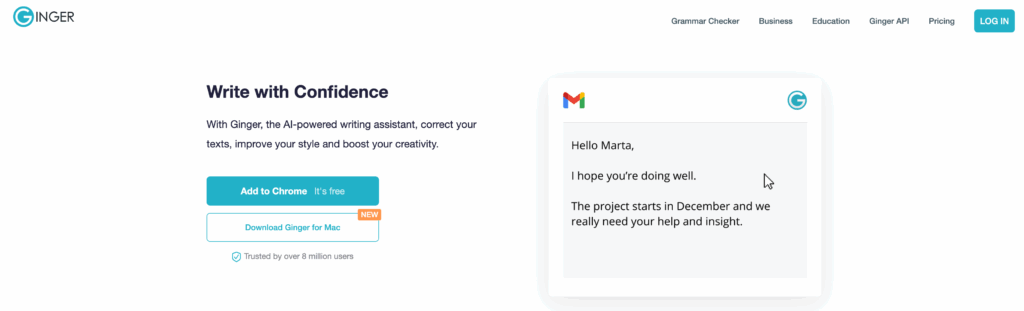
Ginger is sometimes discussed as the lesser alternative to Grammarly. It is cheaper (although both have free versions as well) and it does offer a translation tool for over 40 languages.
If you are a non-native English speaker or simply feel a bit unsure about your writing, this Grammarly alternative may be for you.
White Smoke
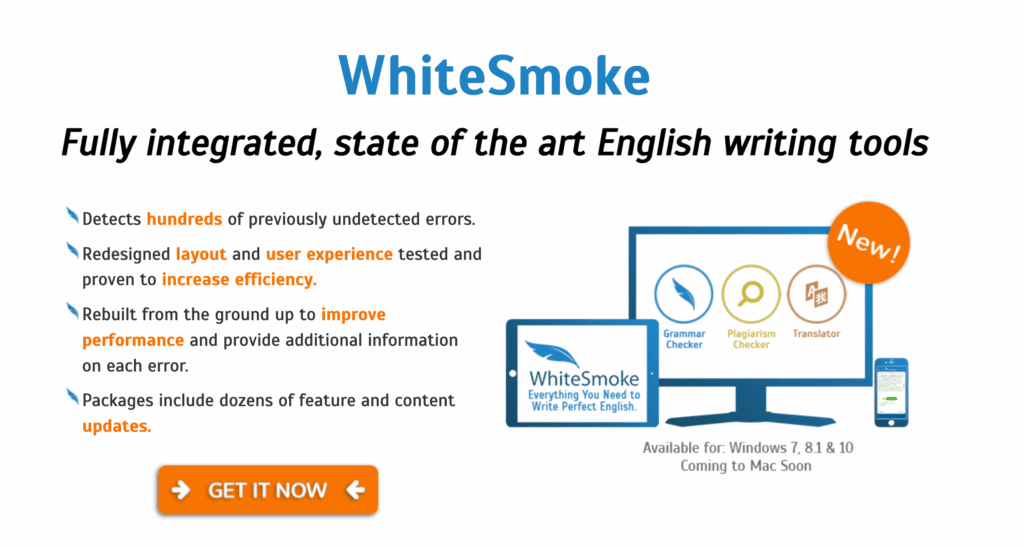
White Smoke is another Grammarly alternative that uses natural language processing technology (NLP) to enhance your writing.
It’s key features are:
- Grammar checkers
- Style checkers
- Spelling checkers
- Punctuation checkers
- Translation aid
Grammarly is said to be better for longer-form content with White Smoke being better for shorter-form content. As far as layout, White Smoke feels a bit outdated and less modern, and doesn’t offer much in terms of free services.
Scrivener
As far as Grammarly alternatives and competitors go, Scrivener is a bit more of an add-on, but bears mentioning. Scrivener is an online writing software just as Grammarly is, but it focuses more on helping writers organize the different aspects of their novels.
In fact, it can even be paired with Grammarly. Used in conjunction, these two can help you:
- Organize and store your project (Scrivener)
- Outline, structure, and track your word count (Scrivener)
- Check spelling, style, and tone (Grammarly)
- Provide feedback on your writing (Grammarly)
- Check for plagiarism (Grammarly)
While Scrivener can be a Grammarly alternative, it is better used in conjunction with Grammarly.
Grammarly competitors
Onto Grammarly competitors!
ProWritingAid
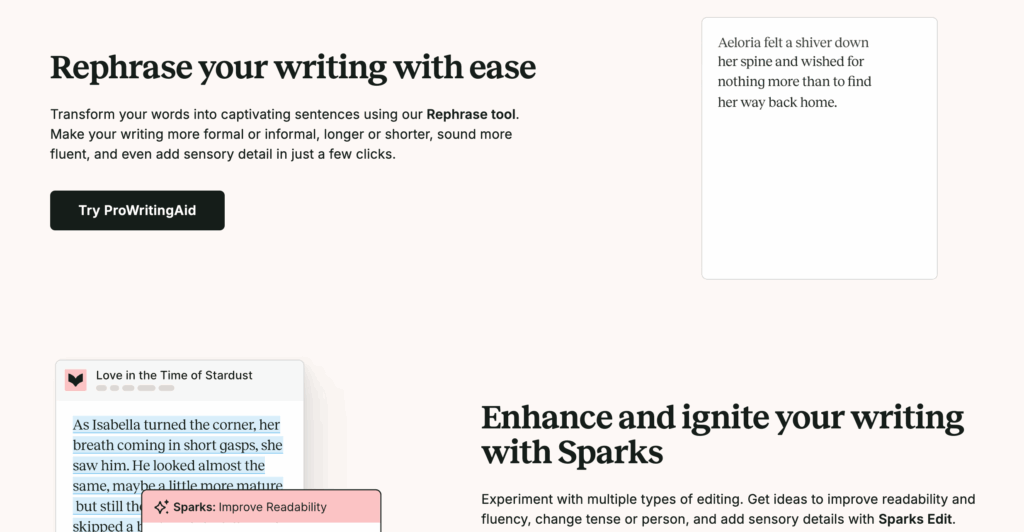
You’ve likely heard ProWritingAid (PWA) come up in discussions about Grammarly because it is one of the top Grammarly competitors.
ProWritingAid offers a variety of the same features as Grammarly, while also offering:
- The ability to compare your writing to 90 authers across genres
- More advanced style improvements
- Writing analysis reports
Depending on how heavily you want AI to influence your writing, this may or may not be a good Grammarly competitor for you.
Hemingway Editor
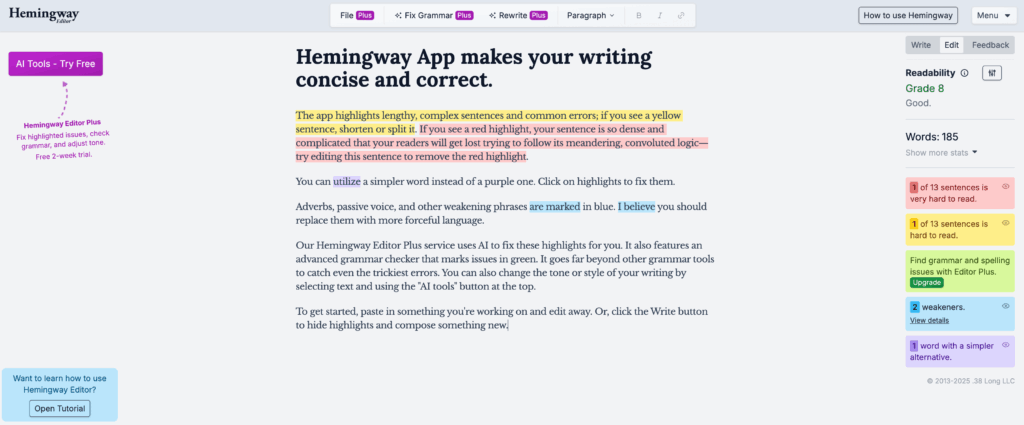
Among the Grammarly alternatives and competitors stands Hemingway Editor, a true Grammarly competitor.
Hemingway Editor uses color coding to help you identify and fix complex sentences, dense phrasing, or singular words that could benefit from being swapped with a synonym.
It also tracks your work’s readability level in grades. This can be helpful, especially if you’re writing a children’s book or YA novel.
QuillBot

QuillBot is used by brands such as PayPal and Hootsuite. Like Grammarly, it offers a plagiarism and grammar checker. It also offers a paraphrase option that helps you edit your writing with ease.
While Grammarly is better known for its grammar checking, QuillBot can get some of that work done for you.
Which is better, Grammarly or ChatGPT?
Lastly, as far as Grammarly alternatives and competitors, Grammarly is best for editing your writing while ChatGPT can generate ideas for you.
That said, there are many ongoing discussions of using generative AI in creative writing. When authors query literary agents, agents often ask authors if they used AI to create any of their work.
Much of the joy of writing is in generating fresh ideas from an individual’s perspective. While ChatGPT can have a place in creative writing, Grammarly is usually the best alternative for proofreading your text.
Grammarly alternatives and competitors: take your next step
Now that you know all about Grammarly, as well as its alternatives and competitors, take your next step by using our free resource below! Today is the day to pursue your writing journey by outlining your book!
Book Outline Generator
Choose your Fiction or Nonfiction book type below to get your free chapter by chapter outline!
Book Outline Generator
Enter your details below and get your pre-formatted outline in your inbox and start writing today!
CONGRATULATIONS
Thanks for submitting! Check your email for your book outline template.
In the meantime, check out our Book Outline Challenge.