


















When I started writing, I had little knowledge about the elements of creative writing. I didn’t know I’d need a book editor (this is ironic, as I edit for a publisher today). I didn’t have a firm grasp of the different themes in storytelling.
I did know basic plot structure: inciting incident, rising action, climax, falling action, ending. But as far as the elements of creative writing? Little to zero knowledge base.
At the time, I was just a third grader, writing my first story. This transitioned into my first book series…then many short stories…and finally, my first novel.
Still, while my history classes taught me quite a bit about the character arcs of historical figures and science class gave me great details to draw from for worldbuilding, I hadn’t studied creative writing as its own entity.
It wasn’t until I began training under a New York Times bestselling author that I realized there were specific elements of creative writing that could transform my stories.
I’ve put these lessons into practice over the years and it’s showed in my plot, characters, and themes. Add to this the fact that we’ve taught over 8,000 authors how to write, publish, and market their books over the last 10 years.
To say we love the elements of creative writing is an understatement! Today we’re taking you through the key elements of creative writing so you can flatten the learning curve I had to slog through.
Elements of creative writing: what you learn
- What is creative writing?
- What are the five basics of creative writing?
- What are the seven steps of the creative writing process?
What is creative writing?
Creative writing tells a story, often using the imagination and magical power of language to do so. For example, I could tell you that once I was on a sailboat, the engine went dead, and we had to take a small dingy to shore for supplies.
This is not creative writing. It’s recounting events, much like ingredients in a recipe. But I could also tell you that one day I stepped off a sun-splintered dock onto a sailboat and with just three other passengers, took off into the Caribbean.
With the sun sparkling off the sea, suddenly the sailboat’s engine went dead. For safety, we needed to get back to land and get supplies to fix the engine. But due to a variety of factors, we couldn’t sail back.
We dropped anchor, realizing our transportation was now just dead weight in the sea. From here, we grabbed the few belongings we could and boarded a small dingy that quaked in the waves.
Up against a strong wind, we strained with nothing but oars and willpower. With every stroke, I wondered if our small paddles could be stronger than the wind, and if we were blown out to sea, if we’d be able to alert the Coast Guard or turn into another Castaway story ourselves…
What are the five basics of creative writing?
There are many elements of creative writing, and we’ll get into eight of them below, but the five basics are plot, character, setting, point of view, and style.
Whether you write fiction or nonfiction, plot and characters must drive the story, take place in a setting, have a point of view (POV), and will exhibit a writing style. Now your style, or voice, is unique to you. It takes time to develop. But it can set your writing apart in a crowded bookstore.
What are the 5 C’s of creative writing?
The five basics are: content, craft, creativity, clarity, and coherence. Writing, otherwise known as your content, should be engaging. You can do this by mixing craft with creativity, while always striving for a story that is clear and coherent.
What are the 5 R’s of creative writing?
Gutkind defines the key “elements of creative nonfiction as five ‘R’s’: real life, reflection, research, reading, and (w)riting.” However, this applies to fiction too, minus the “real” life.
My writing mentor often says something along the lines of, fiction should feel so real it could be nonfiction, and nonfiction should be so inspiring it feels like it could be fiction.
What are the seven steps of the creative writing process?
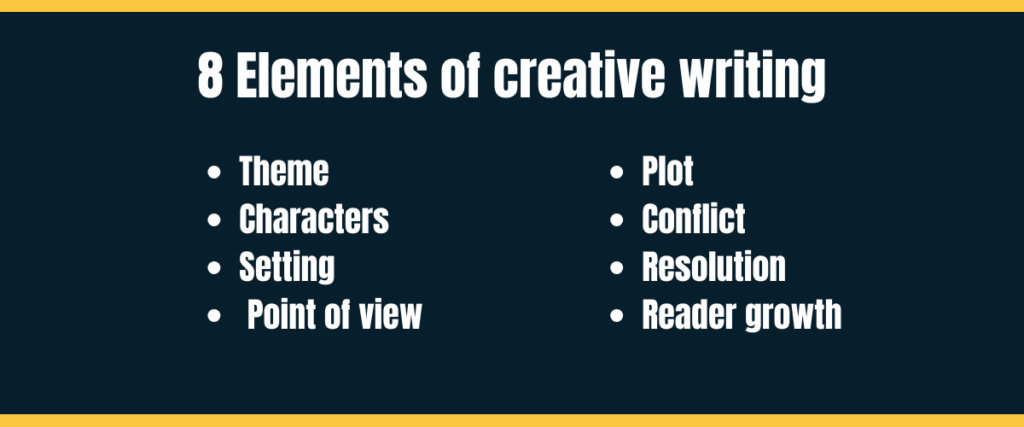
With this groundwork laid, the seven steps, or elements, of the creative process are theme, characters, setting, point of view, plot, conflict, and resolution. I’m adding an eighth, which I share in a bit. Let’s break these elements of creative writing into actionable steps.
1. Theme
Theme is one of the core elements of creative writing because it is the why behind your plot. Consider The Hunger Games trilogy.
Katniss Everdeen volunteers as tribute for the Games, becomes the face of the revolution, and leads a rebellion. This is what happens.
But why does it happen? She cares about her sister. She wants to take care of her family. She is desperate to survive.
The plot reveals the themes of sacrifice, survival, and coming-of-age as Katniss comes into her own, leading District 12 right along with her.
2. Characters
Without engaging characters, no matter how many elements of creative writing you use, your story falls flat.
Character arcs are not necessary for your book to do well (consider Sherlock in the series Sherlock Holmes), but they do need to engage your reader.
Choose to make your characters real, believable, and feel human…then create stakes for them to overcome and you’re well on your way.
3. Setting
A major part of what drives your characters is the setting they find themselves in. For example, imagine if Isla Crown, from the bestselling romanticy Lightlark, lived in modern day New York.
The way she engages with her world would change—drastically. Setting often preys on characters, forcing them to grow or break.
If Mark Watney in The Martian had been stranded in the Arizona desert, the entire story would fall apart. Setting matters!
4. Point of view
Point of view, or POV, is one of my favorite elements of creative writing. The character you choose to tell the story through drastically impacts the story you tell. Take, for example, Suzanne Collins. She authored The Hunger Games with Katniss as her POV character.
However, she also wrote The Ballad of Songbirds and Snakes. This story takes the villainous President Snow’s POV, long before he rises to power over Panem.
Try reading the first book of The Hunger Games right alongside The Ballad of Songbirds and Snakes for a dichotomous reading experience. My writing mentor has a great tip for choosing your POV character: Simply ask, who has the most to lose?
5. Plot
Your plot is what happens in the story. In The Lord of the Rings, the plot is Frodo taking the Ring to Mordor and the many events that encompass this journey.
In The Maze Runner, the plot is the characters trying to get out of the maze. In The Martian, the plot and theme closely correlate: the plot is how Mark tries to survive (what he does) and the theme is survival itself.
6. Conflict
Conflict is the rub between what is going on in the story and what the characters want to happen.
Conflict comes in many forms (character against self, another character, and nature) but without at least one conflict present, the other elements of creative writing fall apart.
When I was in a dinghy in the Caribbean, blowing out to open water, I had a couple of conflicts happening at once: my own doubts (self) and the wind (nature).
Whether you write nonfiction or fiction, conflict is what drives the plot and characters forward.
7. Resolution
Oof, endings are often what make or break a story’s success. When readers commit their time to entering your story world, it’s with the trust that you, the author, will provide a satisfactory ending.
Recently, I watched a YouTuber break down how Harry Potter should’ve ended. Now, before you Potterheads come after me, just listen to the logic:
This series, a worldwide phenomenon, ended with a focus on Harry, Ron, and Hermione’s children—characters we had little to zero investment in.
Imagine, this YouTuber said, if the series had ended with them all at the Weasley’s, getting ready to leave for school at Hogwarts. They could recount how they felt their first time going, how they missed Fred, the escapades they had avoiding the caretaker, Filch.
How you end your story should be with a focus on some kind of resolve…hence the term resolution.
While I think Harry Potter ended well, I do see value in the above ending. Brainstorm your own by asking, what ending best aligns with the story and characters, while not feeling too expected?
8. Reader growth
Reader growth is not always included in the elements of creative writing, but I would be remiss not to mention it.
Over the years, my writing mentor stressed that above all, focus on putting the reader first. Yes, we write for love of craft and specific themes. That’s one reason why we study the various elements of creative writing and spend so much time editing.
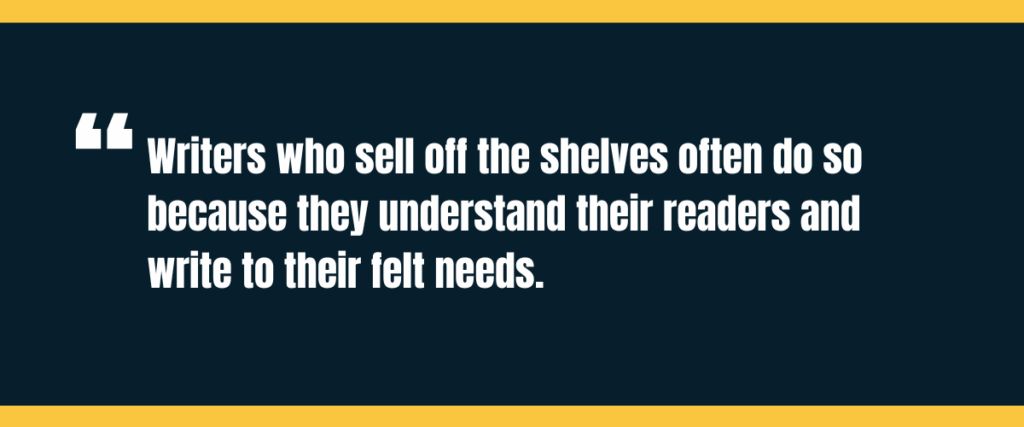
But at the end of the day, without readers, books don’t sell. Writers who sell off the shelves often do so because they understand their readers and write to their felt needs.
Elements of creative writing: take your next step
Now that you know the eight elements of creative writing, it’s time to take the next step in your author journey. Use our free resource below to get started. Take just two minutes to discover the best Publishing Path for you!