















Author interviews are one of the best ways to build authority and reach targeted audiences of ideal readers, as well as promote your book.
Best of all, once you’ve appeared on a podcast, you’ll be able to use your interview as proof of your expertise and experience when you pitch to other podcasts.
This is especially beneficial if you self-published a book since you don’t have the support of a big publishing house. You’re doing all the book marketing on your own!
I’m going to share ways to land author interviews to help promote your book. But, I’m also going to share what I did to land a podcast interview alongside one of CNN’s former editors before my book was even published.
Add to this the fact that we’ve taught over 8,000 authors how to write, publish, and market their books over the last 10 years. This includes lots of tips on marketing! Today, we want to share our expertise with you so you can go out and land your next interview.
Here’s how to land author interviews:
Why do you need author interviews?
Author interviews are beneficial for authors to spread the word about themselves as an author as well as their new and previous books. Author interviews are similar to celebrity interviews when they have movies or TV shows premiering: they interview to promote their work. As authors, we should, too.
Here’s how author interviews can benefit you:
- You will reach a new audience
- Your audience will be more receptive
- You market yourself as an author
- You market your newest book launch
- You can market any previous books you have
- You will gain a larger social platform
- You will sell more books
Overall, author interviews can only help you in your quest to become a full-time author by offering you book marketing opportunities.
How to get author interviews on podcasts?
Landing author interviews comes down to simply asking. This is what I did to land an interview without even having a published book. I found a podcast I wanted to guest on, wrote an email, and simply asked.
I got a yes. I appeared alongside one of CNN’s former editors (without ever publishing a book!), and raised awareness about my brand. But, there are some specific things I did to help increase my odds of a yes.
1. Do your research
First of all, listen to the show before reaching out to podcast hosts. Podcasters are often approached by an author who sends generic emails proclaiming “I love your show,” and then ask to become a guest to promote their book.
Other times, they’re approached with specific pitch letters, but the fit isn’t right. The reason for the mismatch usually is that the author who is pitching hasn’t listened to the show.
If it feels like a chore to listen to the podcast, that’s a sign that you might be better off reaching out to a different podcast host. After all, you want to find podcasts that are in your niche, which usually happens to be those you listen to anyway.
Here are a few things to ask yourself when you want to reach out to a podcast for an interview:
- Do you listen to them on your own?
- Do you resonate with their core message/theme?
- Are you involved in their community on a regular basis?
- Would you be proud to be a featured guest on their podcast?
- Are you a fan of past featured guests?
Answering these positively will help you determine which podcasts to reach out to. Without doing the proper research, you could wind up upsetting the hosts and burning those bridges.
2. Rate and review the show
Once you’ve listened to a show, subscribe, rate and review. Ratings, reviews, and subscriptions help the podcast’s ranking. Most importantly, reviews are a powerful form of social proof that will encourage new people to listen.
Mention the review when you submit your pitch.
For example, you could write, “Listening to John Doe’s description of his struggle to grow his business in spite of his terminal disease was truly inspiring. Now, when things get tough, that message keeps me going. That’s why it was such a pleasure to write a 5-star review of your show on iTunes.”
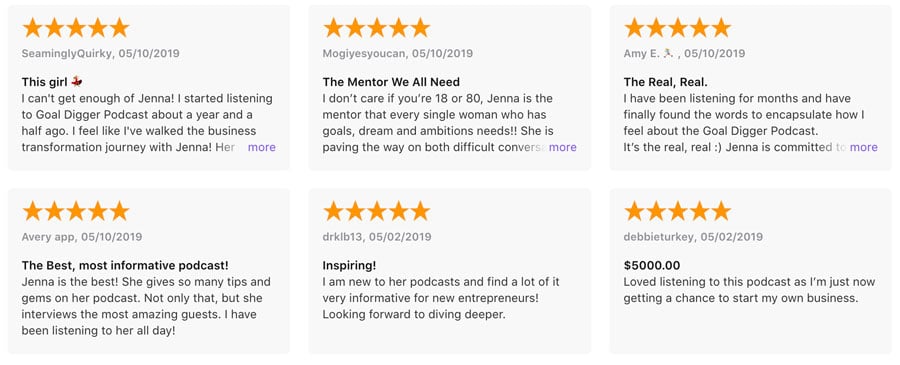
Your message will bring awareness to what you’ve done to support the show, greatly increasing your chances of landing a guest spot.
3. Feature the podcast hosts
If you have a blog, podcast, or YouTube channel, talk about their show. You could also write a blog post about the main lessons learned from the show, and tag the host on social media when the article is published.
I have blogged about different individuals I want to connect with. It works well. Just be careful to present your best work and be thoughtful in your feature.
4. Tailor your pitch to the host’s story and the mission of the show
Find out why they do what they do, and if it resonates with you, then center your pitch around that.
Here are a few tips for tailoring your pitch to land your author interview:
- Mention something you learned from their show
- Make a connection from yourself to the show’s mission and theme
- Connect your book’s message with their show’s
Doing this will help you reach podcast hosts much more effectively and show them you’re a great fit for their show.
5. Offer three unique ideas related to your book
Write down three to five topic ideas based on the core message in your book, which you can modify depending on the targeted show. For example, I pitched myself as a fiction writer, but because I am also an editor who helps authors learn how to make it in the publishing world, I was invited to join.
For a different podcast, I spoke directly about my experience as an author, rather than focus on my experience as an editor. These two topics landed me podcast interviews I wouldn’t have gained otherwise.
6. Leverage common connections you have with the host
Common connections matter. Podcast hosts are often willing to introduce guests to other podcast hosts who have a similar audience. This is one of the easiest ways to secure future guest appearances.
You might not even need a formal introduction. When you pitch, just mention that you know one or more of their previous guests. The idea is to find common ground.
7. Send samples of previous interviews
Once you have one rep under your belt, you can link your interview in your pitch. You can say something along the lines of, “Recently, I appeared on [podcast title] and spoke about [topic or theme]. I would love to speak on the [similar topic], as I think it will directly relate to your audience.”
If you haven’t had podcast appearances yet, I encourage you to create audio or video clips with valuable content relevant to your audience that you publish on your site, and use those links as samples for the host.
Even though samples of actual podcast interviews are much more powerful, the mere fact that you have a sample of your work will help you stand out among the competition.
8. Create a one-sheet
To save yourself time and effort, and to show your professionalism, I suggest you create a “one-sheet.” A one-sheet is a document that’s a summary of who you are and what you offer as a guest.
You could send the link to your one-sheet with your pitch, or use the information within the one-sheet to complete your guest request form or email pitch. Regardless of the situation, having this document readily available will save you time and effort.
The main elements of a one-sheet are:
- Bio
- Headshot
- Potential interview topics
- Talking points
- Relevant links
- Affiliate links
- Contact information
Bio tips
Create different versions of your bio (50-, 100-, 150-, and 200-word bios) so you’re ready when the podcast host asks you for a specific length. If you’re submitting the entire one-sheet, include the 100-word version of your bio in it.
The bio should mention your book (even if you haven’t published it yet), and other credentials as proof of your expertise, along with at least one personal tidbit about yourself.
It’s standard for all podcast guests to submit their profile picture before they’re interviewed. Invest in a professional photographer. No selfies, please!
Topic tips
List no more than seven topics related to your book you could explore as a guest. Some hosts will ask you to provide talking points for the topic you’ll explore. Others favor a free-form style, and will lead the interview as an informal conversation.
I’ve done both, and both are important to prepare for. You can practice responding to questions you think they may ask so you are prepared. You can also ask them to give you questions ahead of time. This is something I love to do.
In either case, you should be prepared to provide talking points within 48 hours of being approved as a guest, though you can double check with the podcast host for specifics about this.
Tips about links
Include links to your main website, your book, your free offer for the listeners, and your primary social media pages.
Depending on the host, you might also be asked to provide an affiliate link to a free download or low-ticket offer. In most cases, providing affiliate links isn’t required, but having the ability to create such a link on demand will help you stand out.
If you’re submitting the one-sheet, then just write “Affiliate link for free download available.” Include your email address and phone number.
Having your one-sheet ready will allow you to simply copy and paste the information when you complete guest request forms or pitch via email.
9. Always deliver value first
Above all, remember that your primary goal is to deliver value to your audience. Book sales will be a natural result of that value.
When you submit your pitch, start with a personalized explanation of why you are a fan of the show and how you can inspire and educate its audience. Then, mention your book as an additional asset listeners may benefit from. Value first.
Author interviews: take your next step
Now that you know how to land author interviews by simply doing your research and asking, it’s time to take your next step in your author journey. Use our free Publishing Path Assessment below and get started today!
This blog was rewritten from the original version published by Cloris Kylie.