








There are more and more online book publishing companies now that people have the power to publish on their own, with nothing more than a computer and internet connection. Or at least, that’s what they want you to think is all you need.
The truth is that while self-publishing online is more accessible than ever, not all companies dedicated to assisting in the process are created equally. It’s important to understand what it is they do, what your own goals are, and how the publishing company you choose can make a huge difference in your success.
To help with all of the above, we’ll talk about:
- Can you publish a book online?
- Cost of online publishing
- Types of companies
- What they do
- Pros & cons of the top 5
- How to choose
Can you publish a book online?
Yes, you can publish a book online! The process has never been easier, thanks to the rise of online book publishing companies. These platforms provide a variety of tools and resources to help authors turn their manuscripts into published books available for purchase in digital and print formats.
Specifically, this is how people are self-publishing books nowadays. Whether you’re a first-time author or a seasoned writer, online book publishing companies can offer you the flexibility, convenience, and control needed to publish your work.
But there are a few things you’ll need to understand about publishing a book online, including the fact that if you want to do it well, there are many steps involved—more than just uploading your book and hitting “publish”.
How much does online book publishing cost?
The cost of online book publishing can vary widely depending on the services you choose. Some platforms offer free publishing options, while others charge for premium services such as professional editing, cover design, and marketing. Technically, you can do everything yourself, without spending a dime. But that will produce a book that looks exactly as it sounds (and without design and editing experience, it’s highly recommended you do not pursue this option if you want to actually sell books).
That said, here’s a breakdown of potential costs:
- Uploading to Publish: $0 to $100
- Professional Editing: $500 to $3,000+
- Cover Design: $100 to $800+
- Formatting: $50 to $300+
- Marketing and Promotion: $100 to $1,000+
OR
- Book Publishing Company Fee (that does all of the above): $4,000-$10,000
Overall, the total cost can range from a few hundred to several thousand dollars, depending on your specific needs and the level of professional assistance you require. All of this is, of course, if you choose to go it alone and self-publish your book online.
Types of Online Book Publishing Companies
This is a broad topic, and there are tons of different options. It’s important for you to understand that just because it carries the online book publishing companies label doesn’t mean it’s all the same.
Here’s a list of the types of publishing companies:
- Self-Publishing Platforms: Platforms that allow authors to publish their own books independently, offering tools and services for editing, formatting, cover design, and distribution.
- Hybrid Publishers: Companies that combine elements of traditional and self-publishing. They offer more support and services than self-publishing platforms and often share costs and profits with the author.
- Vanity Publishers: Companies that charge authors to publish their books. These services often include editing, design, and marketing, but the author bears all costs.
- Print-On-Demand (POD) Services: Services that print books only when an order is placed, reducing the need for large print runs and minimizing inventory costs.
- Education Online Book Publishing Companies: Companies that focus on publishing scholarly, educational, and research-based content, often offering services tailored to academic authors.
- Niche/Specialty Publishers: Publishers that cater to specific genres or types of books, such as photobooks, cookbooks, or graphic novels, offering specialized services for these formats.
- Crowd-Publishing Platforms: Platforms that combine crowdfunding with publishing, allowing authors to raise funds from readers and supporters to finance the production and distribution of their books.
In this write-up, we’ll focus on the most common types of online book publishing companies.
The Ins & Outs of What Online Book Publishing Companies Do
Not all publishing companies are the same. Some solely do printing, others allow you to upload and distribute to various book retailers, and others have a team that provides services (and coaching) for you.
Online book publishing companies offer a wide range of services designed to help authors bring their books to market.
Here’s what these companies typically do:
- Manuscript Submission: Provide a platform for authors to upload their manuscripts.
- Editing and Proofreading: Offer professional editing and proofreading services to ensure the book is polished and error-free.
- Cover Design: Create eye-catching book covers that attract readers.
- Formatting: Format the manuscript for both print and digital versions.
- Distribution: Distribute the book to various online retailers such as Amazon, Barnes & Noble, and Apple Books.
- Marketing: Assist with marketing and promotion to help authors reach their target audience.
- Sales and Royalties: Manage sales and royalty payments, providing authors with regular updates on their earnings.
Again, most online book publishing companies will do some of these, but rarely will one do them all. Below you’ll find one example that does most of the above.
Pros & Cons of the 5 Best Online Book Publishing Companies
You’ll find a lot of options for publishing. These, however, are among the best options to choose from.
1. selfpublishing.com
This is one of the online book publishing companies that does it all. It’s more service-based than platform based. Meaning, you pay to work with this company for all aspects of the publishing process. At selfpublishing.com, they have packages to fit various author needs, including differentiation for nonfiction and fiction, a marketing extension, and advanced programs called Author Advantage Accelerator that includes marketing materials as well.
Most importantly, selfpublishing.com is an education and coaching company that offers services. Meaning, they’re not a hybrid publisher, and therefore, you keep 100% of the royalties you earn from your book.
You can head to their services page to check out more of what they offer for online book publishing.

Like I mentioned earlier, you won’t find everything you’re looking for across all online publishing companies. For this one, here are some pros and cons to keep in mind:
Pros:
- Comprehensive self-publishing packages that include coaching and support.
- Access to a community of authors and industry experts.
- Emphasis on helping authors build their brand and audience.
- Quality book production services (cover, formatting, editing) all in one place
Cons:
- Higher cost due to bundled services and quality.
- May be overwhelming for authors who prefer a more hands-on approach.
What people are saying:
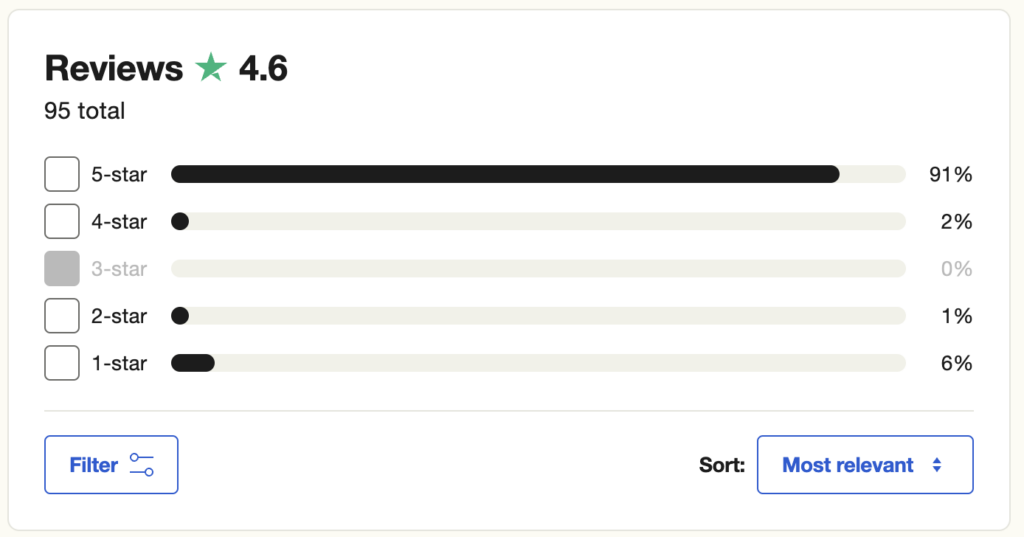
This publishing company has a 4.6 rating on Trustpilot. You can read the reviews for yourself here.
2. Lulu
Lulu is an online book publishing company that provides a comprehensive platform for authors to publish, print, and distribute their works. Founded in 2002 by Bob Young, Lulu offers a range of services designed to help authors turn their manuscripts into professionally published books, available in both print and digital formats.
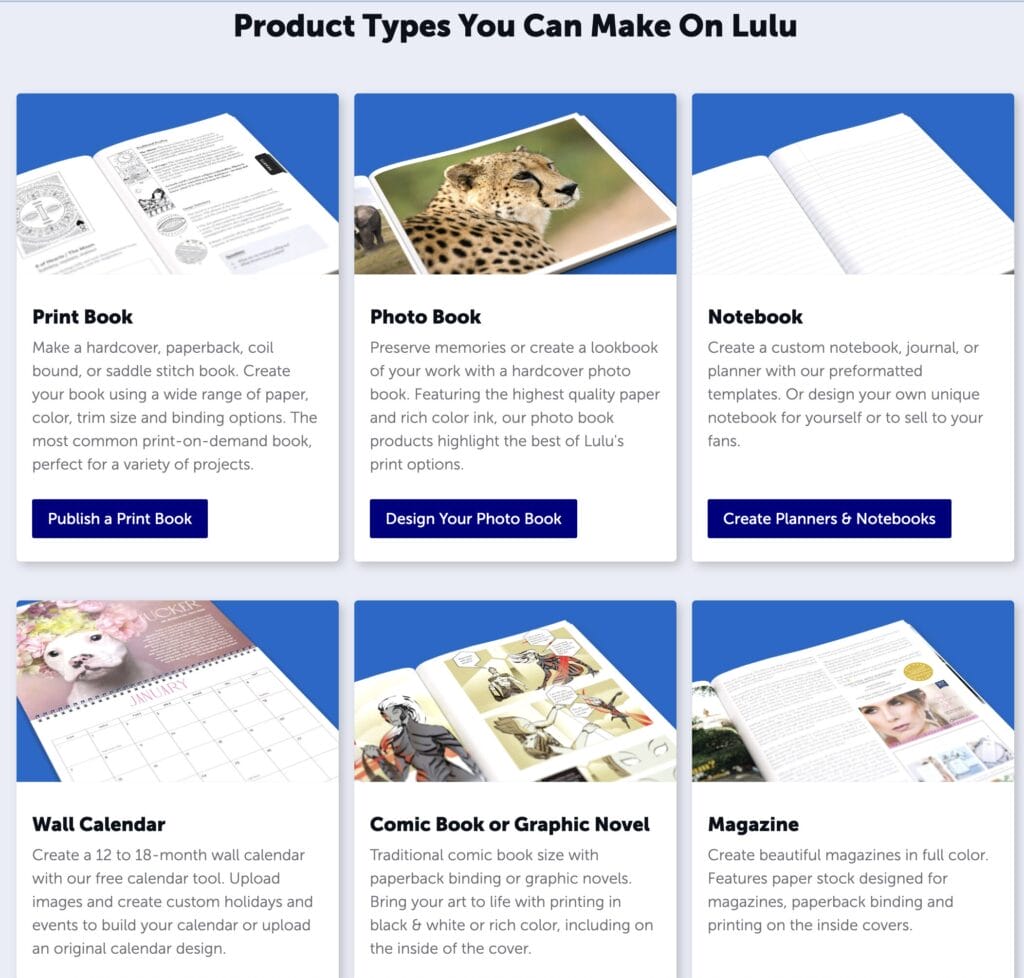
Basically, you can find a bit of what you’re looking for on Lulu, including more than just books. It also allows comic book and graphic novels, notebooks, magazines, calendars, etc. with more customization options than somewhere like Amazon.
Pros:
- Wide range of services including editing, cover design, and marketing.
- Distribution to major online retailers and their own marketplace.
- High-quality printing options for print-on-demand books.
- Extends beyond books for supplemental products for your author platform.
Cons:
- Higher upfront costs for premium services.
- Steeper learning curve for beginners due to the extensive range of options.
- Mostly self-guided.
3. Amazon (Kindle Direct Publishing)
You’re likely most familiar with this of all the online book publishing companies. Amazon is well known for allowing authors to easily upload and self-publish their books. Even other publishing companies distribute through Amazon, because it’s one of the top book retailers in the entire world.
The accessibility of Amazon KDP makes it a go-to for a lot of authors who want to self-publish on a budget. But it’s actually not as straightforward to sell books consistently on Amazon without the help of other companies.
You still have to understand how to use categories, write a good description, get reviews, and market the book effectively, all of the pieces of self-publishing on Amazon.
Of course, it’s still one of the strong options for online book publishing companies, and here are some pros and cons as to why:
Pros:
- Easily accessible platform ideal for beginners.
- Largest online retailer with massive reach.
- Free to publish with competitive royalty rates.
Cons:
- Limited control over pricing and discounts.
- Exclusivity requirements for certain promotional benefits.
- Difficult to get visibility without a strong marketing plan.
4. IngramSpark
IngramSpark is a self-publishing platform that offers authors and independent publishers the ability to print, distribute, and manage their books globally. It is a part of Ingram Content Group, one of the largest book distribution companies in the world.
This is also what’s known as a book distributor. So in addition to publishing, you can upload and have your printed book come from IngramSpark, but be listed on various retailers, like Amazon. You can find more details about how to work with IngramSpark at their How It Works page.
Pros:
- Extensive distribution network including bookstores, libraries, and online retailers.
- High-quality printing with various options for customization.
- Detailed reporting and analytics for sales tracking.
Cons:
- Setup fees and additional costs for revisions.
- More suitable for authors with some publishing experience.
5. B&N Press (Barnes & Noble)
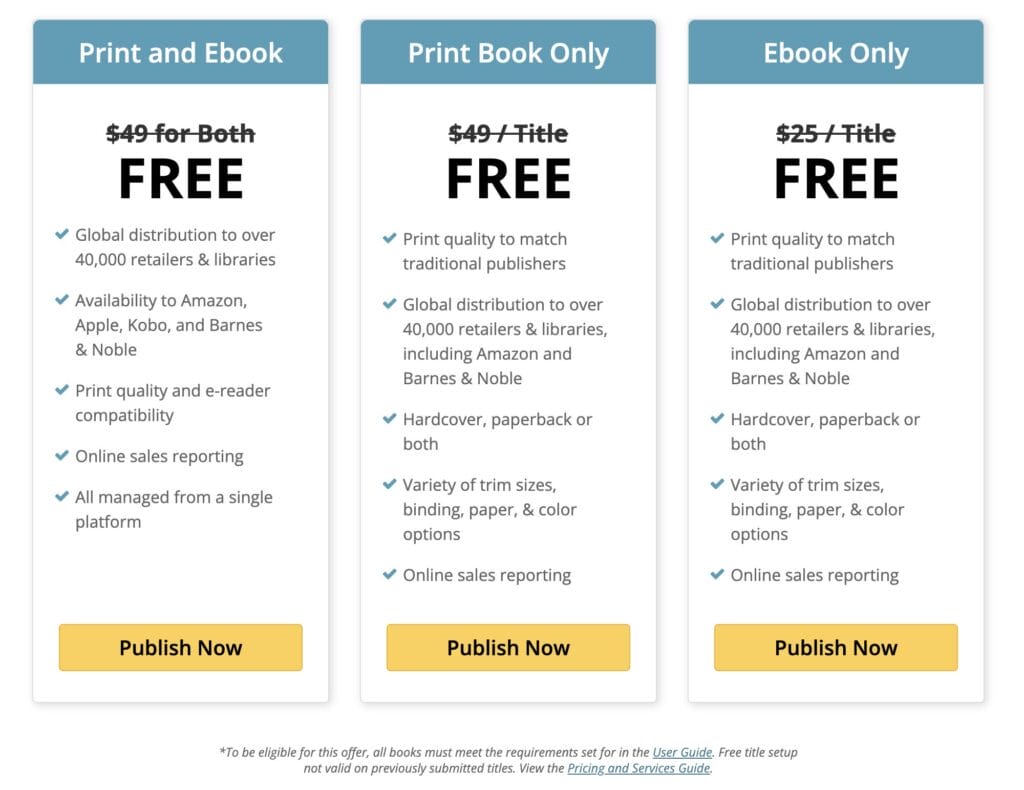
B&N Press, formerly known as NOOK Press, is the self-publishing platform of Barnes & Noble. It’s much like the other online book publishing companies in that it provides authors with tools to publish and distribute their books in both print and digital formats.
Through B&N Press, authors can reach readers via Barnes & Noble’s online store and physical retail locations. The platform offers services for formatting, cover design, and marketing, enabling authors to create professional-quality books and reach a broad audience. B&N Press also supports print-on-demand, allowing authors to print books as needed, reducing upfront costs and inventory risks.
They also have dedicated third-party partners to help direct you to the book production process, including recommended cover designers, and more.
Pros:
- Direct access to Barnes & Noble’s online and physical stores.
- Easy-to-use platform with free publishing options.
- Ability to create both print and eBooks.
Cons:
- Limited distribution compared to other platforms.
- Fewer marketing tools and resources available.
How to Choose from Online Book Publishing Companies
Selecting the right one, from all of the online book publishing companies available, is crucial for your success as an author. With numerous options available, it’s important to consider several key factors to ensure you make the best choice for your specific needs and goals.
I’m asking you to dig a bit deeper, and think long-term about what it is you actually want.
Here’s a guide to help you make an informed decision:
1. Define Your Goals
Start by clarifying your publishing objectives. Are you looking to publish a print book, an eBook, or both? Do you want extensive distribution across many online retailers, or are you focusing on niche markets?
Understanding your goals will help narrow down the options.
Most people will choose to “go wide” with distribution, and that’s a wise choice, but also makes the choice between online book publishing companies more difficult.
2. Assess Your Budget
Consider how much you’re willing to invest in the publishing process. Some platforms offer free publishing services, while others charge for additional features such as professional editing, cover design, and marketing. Other online book publishing companies will allow you to “publish” for free, but then charge additional fees for making small edits (you really do pay for typos now!).
Determine your budget for each aspect of the publishing process. And if you’re serious about becoming a successful author, start saving and invest in one of the better online book publishing companies.
3. Evaluate Service Offerings
Look at the services each company provides. Key services to consider include:
- Editing and Proofreading: Does the company offer professional editing services?
- Cover Design: Can you get a custom book cover designed?
- Formatting: Does the platform offer formatting for print and digital versions?
- Marketing and Promotion: What marketing tools and promotional opportunities are available?
- Distribution: How extensive is the distribution network? Can your book reach major retailers and libraries?
Do some detailed research! You want to work with one of the online book publishing companies that really fits your needs.
4. Consider Print-On-Demand Options
Print-on-demand (POD) can be a cost-effective solution, especially for new authors. It allows you to print books as they are ordered, minimizing upfront costs and inventory risks.
Check if the publishing company offers POD services.
5. Research Distribution Channels
The ability to distribute your book widely is crucial. Some platforms, like Amazon’s Kindle Direct Publishing, offer extensive reach, while others might have more limited distribution. Ensure the option of online book publishing companies you choose can get your book into the hands of your target audience.
6. Read Reviews and Testimonials
Look for reviews and testimonials from other authors who have used the platform. Their experiences can provide valuable insights into the company’s reliability, quality of service, and customer support.
7. Check Royalty Structures
Different online book publishing companies have different royalty structures. Understand how much you will earn per sale and what percentage the platform takes. Compare these figures to ensure you’re getting a fair deal.
8. Evaluate Ease of Use
The platform should be user-friendly, especially if you’re new to self-publishing. A complicated interface can add unnecessary stress to the publishing process. Look for platforms that offer intuitive tools and clear instructions.
9. Customer Support
Reliable customer support is essential. Check if the company provides support through various channels such as email, phone, or live chat. Quick and helpful customer service can make a big difference, especially if you encounter issues during the publishing process.
10. Long-Term Goals and Scalability
Consider whether the platform can support your long-term goals. If you plan to publish multiple books, look for a company that offers scalability and additional services that can grow with your career.
Not all online book publishing companies are the same. You have to be dedicated to finding a solution that works for you, understanding that each part of the publishing process will require new, unique skills to be successful.
Best Online Book Publishers FAQ
What is the best publishing website?
The best publishing website depends on your needs. Amazon’s Kindle Direct Publishing (KDP) is ideal for accessibility and reach, selfpublishing.com is great for those seeking comprehensive support, and Lulu offers flexibility for various book types.
What is the highest rated self-publishing company?
selfpublishing.com is highly rated for its all-inclusive services, offering coaching and support throughout the publishing process. It focuses on quality and helping authors build their brands.
Who is the best publisher for first-time authors?
Amazon KDP is often the go-to for first-time authors due to its ease of use and vast reach. Selfpublishing.com is also a good option if you’re looking for more hands-on guidance.
Should a first-time author self-publish?
Self-publishing can be a great choice for first-time authors because it offers more control and faster publication. It’s especially beneficial if you’re willing to handle marketing and promotion yourself.
How do most authors get published?
Most authors today get published either through traditional publishing houses or by self-publishing. Self-publishing has become increasingly popular due to its accessibility and the ability to retain creative control.