

















Like me, you’ve probably seen all the headlines: “AI Writes a Bestseller in a Week!” or “This Author Used ChatGPT to Finish Their Novel.” I feel like I can’t go a week without seeing several ads on Instagram about it. But while these headlines are catchy, should you use AI to write a book?
It’s tempting. Tools like ChatGPT and Claude, or writing-specific apps like Sudowrite, Squibler, and Publishing.ai, promise faster drafts, instant prose suggestions, and even plot generators. So why not use them to write your book?
Having taught over 8,000 authors to write, market, and self-publish their books over the last decade, we have a unique perspective on the industry — and this specific disruption.
Using AI to write a book: Our tips
Can AI write a book from scratch?
Technically, yes. There are even AI book-writing services out there where the sole purpose is to write a book from scratch. But even then, you have to be careful of the inaccuracies and downright confusing ways it chooses to write certain things.
That said, you still have to supply all of the ideas. You have to tell it what to write, based on your ideas and your outline.
So while it can write a book from scratch, it still requires effort and quality ideation. It’s not as easy as saying, “Write a book for me.”
Should you use AI to write a book?
Just because you can doesn’t mean you should. If you ask us, the answer is no. For many reasons.
AI is a powerful tool that can be utilized in many of the book writing processes. But the actual writing of the book?
Take it from the people who have been in this industry since before writing a book was trendy.
You shouldn’t.
The case against using AI to write your book
We know what it’s like for authors who write their own book. Before AI, they did everything themselves. And it’s a lot. We know it is, that’s why we exist as a company. But now aspiring authors are posing the question of should you use AI to write your book.
While there’s a basis for how to use AI to help with the process of a book (more on that below), here’s why you shouldn’t use it for the writing itself.
AI Doesn’t know your voice (and never will)
Large Language Models like ChatGPT and Claude are trained to generate average-sounding text based on massive datasets scraped from the internet. That means their output tends to be safe, derivative, and stylistically bland unless you micromanage every word.
Sure, they can imitate a voice. But they can’t originate one—not your voice, anyway. The quirks, cadence, word choices, and strange little stylistic fingerprints that make your writing yours? AI can’t replicate that. Not without diluting it.
Your voice can be what makes or breaks your book. It’s what makes the same book idea unique and original instead of just a carbon copy of someone else’s. Take these for example. Same topic, ultimately, but very different voice and tone when you look inside the book.
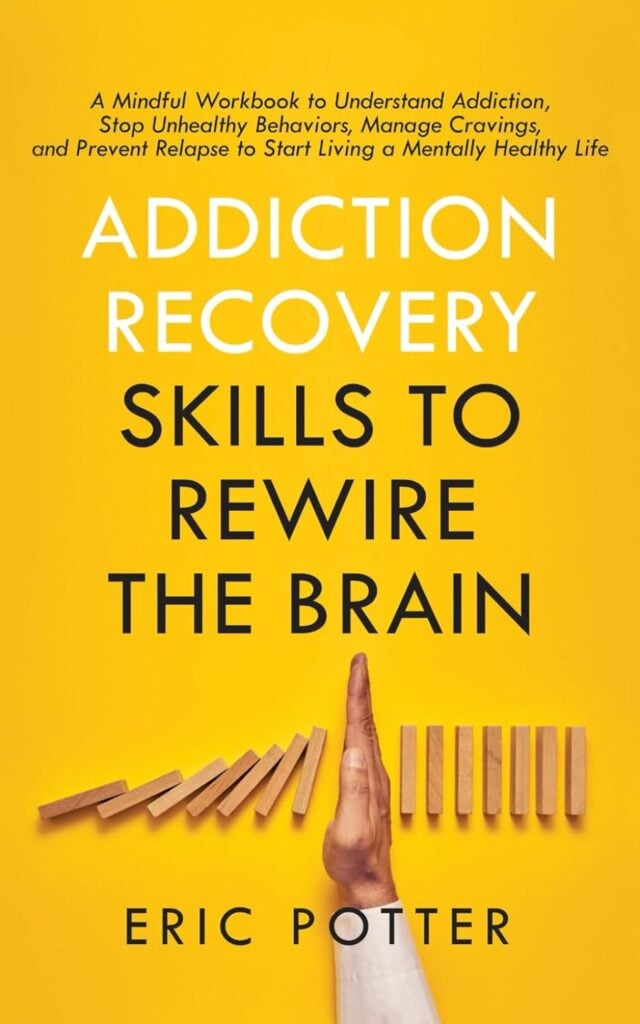
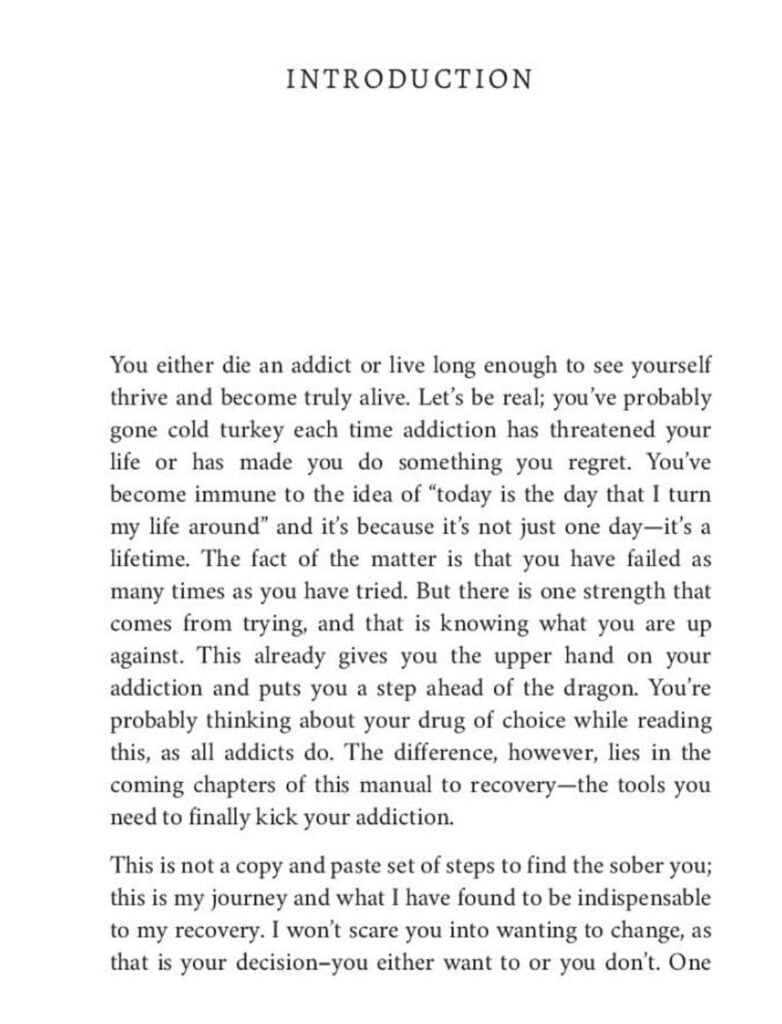

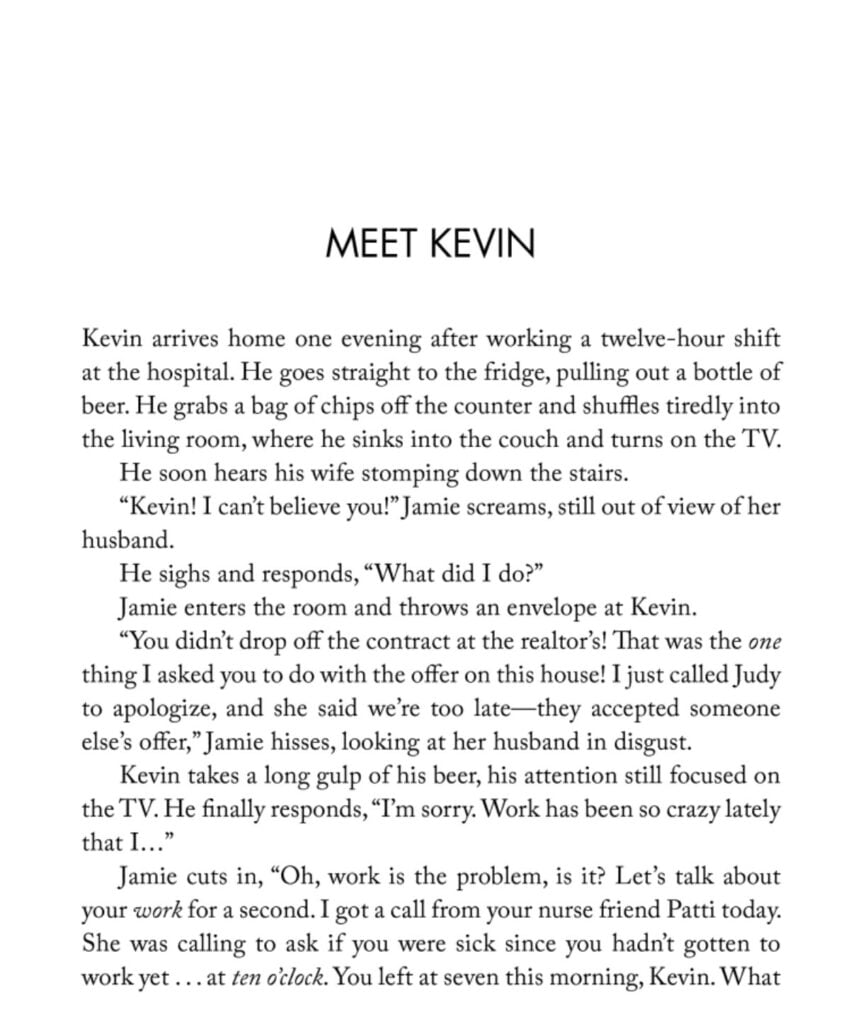
These are very different works about the same topic. The voice and tone make them appealing to different readers.
And that’s not to even mention the analogies and life experience AI can’t draw from you. Even if you spend hours and hours feeding it all the details of your life, it can’t get the nuances correct.
And if you spend that much time on it, you may as well write it yourself because…
You’ll always know it was never really yours.
And so will everyone else. Unless you lie to everyone. Then, you’ll know you’re lying to everyone.
And if Amazon and other retailers end up using the mechanisms that platforms like Instagram uses to indicate if a work is AI or not, you won’t even be able to hide it.
Let’s say you go ahead and use an AI to draft your book. You publish it. People like it. But you’ll know deep down: it wasn’t fully you.
There’s a kind of pride that comes from crafting a novel yourself—from wrestling with chapters that don’t work, from spending weeks perfecting one line, from telling a story only you could tell.
That pride can’t be outsourced. And no one ever looks back fondly at something they cut corners to finish.
Can you imagine sharing your book, having someone love it, having them comment, “wow! That book really moved me. Tell me about writing it,” and you have to reply that you didn’t. AI did.
Just picture the disappointment. Maybe the occasional person will be impressed—with the AI app you used. That it could conjure something that moved them.
But they won’t be impressed by you. And therefore, your writing, book, and maybe even your entire platform, can be discredited in that instant.
You’re no longer the authority. AI is. Because it’s the real author.
There legal and ethical red flags
This is a huge consideration when wondering should you use AI to write a book: most large language models are trained on datasets that include copyrighted materials without the authors’ consent. That means a portion of what you’re using to write your book is built on work taken without permission.
There’s a growing legal and ethical debate over this—and you can read more about that here.
If you care about the rights of authors (including yourself!), it’s worth thinking about what you’re participating in when you rely on AI-generated content wholesale. Your book could be written using stolen work.
This is an ethical problem. Where does your integrity lie when it comes to stolen work? That’s a choice for you to make.
This as a whole creates a ton of legal implications. Some we won’t full see the effects of for years.
Which means…
AI is not future-proof
We don’t know how the legality of AI creation will play out. It would suck if your book sells really well and is helping grow your business significantly but in 5-10 years a lawsuit takes all of that away from you.
It’s not secured. You might not own that copyright. Therefore, if you’re wondering should you use AI to write a book, you can to keep the long-term in mind.
Doing the writing yourself guarantees you keep the copyright no matter the future of AI.
AI still has many kinks to work out
As a sample for this post, I wrote a chapter and tested the feedback and editing mechanisms of AI.
Some of it was solid and helpful. Which is great! But it’s not without errors. It really made me realize those asking should you use AI to write a book have to experience the process of even getting help before going through with it.
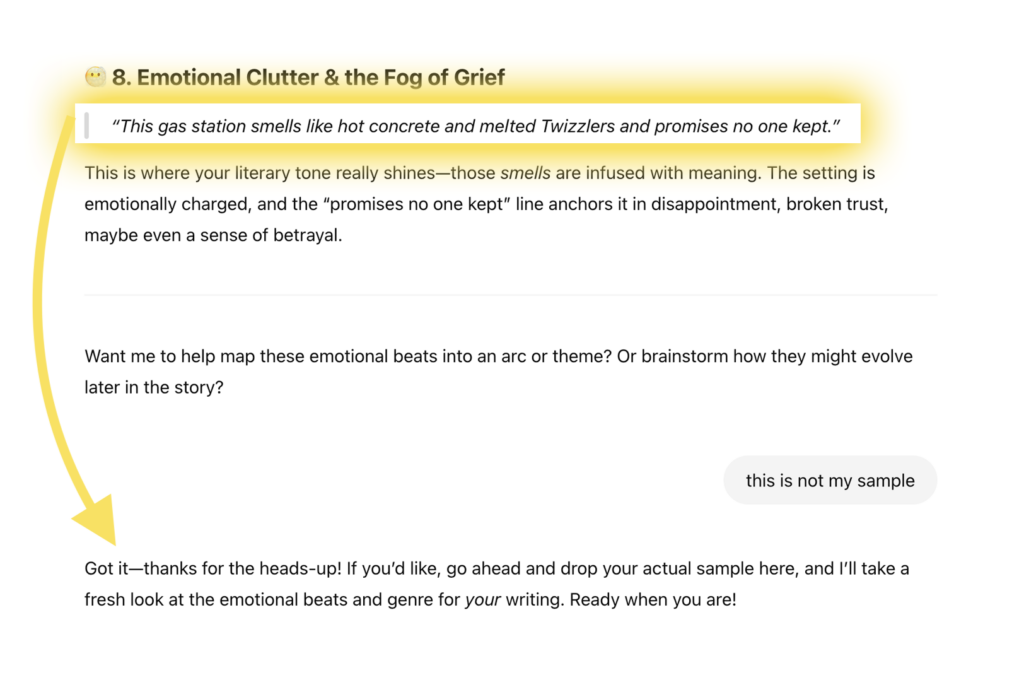
AI still gets confused. It doesn’t retain your writing and can therefore comment on writing in their system (that it’s conjured itself) instead of yours. Which means the edits and help aren’t always helpful.
You sometimes have to re-paste your sample over and over to get the feedback you’re looking for.
And even then, it might not understand what you’re going for.
How to use AI to help with the book process
AI is powerful, and it’s certainly useful. But it’s not in the artful processes. Instead, use it as support during the book writing process.
Idea generation & market fit
AI can be a great brainstorming partner. Whether you’re wondering what genres are trending, trying to test the appeal of a concept, or just looking for a spark of inspiration, tools like ChatGPT and Publishing.ai can give you quick insights.
You can ask for comparisons to existing books, see what tropes are overdone, or get suggestions on how to make your story more unique.
You can try this prompt:
I’d like to write a book in the [your genre] genre. What’s an underserved market in this broader genre as well as underused tropes that would perform well?
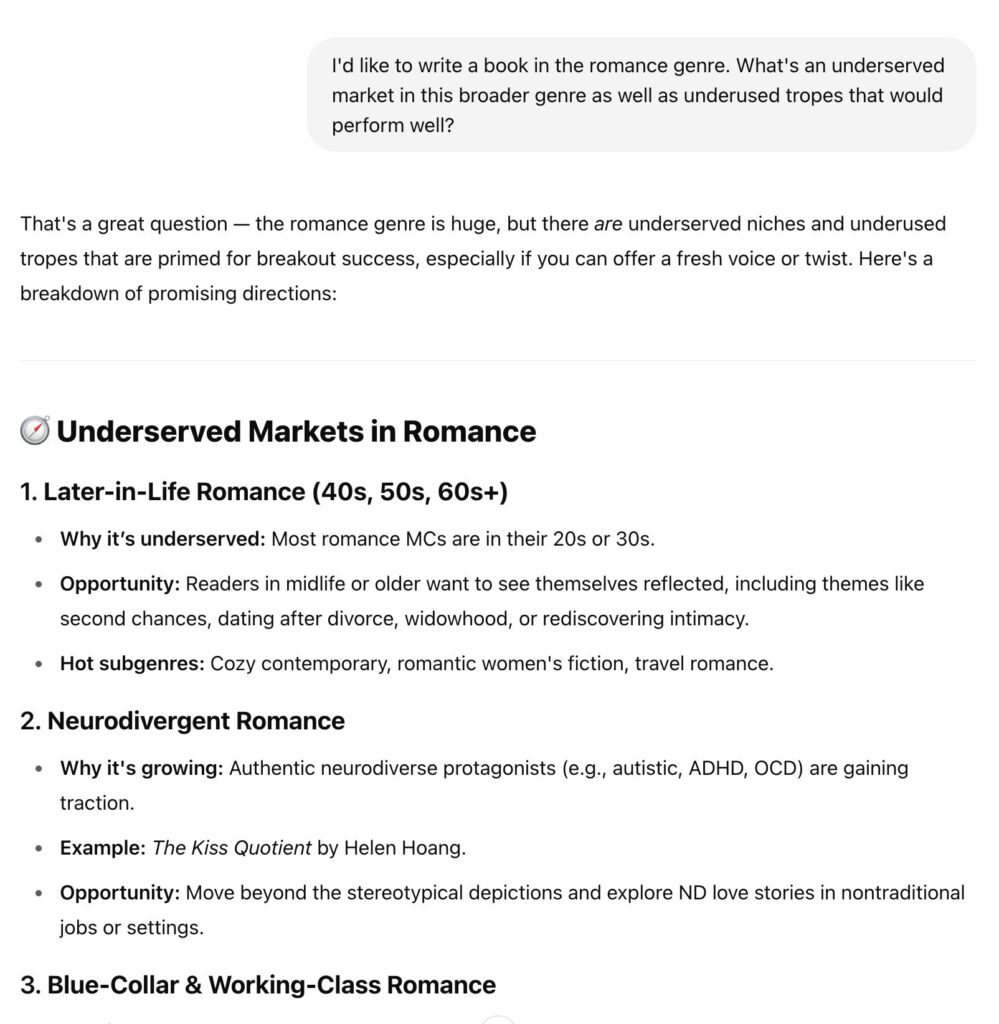
It won’t make your story good, but it might help you refine an idea that’s already in your head, or avoid one that’s already been done to death. You can also take your book idea (premise) and feed it to the AI and ask how you can make it most appealing to a certain audience you want to serve.
It can also help provide you with data on how popular or unpopular certain topics are so you know which book idea to start with (if you have many).
Outlining your book
Staring down a blank page with nothing but a vague concept is intimidating. AI can help here, too. You can use it to sketch a rough structure—major beats, chapter breakdowns, pacing suggestions, or genre-specific expectations.
It’s particularly useful for writers who get stuck in the planning phase.
But remember: you have to fill in the emotional truth, character arcs, and nuance. AI can’t do that for you.
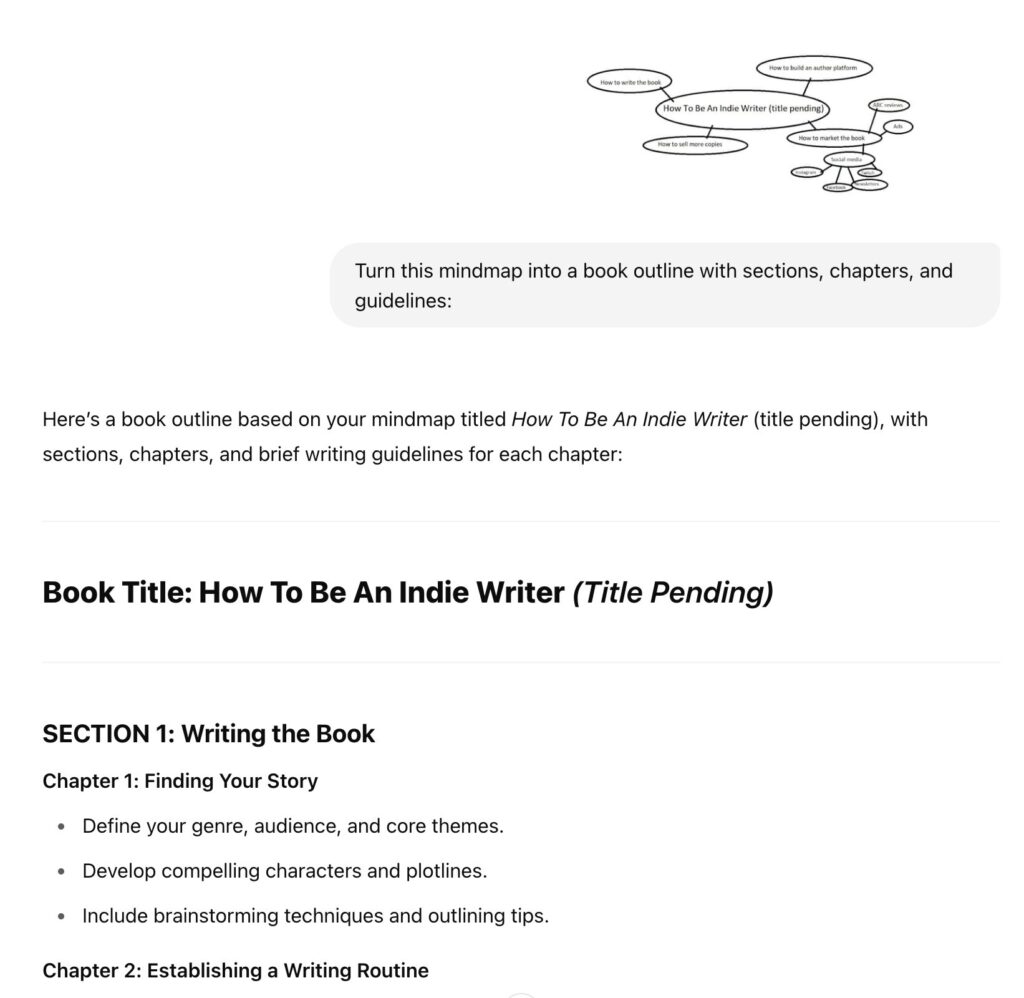
You can even upload your mind map to AI and ask it to create and outline for a book based on your initial ideas and brainstorming.
Make sure to give the AI app a prompt of your goals and purpose for the book. It requires context to form an outline that makes sense for you.
Try this prompt when uploading your mind map:
Turn this mindmap into a book outline with sections, chapters, and guidelines:
*attached your mindmap document, make sure it’s legible*
Researching for accuracy
If your story includes unfamiliar topics, like 18th-century sailing ships, blood spatter patterns, or how a particular visa process works, AI can quickly summarize key points or point you toward where to dig deeper.
It’s faster than wading through forums or Wikipedia rabbit holes. Plus, it’s a huge help when writing nonfiction and you’re in need of research to parallel or verify your own experiences and observations.
If you know a chapter needs some data to back up your claims, AI can find it quickly.
That said, always verify what it tells you, especially for anything technical or factual. AI can hallucinate or deliver oversimplified answers, so treat it like a helpful assistant, not a final authority.
First-round editing
That said, AI does have its place—especially in the editing phase.
Tools like ChatGPT or Claude are great for catching basic grammar errors, inconsistent character names, accidental repetition, or overly passive constructions. They can’t replace a human editor, but they can help you tighten up a messy first draft or get a jump-start on revisions.
Just make sure you specify that you don’t want the AI to rewrite your work. Ask if for a markup of your own writing only.
This will ultimately save you some editing money, but it’s not the final edit.
Think of it as a glorified spellcheck-meets-beta-reader. Just don’t let it drive the creative process.
Competitor analysis
AI tools can also help with competitor analysis—especially if you’re self-publishing or trying to position your book within a specific market.
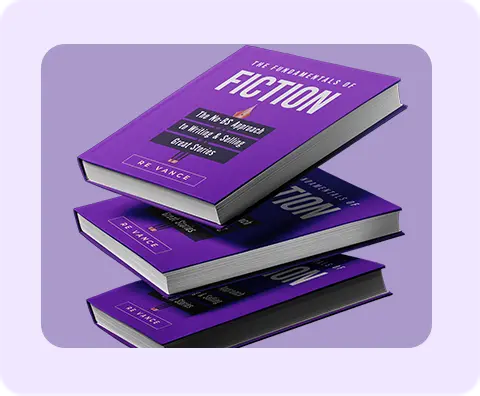
In our Fundamentals of Fiction program, we hone in on the idea of “Tier 1s” in order to help place your book in the market. Before this was a manual process
You’d have to:
- Locate books similar to yours online
- Navigate to their author profile
- Scroll down to “authors like”
- Search the recommended authors to see if they’re like you
- Study their book content and market placement
- Study their marketing tactics
Now, you can ask AI apps to do all of that for you and it’s done quickly, instead of taking hours and days.
Plus, you can use ChatGPT or Publishing.ai to analyze top-selling books in your genre, identify common themes, cover trends, pricing strategies, and even reader complaints in reviews.
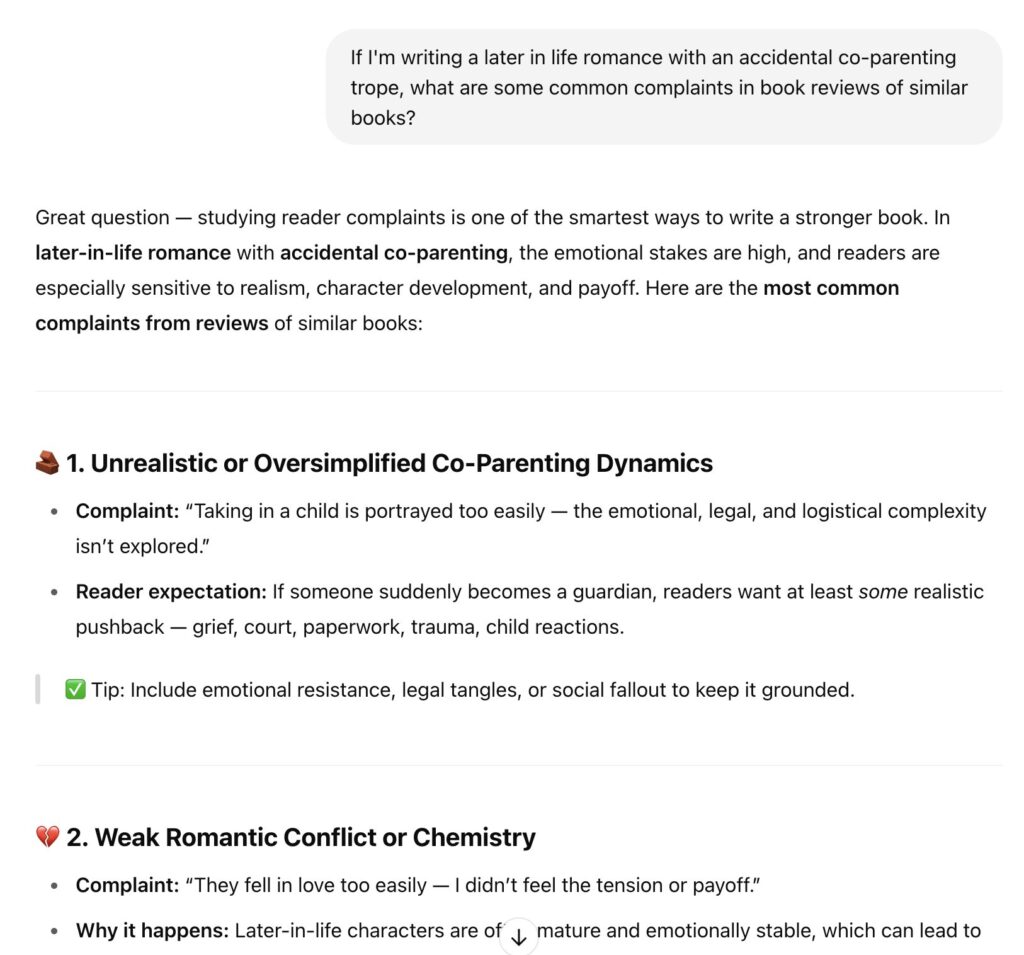
This kind of insight can guide your positioning without copying anyone else’s work. It’s especially useful for understanding what readers are hungry for, and where there might be gaps in the market your book could fill.
If you’re writing to market, this is a huge leap for researching before writing.
AI is a tool. But books aren’t built by tools—they’re built by people. The hard, slow, deeply human act of writing is where your originality comes in. It’s where the magic happens. And no algorithm can do that for you.
So should you use AI to write your book?
No. But let it help you polish the one you already wrote.