



















If you’re new to writing or simply want a bit of a faster route to make money publishing books on Amazon, self-publishing a chapbook may just be your next step.
Long before I ever wrote my first novel, I wrote short stories. This allowed me to focus on one scene at a time and practice completing an entire story, all without feeling overwhelmed at the magnitude of the task.
Writing short works of fiction (and nonfiction) helped equip me to take on my first novel—a 130,000 word fantasy.
But I’m getting ahead of the story (pun intended). We’ve taught over 8,000 authors how to write, publish, and market their books over the last 10 years. If you want to become a successful author, let’s discuss the merits of self-publishing a chapbook.
Self-publishing a chapbook: what’s covered
- What is a chapbook?
- Is it worth publishing a chapbook?
- Self-publishing a chapbook: marketing
- Examples of successfully self-publishing a chapbook
What is a chapbook?
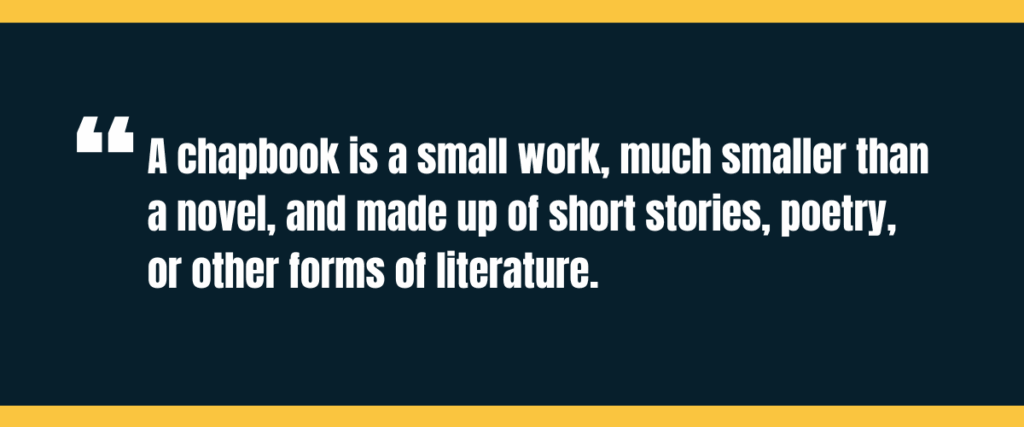
A chapbook is a small work, much smaller than a novel, and made up of short stories, poetry, or other forms of literature.
Chapbooks are said to have emerged as early as the 16th century. They were frequently sold by traveling salesmen. Selling them in brick and mortar stores? Not so much for this type of storytelling!
With such a history, you may wonder why we’re bringing up the merits of self-publishing a chapbook today. But before you become too skeptical, remember that creativity is a skill, and one you can develop through all forms of writing.
A chapbook gives you the creative liberties to try something new without the massive word count or long, intricate plot structure attached.
What is the difference between a zine and a chapbook?
If you’ve heard of chapbooks, you may have heard of zines, which are also small works with simply a different content focus.
While chapbooks tend to stay in the fiction/poetry realm, zines take a more personal approach in content. You may read zines that focus on cultural commentary, personal experience, or topics the major media outlets may not generally focus on.
Is it worth publishing a chapbook?
Self-publishing a chapbook can be a fantastic way to test your writing chops, explore literary conflicts, and finally reach your goal of becoming a published author.
Below are several reasons why self-publishing a chapbook may be for you.
Fitting into a typical word count feels impossible
Let’s say you’ve written an incredible short story and you know it will speak to your target audience. You want to publish and are eager to do so.
But then you discover your word count is too low for you to publish your book as a novel . . . and worse, it’s too high for you to submit the piece to a literary magazine.
Self-publishing a chapbook becomes a viable option: You can stick to your word count and become a published author.
Growing your platform seems impossible
We’ve all heard the old adage, “Writer’s write,” right? Well, it can feel difficult to complete a full-length novel and post on your website blog with regularity, stay active on social media, and continue learning the craft that is writing.
Self-publishing a chapbook allows you to focus on all of the above, all at once. Not only do you get to practice writing every day, but you can quickly share this writing.
Unlike publishing a novel, where you may spend months (or years!) writing and revising, simply due to word count, self-publishing a chapbook has a much shorter turnaround time.
In just days or weeks, you can:
- Write your chapbook
- Publish your chapbook
- Share it on social media
- Publish a snippet to your website blog
Repurposing your chapbook in this way allows you to write, publish, and build your platform simultaneously.
Self-publishing a chapbook: marketing
While there are many pros to writing a chapbook, it’s important to note the differences in marketing tactics before plunging into the publishing world. Publishing a novel follows a specific marketing formula.
Although this formula is fine-tuned for each author’s needs and goals, the structure often focuses on:
- Creating a launch
- Landing major news interviews
- Going on a podcast tour
- Going on a book tour (if possible)
- Online promotion (paid ads, etc.)
While you can certainly include some of the above for your chapbook (and should), marketing a chapbook does take a little bit of a different approach.
If you want to successfully publish your chapbook, it’s important to remember what this type of work is: a short, often intimate piece of writing.
Because of this, you will want to pivot your marketing efforts to best encompass your story and what you are trying to communicate to your readers.
Below are three ways you can take novel-marketing efforts and change the format just a bit to best fit your chapbook marketing needs.
Focus on in-person events
While authors of full-length novels often spend most of their marketing efforts online, effectively self-publishing a chapbook means focusing on in-person events.
By nature, chapbooks are more personal, relationally-driven, and still follow the mindset of the 16th century: direct to consumer.
Attending library events, readings, or reaching out to small, indie stores is a great way to get your chapbook into the hands of your target audience.
You can build up a close-knit reading community who then subscribes to your newsletter, eager to read your next chapbook.
Highlight personal expression and reader experience
Chapbooks are highly personal. By nature, they make space for authors to create an intimate reader experience.
This type of work is short, intimate, and even its publication style reflects creative expression. When you decide to try self-publish a chapbook, you will likely engage in saddle-stitch binding.
This type of binding even feels personal in the readers’ hands. When marketing, showcase the personal expression readers will find and the intimate experience of reading such a work.
Emphasize the lower price point
Novels have a higher word count (80-100 thousands words) and therefore cost more to produce. Chapbooks, on the other hand, are shorter, soft cover, and more of a pamphlet than a book.
This lowers the price point, making the reading experience accessible to an even larger readership. When marketing, focus on this accessibility and how it empowers readers everywhere to join together in an intimate reading experience.
Examples of successfully self-publishing a chapbook
Just to show you it is indeed possible to succeed in self-publishing a chapbook, here is a list of notable mentions. We’ll take you on a brief history, jumping across centuries so you can see the enduring legacy of chapbooks throughout time.
Another Way of Coming Home
Chris Helvey’s 24-page chapbook, “Steeps readers in the rich beauty of the Appalachian land while reminding them that no man is safe from the justice of the mountains.”
In these brief, 24 pages, readers engage with the story through Harley Upton. A drug addict and on the run after committing a crime, this protagonist’s point of view shapes the story.
Of Love and Water
Elizabeth Burton shares a story of renewal through her protagonist, Grace. Grace left Kentucky to and traveled all the way to western China to teach English.
Just 32 pages long, this is a compelling and intricate example of self-publishing a chapbook successfully.
Wolfstein
Also known as The Mysterious Bandit, this successful chapbook was published in 1822. Yes, we’re going back a few centuries!
It starts with a gripping sentence. “Red thunderclouds, borne on the wings of the midnight whirlwind, floated at intervals athwart the sky…”
Alice of Old Vincennes
Written by Maurice Thompson, this chapbook takes place during the Revolutionary War. A bestseller said to have been the tenth highest selling book in the entire United States in 1900, you may want to give it a read for your own inspiration.
The Hundredth Story
Moving up 30 years to 1930, A. E. Coppard made a name for chapbooks, but in particular, this one. A prolific writer, this was just one of several chapbooks and countess works.
A. E. Coppard goes to show you do not need to restrict yourself to only engaging in self-publishing a chapbook or a novel. You can do both. You can throw in another genre altogether.
You can simply be a creative writer, successfully, across genres. Give your best work, publish, and see what happens.
Self-publishing a chapbook: take your next step
Remember how I said I wrote copious amounts of shorter stories before writing my first, full-length novel? Writing a chapbook is one way to equip you to do. It takes the pressure of and this frees up your creative abilities.
Publishing a chapbook tackles multiple writing needs all at once:
- Helps you write daily
- Teaches you how to publish
- Engages an eager audience
- Builds up your writing portfolio
- Gets your name out there
- Teaches you how to craft a tight story
- Aids you in crafting compelling characters
I mean seriously, the list could go on… But you get the point. You can be a successful author. Just start where you are and see where your efforts take you. We believe in you.
Now that you understand all about self-publishing a chapbook, take your next step by using our free resource below!