
















If you’re anything like me, then trying something before you buy it is one of the best ways to get me to lay down my hard-earned dollars. Better yet, give me the pros and cons from someone who has done more than just tested a product, and you’ve got me listening.
This is how I see book reviews. I have tons of books on my shelves that I made it through a chapter or two, then plopped them right back next to other books from my past that will likely never see the light of day. If I’d taken the time to read a book review first, I could have saved some extra $$ and shelf space.
A good book review takes the guesswork out of the question, “Is this book for me?”
The review doesn’t have to be a bad one for me not to read the book. It could just mean that I’ve already read something similar, or the author’s writing style is not a good fit for me. Whatever the case, a good book review is valuable to any reader who is short on time but longs for something interesting to occupy their minds.
Learning how to write a book review is useful for many reasons. Whether you want to review books professionally for others or start a blog or newsletter, knowing how to share your thoughts in a way that’s helpful will offer value to readers and create trust in your assessments.
Also, if you’re a beta reader or on someone’s launch team and have no idea what to say in your review, learning how to write a book review can help you feel like you’re fulfilling your commitment and helping sell an author’s book.
Let’s take a look at those uses, the difference in types of book reviews, and how to write a book review that will fulfill your purpose for writing one.
Here’s what we’ll cover:
Types of book reviews: academic, personal, retail
Whether you’re writing a book review for a professor, a personal blog, or in a reader group, there are differences in how each type of book review should be written.
Academic book reviews have a specific structure and format that the writer needs to follow to fulfill the assignment. The standard format is listed below, but instructors often set the requirements for the assignment based on the syllabus or assigned reading.
Personal book reviews are often more exciting for the writer, since they are generally written for enjoyment for a secondary purpose like a blog, email newsletter, social media page or group, or a video shared on a platform like YouTube.
Personal book review structures are dedicated by the writer rather than an accepted standard.
Book reviews on a retail website benefit potential book buyers who are trying to decide whether to buy the book or not, and use the review to help them make a decision. These can include casual reviews from buyers to more professional reviews. Many beta readers and launch team members can fall on either end of the review spectrum.
What makes for a good book review?
A good book review is not for the reviewer to display all they know of the literary world and talk down about an author. It’s to showcase the nuances of a book so the right readers can choose to read for themselves. And if the book is truly poorly written, a book review can serve as a means to uncover the reasons it didn’t deliver well, and even showcase how the author could have done better.
Book reviews are highly subjective because everyone’s taste differs. What some people love about a book, others can’t stand.
This much is evident if you’ve spent any time in reader groups, like this Fantasy Faction group.
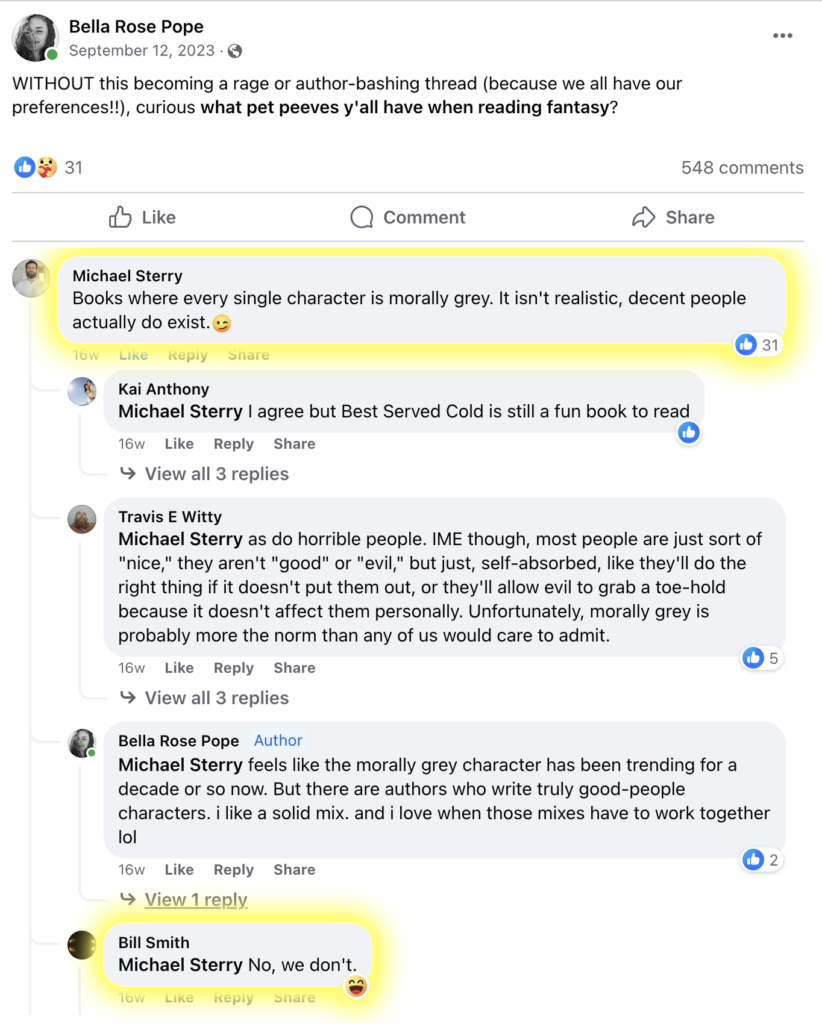
Personal opinions often affect the way we read a book, and that’s why a good book review ensures the reader of the review understands the writer’s worldview and perspective. Someone who doesn’t think there are any actually good people in the world will interpret a book filled with morally gray characters completely differently than someone who believes most people are good.
How to write a book review: formats and structure
If you’re learning how to write a book review for academic purposes, yes, there is a format that’s typically preferred, but there’s more than one way to do it right. If you’re writing a book review for more personal reasons, there’s less structure, but elements you want to make sure you include.
Academic book review format
Your instructor may give you the format they’d prefer for you to use, but if you’re learning how to write a book review for academic purposes, you’ll have four main components.
Introduction:
This is where you’ll state the book, author, genre, and possibly the book length. You’ll also give a short synopsis of what the book is about, without too many details or spoilers. This helps the reader (your instructor) understand the overall makeup of the book so they can move through your review with a sense of the piece.
Book contents or outline:
If the book is separated into parts, beats, or has any other structural elements that are relevant, here’s a good place to mention them. You’ll also go into more detail about the contents of the book, including the elements of fiction if it’s that type of book, or what’s covered throughout the book if it’s nonfiction.
This part can include details that may be spoilers, and hone in on aspects you’ll be reviewing further in the next section. If you’re going to highlight an author’s skill set in character development, for example, focus on outlining that journey in this section.
Opinion/argument/takeaway:
Many academic book reviews are aimed at a purpose. Sometimes it’s persuasive, and your job is to convince the reader to buy the book. Other times, it’s to demonstrate your ability to dive into a specific nuance of the content. No matter the purpose, here is where you’ll focus on making it known.
You’ll make your opinion clear and use specifics from the book to back it up.
If you’re making a case about a character’s development, you’ll want to cite pages, quotes, and bring up plot points and the character’s actions that support your opinion or argument. Or, you can use this space to focus on the book’s main takeaway.
This section is more of the nitty-gritty of the book and will contain spoilers if it’s fiction and have content from within if it’s nonfiction.
Conclusion:
This section of the review should be short and contain a restatement of your overall opinion of the book, along with a summary of a few main points that support your opinion.
Personal book review structure
There’s a lot of wiggle room when it comes to learning how to write a book review for your blog, friends, or just to post on the book’s sales page online. These don’t have formats, necessarily, but you do want to touch on a few key elements to make a well-rounded review.
- Your rating out of 5 stars
- Whether or not the review contains spoilers
- A brief synopsis
- Whether or not you’re the book’s target audience
- If you read books like this often or not
- What you enjoyed most and why
- What you felt was lacking
- Things you were surprised by
- Your favorite character/s and why
- Things you’re looking forward to in the next (if it’s a series)
- If you would recommend the book to people, and what type of person
Remember the purpose of the book review if it’s personal. Are you trying to get someone to buy the book? Are you highlighting a specific talent of the author you want others to see? Or are you supporting a new author by leaving a review that will help them sell more copies? All of that will dictate the structure and length of your book review.
If this is something you’ll continue to do often, you’ll fall into your own rhythm and end up creating your own sort of “structure” for the book review.
Note: When writing book reviews for professional websites, I found that the requirements can fall anywhere between the stricter rules found in academia and the more relaxed rules of personal blogs. It just depends on the site. Before writing a review, make sure you are clear on what’s expected.
Examples of well-written book reviews to learn from
Learning how to write a book review is more intuitive than you think. As long as you’re providing “evidence” to back up your opinion on the book, it’s a good review! Just saying whether it was good or bad offers no insight for those deciding whether or not to purchase the book.
Learning from examples will help you more than any book review format or framework. Let’s take a closer look at the book review types below.
Book review example 1 -blog post review
Many book review bloggers nowadays take to YouTube, Instagram, and even TikTok to share their thoughts and grow their platform. But there are still book bloggers out there who serve as a good example of how to write a book review.
This post is an example of a round-up style book review, where they cover various books, their thoughts, and whether or not they’d recommend them.
Book review example 2 – comment in group
This demonstrates how to write a book review in a short, concise manner that will answer someone’s question in a Facebook group, or even just in a text to friends.
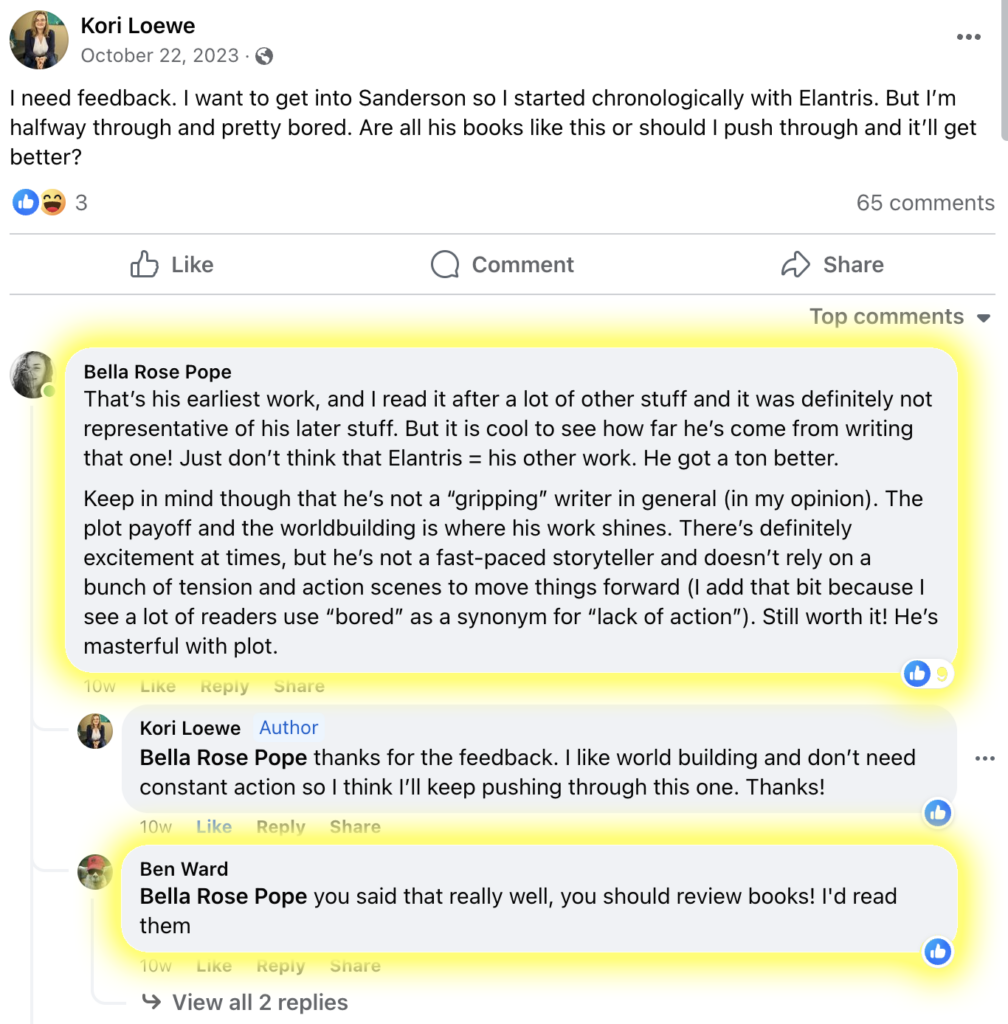
That’s his earliest work, and I read it after a lot of other stuff and it was definitely not representative of his later stuff. But it is cool to see how far he’s come from writing that one! Just don’t think that Elantris = his other work. He got a ton better.
Keep in mind though that he’s not a “gripping” writer in general (in my opinion). The plot payoff and the worldbuilding is where his work shines. There’s definitely excitement at times, but he’s not a fast-paced storyteller and doesn’t rely on a bunch of tension and action scenes to move things forward (I add that bit because I see a lot of readers use “bored” as a synonym for “lack of action”). Still worth it! He’s masterful with plot.
The highlighted response to the poster’s original question talks about the book, the author’s strengths, as well as touching on why a feeling of boredom can happen. Sometimes learning how to write a book review is also about seeing what most people are saying is wrong with the book and covering those components in your review.
Book review example 3 – fiction Amazon review
I purchase books from different companies online, but I’ve found Amazon reviews to be the most helpful. The platform has a strong focus on customer reviews, which has saved me many times from making a poor purchase decision.
This is a review of a very popular book, where the reviewer gave 3 stars. Whether you’re writing about a book you like or don’t like, it’s important to know how to write a book review in a way that will help the reader make an informed decision. This reviewer did a good job of backing up her opinions with information from the book, without spoiling it.
“The first half of the book was challenging, it was a painfully slow and uneventful read. The writing is easy to follow but heavy on the internal dialogue and narration. There would be mere snippets of dialogue between characters, never a full-blown conversation. We mainly follow the main character, Feyre, as she’s lounging around an estate. Her days consists of walking around, painting, having dinner, and checking out the forest. The plot was pretty much dead until about 250 pages.
Due to the lack of interaction and dialogue, and Feyre just milling around, you don’t learn anything about… anything. I had no idea what the plot was, whatever was revealed was done so only in riddle or mystery. I can do with little world-building as long as the story thrives on other points, but this just fell flat all-around.
Tamlin, the love interest, is there… I liked him fine but felt that I learned nothing about him or his personality. It’s not an insta-love, per se, but there should’ve been more build-up and interaction, I don’t see where the physical attraction or emotional connection happened. Feyre and Tamlin were basically just skirting around each other, hardly having a meaningful conversation, so the sudden want for one another felt out of the blue.
Past the midpoint is where the story starts to pick up. There’s an info dump to catch the reader up on the plotline, the setting changes, and it generally becomes much more interesting and fun to follow along. It practically turned into a whole other book. Frankly, I was glad to get to the finish line and won’t be reading the rest of the series.“
Book review example 4 – nonfiction Amazon review
Nonfiction books typically serve a specific purpose. They’re teaching, informing, arguing, or enlightening in various ways. So when learning how to write a book review for nonfiction books, it’s vital to focus on whether or not there’s a solution, how it works, and a few of the other details of the book.
This reviewer did a good job of keeping it condensed, but voiced a reality of the book and rated it 4 stars.
“The book seems to be intended for people that are looking for a set of practical guidelines towards understanding and limiting distractions. As such, it does a rather fine job at conveying a pretty thorough rule set for an indistractable life
The only thing that the book is missing is some ‘poetry’ or something to keep it interesting at times and also a structure that it would stick to. Although the book introduces the concept of indestractability on 3 planes : personal, home, work, it seems to not be keen on respecting the structure near the end of thr book.
Overall, I do recommend the book to anyone that is struggling with attention span and I give big kudos to the author.”
Book review example 5 – Facebook post
You can keep your writing short and still know how to write a book review that gets the job done. This is what someone wrote about a popular book and their take on it. Notice how they specifically tell who this book is for and who would most enjoy it.
“
Legends and Lattes is a charming, lower key story that us fantasy lovers can enjoy without intense pressure on the hero to save the world. I don’t necessarily want to read about assassins on a mission gone wrong, sidekick-eating ogres or blood and gore befouling someone’s armour while eating breakfast. It was an awesome book to pick-up and casually read while slipping into a classic high-fantasy world with all of the familiar elements of magic, mystical creatures and heroes (my other current read, The Shadow of the Gods, is a little intense). I’m sad that it’s over and hope that Baldree churns out a few more.”

 Legends and Lattes is a charming, lower key story that us fantasy lovers can enjoy without intense pressure on the hero to save the world. I don’t necessarily want to read about assassins on a mission gone wrong, sidekick-eating ogres or blood and gore befouling someone’s armour while eating breakfast. It was an awesome book to pick-up and casually read while slipping into a classic high-fantasy world with all of the familiar elements of magic, mystical creatures and heroes (my other current read, The Shadow of the Gods, is a little intense). I’m sad that it’s over and hope that Baldree churns out a few more.”
Notably, though, they did leave out an overall rating, which would make this a great book review. But that’s okay. As you can see, you can learn how to write a book review and get the point across without a full rating.
Book review example 6 – Facebook post
This review is short, to the point, and covers the criteria we talked about above. Because it’s shorter, you won’t find too many details, but that’s because it’s spoiler-free. This was a post in a Facebook group and can serve as a great example of how to write a book review that doesn’t take a lot of your time, or what you can write if you’re on a launch team.
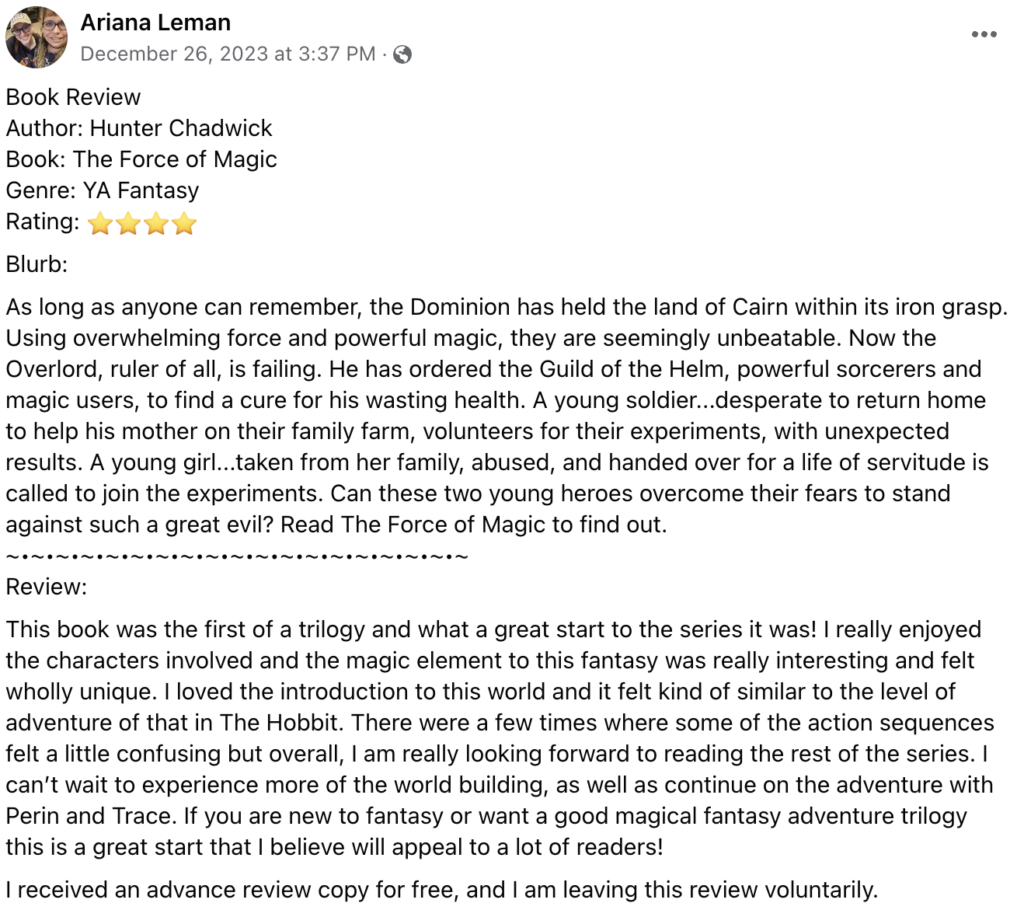
“Book Review
Author: Hunter Chadwick
Book: The Force of Magic
Genre: YA Fantasy
Rating:
Blurb:
As long as anyone can remember, the Dominion has held the land of Cairn within its iron grasp. Using overwhelming force and powerful magic, they are seemingly unbeatable. Now the Overlord, ruler of all, is failing. He has ordered the Guild of the Helm, powerful sorcerers and magic users, to find a cure for his wasting health.
A young soldier…desperate to return home to help his mother on their family farm, volunteers for their experiments, with unexpected results. A young girl…taken from her family, abused, and handed over for a life of servitude is called to join the experiments. Can these two young heroes overcome their fears to stand against such a great evil? Read The Force of Magic to find out.
~•~•~•~•~•~•~•~•~•~•~•~•~•~•~•~•~•~•~
Review:
This book was the first of a trilogy and what a great start to the series it was! I really enjoyed the characters involved and the magic element to this fantasy was really interesting and felt wholly unique. I loved the introduction to this world and it felt kind of similar to the level of adventure of that in The Hobbit.
There were a few times where some of the action sequences felt a little confusing but overall, I am really looking forward to reading the rest of the series. I can’t wait to experience more of the world building, as well as continue on the adventure with Perin and Trace. If you are new to fantasy or want a good magical fantasy adventure trilogy this is a great start that I believe will appeal to a lot of readers!
I received an advance review copy for free, and I am leaving this review voluntarily.”

Book review example 7 – blog post review
This example of how to write a book review is done by a single-person-run website. She takes various books and does a write-up on what she liked, didn’t, and so on.
You can read this full review here, but there’s also a sample below.
“And I need to take a moment for Ravel, the boy who is so vicious and monstrous and spilling over with uncanny and inhuman claws and fangs–but yet is an absolute sweetheart deep down inside. The raw way he cherished Everline had me on the floor. Every time the book described Ravel, I was just [clenches fist] so enraptured. He is meant to be a mindless monster and Everline is confused why he seems so…human but yet not human. Their hatred for each other is so palpable, and the way they fall in love while still distrusting each other is addictive to read. It’s enemies-to-lovers the way I crave: claws and teeth and generational hatred and monstrous love.“
Part of learning how to write a book review is developing self-awareness. Although book reviews are subjective, it’s important to have a full grasp of why you feel the way you do about a book, so that you can articulate that to the reader. Without clarity, your review can come across as muddy or incoherent. When writing reviews, how you view the world matters. Don’t be afraid to express your viewpoint to the reader.
Are you an author interested in self-publishing? Try our Publishing Path Assessment to get more clarity on your journey.
Note: The original article by Bella Rose Emmorey has been updated.