













Selling books on Amazon has become one of the most accessible ways for authors and entrepreneurs to earn money online. But how much can you make selling books on Amazon? Should you quit your day job?
Maybe! It’s definitely possible, as we’ve learned teaching over 8,000 students to write, publish, and market books over the last 10 years, but it does take some work, and the right knowledge implemented.
Whether you’re a fiction writer or a nonfiction expert, Amazon offers a global marketplace where your words can translate into income. But how much can you actually make? Because we’ll be honest…there are plenty of authors selling on Amazon making nothing. There are also authors earning such substantial incomes they’ve more than doubled their old salaries.
Let’s break it down into two main methods—fiction and nonfiction—and look at the earnings potential in both.
Here’s what we’ll cover:
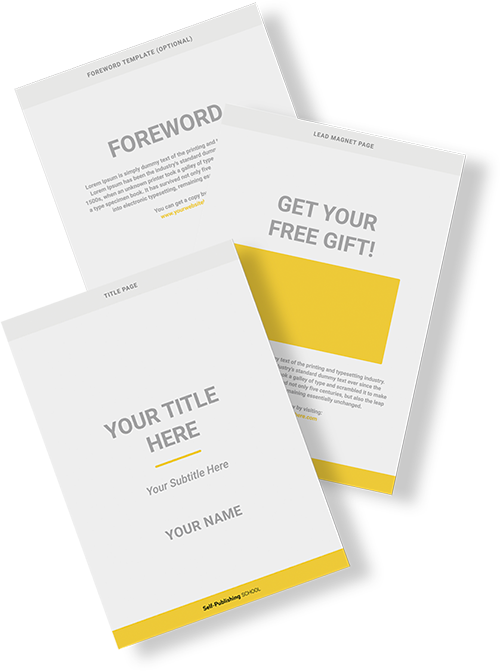

Book Outline Generator
Choose your Fiction or Nonfiction book type below to get your free chapter by chapter outline!
Book Outline Generator
Enter your details below and get your pre-formatted outline in your inbox and start writing today!
CONGRATULATIONS
Thanks for submitting! Check your email for your book outline template.
In the meantime, check out our Book Outline Challenge.
How much can you make selling books on Amazon with Fiction
Fiction books thrive on Amazon, especially in popular genres like romance, mystery, fantasy, and science fiction (and most genre fiction in general). While the competition is fierce, the opportunities are real for authors who understand their audience and write consistently.
Not to mention those who know how to navigate their Tier 1s and use the right categories and keywords (some basics we cover in our course Fundamentals of Fiction).
There are a couple different ways fiction authors can earn on Amazon. So if you’re wondering how much can you make selling books on Amazon, here’s the data for physical books and Kindle Unlimited (KU).
Physical book sales
Physical books, often sold through Amazon’s print-on-demand service (KDP Print), can bring in a decent income, especially for longer series or niche subgenres.
Here’s how it breaks down:
- Royalties: For paperbacks, you typically earn 60% of the list price minus printing costs.
- Example: If you price your book at $14.99 and printing costs $4.25, your royalty is around $4.74 per sale. You take the list price, take 60% from that, and take the printing cost from that rate to get your earnings.
- Monthly sales potential: New fiction authors may sell 50–200 copies a month, while midlist authors can reach 1,000+ sales monthly.
This means some fiction writers earn a few hundred dollars a month, while successful authors can bring in $5,000–$20,000+ monthly just from paperback sales alone—especially if they have a backlist of multiple books.
Let’s take a look at an example of an urban fantasy author’s total earnings over time, as he made over $500,000 (after converting to US Dollars) since October 2022.

As you can see below, this author has made a significant amount of income in total. This is since 2022.
This author has sold (or given away, including “free”) over 167,311 books. This does not include KENP Pages, which is how Amazon counts KU pages read (more on this below). Of this number, only 41,747 have been physical copies—hardcovers and paperbacks.
NOTE: For this article, all money values have been converted from pounds to dollars.

Therefore, this urban fantasy author sells 24% of his books in physical form.
Again, this does not include Kindle Unlimited data. Meaning when it comes to number of readers, this percentage is even smaller.
So while you might think authors are selling physical books in bulk on Amazon, it’s not quite the reality. Only a small fraction of readers are purchasing actual books. The rest are reading from digital copies—including ebooks, audiobooks, and through Kindle Unlimited.
Digital copies (ebooks, audiobooks)
It’s advisable for authors to think about digital copies. If you want to know how much can you make selling books on Amazon, digital has to be included. With devices like Kindles and tablets and smart phones, readers would rather collect a digital library than a physical one.
Ebooks are one of the easiest and most profitable formats to sell, especially for fiction writers. With no printing or shipping costs, your profit margins are higher—and readers often buy them on impulse, especially at lower price points.
- Royalties: You earn 70% of the list price for ebooks priced between $2.99 and $9.99 (outside that range, you earn 35%).
- Example: If your ebook is $8.99, you’ll earn about $4.80 per sale.
- Advantages: Instant delivery, lower reader resistance, and global reach. The faster someone can take action to buy-and-receive, the higher the conversion rate. This is why Amazon has such fast shipping as well. It’s even faster for digital products. Instant.
A strong fiction ebook can generate $500–$10,000+ per month, depending on your marketing, reviews, series length, and keyword targeting. And since digital copies never go out of stock, your book can keep earning 24/7.
Take that same author as an example below.
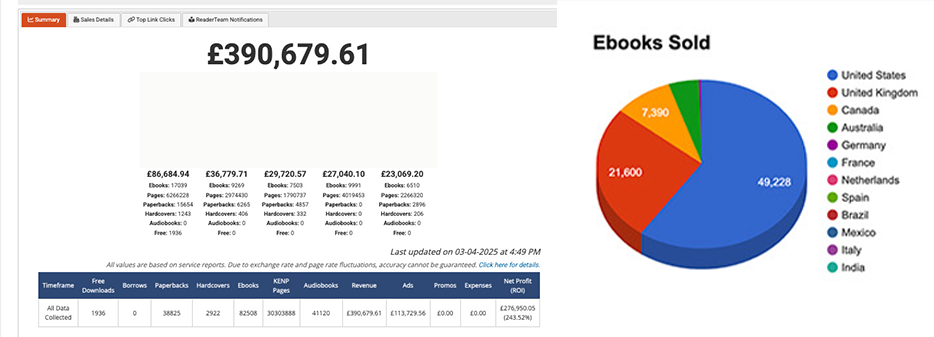
Of this authors total books sold (not counting KU data), he sold 74% in digital copies:
49% ebooks
25% audiobooks
You might be surprised by how much audiobooks contributes to how much you can make selling books on Amazon. Don’t forget to learn how to make an audiobook so you can earn that income! Especially because he sold just as many audiobooks as he did physical copies.
Kindle unlimited (KU)
Kindle Unlimited is Amazon’s subscription service, and it can be a goldmine for fiction authors, particularly in bingeable genres like romance or fantasy series.
- Royalties: You’re paid per page read. The payout per page varies but averages around $0.004 to $0.005, but this changes depending on the month (though not by much) and it’s called KENP (Kindle Edition Normalized Pages).
- Example: If your book is 300 pages and 1,000 readers complete it, that’s around $1,200–$1,500.
- Strategy tip: The more books you publish and the more engaging your stories are, the more you earn through page reads. You can also write your books for read through, which is a whole strategy involving using cliffhangers, chapter-ends, and foreshadowing to pull readers through your book.
Many authors earn more through KU than direct sales, and some KU-exclusive authors make six figures annually just from page reads. These authors have many books. It’s sort of the whole premise of the popular author Facebook group 20booksto50k. The idea is the more you publish, the more readers have to read.
Amazon really helps authors this way by making the next book really easy to start right after you finish another.
It makes logical sense that the more books you have, the more they’ll read your book. If you want to test something like this for yourself, check out the book profit calculator below to see at what point you can start earning a significant income, given a growing reader base:
Book Profit Calculator
Enter Your Information Below To Calculate
Your Potential Book Sales
Enter your details below to see your personalized book profit estimate!
CONGRATULATIONS
Here's What You'd Earn:
Your profit per book: $20
In 3 months, you'll make: $90,000
In 6 months, you'll make: $180,000
In 1 year, you'll make: $365,000

So what is the total breakdown in where this author makes the most money selling books on Amazon? Here’s how the earnings shakes out:
Physical copies – 29% – $143,600.88
Paperbacks: $136,015.96
Hardcover: $7,584.92
Digital copies – 47% – $228,028.99
Ebooks – $137,008.90
Audiobooks – $91,020.09
Kindle Unlimited – 24% – $116,719.65
Total Digital (with KU) – 71% – $344,748.63
How much can you make selling books on Amazon with Nonfiction
Nonfiction books often serve a dual purpose: making direct sales and positioning the author as an expert. This opens the door to much more than just royalty income. If you’re wondering how much can you make selling books on Amazon but you want to write nonfiction, you can still make plenty.
But it’ll be beyond the book sales themselves.
Book sales (including KU)
Nonfiction tends to sell well if it solves a specific problem or targets a clear audience (e.g., productivity, parenting, personal finance). If you can get that bestseller banner and have your book ranking high in searches, you can bank some serious money.
Buy if you’re wondering how much can you make selling books on Amazon with nonfiction, here are some breakdowns:
- Royalties: Same structure as fiction—60% for paperbacks (minus printing), and 70% or 35% for Kindle eBooks depending on price and territory.
- Kindle Unlimited: Some nonfiction authors enroll in KU, but performance here can be hit or miss depending on the topic. Most people who read nonfiction like to have the book itself (unless it’s a topic they’re embarrassed for people to see them reading).
- Earnings range: A well-targeted nonfiction book might bring in $500–$5,000 per month, especially if it gains traction with keyword optimization and niche relevance. If it hits that Amazon Bestseller list, it can go a long way.
What makes nonfiction especially powerful is its ability to bring in leads and convert them into customers beyond the book.
Book-as-a-business-card
This is where nonfiction can massively outperform fiction in long-term income.
Many authors use their book as a lead generator for coaching, consulting, courses, or speaking gigs. It positions them as an authority and helps build trust with potential clients.
When you go this route, you very strategically choose a lead magnet to add to the front of your book—a way for people to consume your content, sign up for your email list, and continue receiving information about your products or services.
Here’s what this might look like, based on one of our student’s books:

- Revenue potential: If a $3.99 ebook leads to a $2,000 coaching client, the return on investment is exponential. Even if you spend on ads to promote your book.
- Strategy tip: Include a free resource in the book that links to your website, building your email list and creating a funnel, as noted above.
Some nonfiction authors use Amazon primarily as a credibility platform, then make six or seven figures annually from the backend of their business.
There are two primary ways to earn beyond the book: products or services (or a combination, of course).
For products:
For many authors, they have a product they can send readers to in order to get more. This can be anything from a course to a physical product—like if your book is about organization and you have a line of organizers sold through retailers (like Amazon).
The more profitable product will almost always be a course based on your book. If they liked learning in a book medium and your course is more effective, you can charge significantly more for a new format (and extended content).

For services:
You can also use a book to get clients for your services, whether that’s to coach or to perform a function, like the author below. She’s been writing nonfiction books for 30 years and discovered the best path was to create upsells to services.

Here are a few ideas for what type of services you can offer from your book:
- Coaching or consulting
- Speaking engagements & workshops
- Memberships or communities
- Done-For-You Services
- Workbooks & companion guides
- Group programs or masterminds
- Certification or licensing
- Freelance or contract work
- Affiliate marketing & partnerships
- Corporate or organizational packages
If you’re asking how much can you make selling books on Amazon, maybe the question you should be asking is how can I sell beyond Amazon in order to create more income.
Book Outline Generator
Choose your Fiction or Nonfiction book type below to get your free chapter by chapter outline!
Book Outline Generator
Enter your details below and get your pre-formatted outline in your inbox and start writing today!
CONGRATULATIONS
Thanks for submitting! Check your email for your book outline template.
In the meantime, check out our Book Outline Challenge.