

















Do you want to get help writing a book? Maybe you have a story idea or have recently started on your author journey.
Getting bitten by the writing bug can be a mix of emotions. There’s the euphoria of actually writing a book and having your name on something mixed with the undercurrent of self-doubt that sneaks in unannounced.
What if I’m not any good?
What if no one likes it?
What if I don’t sell any books?
Don’t beat yourself up. These questions are common, whether this is your first book or your 50th.
When I started writing fiction over a decade ago, my biggest challenge was getting the story that I had in my head to make sense on the page.
For me, it was like trying to draw a three-dimensional masterpiece but ending up with stick figures on the page. My ambition was always overshadowed by my inexperience. I hadn’t written enough, read enough, or understood enough about the art of storytelling to bring my stories to life.
Many writers struggle at the beginning of their author journey. Sometimes you need a better grasp of the foundational elements of storytelling. Other times, you may need a few tweaks to how you approach the story to get it to shine. Or, maybe, you’re just gripped by fear and need a positive boost of confidence to get you moving in the right direction.
Whatever you need to become a better storyteller, there’s likely a coach, course, writing group, or editor who can help.
In this article, we’ll take a closer look at the options available to get help writing a book and which one(s) you should consider.
Let’s discuss:


Book Outline Generator
Choose your Fiction or Nonfiction book type below to get your free chapter by chapter outline!
Book Outline Generator
Enter your details below and get your pre-formatted outline in your inbox and start writing today!
CONGRATULATIONS
Thanks for submitting! Check your email for your book outline template.
In the meantime, check out our Book Outline Challenge.
Why asking for help is okay
No one comes into story writing knowing everything, even if you have talent oozing out of your pores. There’s always something that you don’t know; always something you can improve; and always a better way to write.
Asking for help offers the following benefits:
- A better final product. The book market is crowded. Publishing something less than professional is a sure way to push your book to the bottom of the pile. Getting expert support can help level the playing field.
- Accountability. Do you have trouble staying on task? Do you second-guess yourself or have trouble focusing on the finish line? An accountability partner can help.
- Emotional support. Writing can be an emotional roller coaster. Not only are you dealing with your own thoughts and self-doubt, but then you’re also trying to figure out complex characters and their stories. This can be a lot emotionally. Having emotional support can help you navigate the ups and downs of a writer’s life.
- More efficient progress. If you’ve ever been writing and gotten lost in the weeds, then you know the frustration. Whether you’re an outliner or a pantser, there are writing structures to keep you on task and help you write more efficiently.
- Skill development. Becoming an effective writer is all about buckling up and riding the learning curve. It’s a long, winding one, but worth the ride toward better writing.
Professional help: Who you can hire
Who can you hire to get help writing a book? There are several types of professionals who offer writing support.
Book coach
A book coach guides a writer through the book-writing process. They offer guidance, accountability, feedback, and even emotional support. If you are looking for one-on-one support, a book coach can offer the structure and encouragement you need.
Book coaches are available for fiction and nonfiction books and can be found through coaching directories, writing communities, referrals, and writing websites. A book coach could be the right fit if you are just starting your book.
Developmental editor
There are many types of editors to help shape your manuscript. If you’re looking for someone who can assess your finished manuscript from a high-level view to let you know what’s working and what needs improvement, a developmental editor is your person.
A developmental editor can help with the following:
- plot
- structure
- pacing
- character development
- theme
Line editor
Unlike a developmental editor, a line editor offers a ground-level view of your manuscript. Their job is to determine if the language (tone, clarity, word choice, etc.) works. If you are ready to publish your work but want someone to tweak it to make it even better, a line editor is for you.
Book idea assessment
A book idea assessment is useful at the beginning of your writing process when you want to validate your book idea. This usually requires an outline and the first few chapters and can be assessed by any of the professionals listed above. You can also find some companies online that provide assessments.
When selecting the right person or company to complete the review, you want someone who has experience in your book’s genre, specifically to help you gauge if your book is a viable consideration for the current market.
Here are the types of questions a book assessment will answer:
- Characters
- Are the characters well-developed or one-dimensional?
- Do their arcs make sense?
- Are they believable?
- Story setup
- How is the plot’s pacing? Is it engaging?
- Does the story arc flow smoothly, or is it stilted?
- Is there anything missing? (e.g., beginning, middle, or end issues)
- Message
- Is the story’s message captivating?
- Does it fit the ideal reader?
- Voice
- Does the author’s voice come through clearly?
- Are stylistic choices consistent?
- Marketability
- How is the book different from similar titles?
- Is the book polished and professional?
- Does it fit current market needs?
Can a book assessment point you in the right direction? Try any of these service providers:
- Literary consultancies can match your manuscript with industry professionals.
- Independent editors often offer manuscript assessments as part of their services.
- Writing schools can offer assessments as part of their curriculum. It’s usually set up as manuscript feedback from instructors.
- Publishing services like selfpublishing.com offer a professional staff of industry experts who can offer insight into the strengths, weaknesses, and marketability of your manuscript.
Peer group support
One of the best things a new author can do to get help writing a book and build their career is to find community support. Writing can be a lonely experience, and isolation can be a stumbling block for many. Being in a like-minded community can offer a balanced perspective and be a great motivator to push through writing barriers that surface from time to time. Listed below are some places to look for community support:
Writing groups
These groups are usually small, local, or online groups that meet regularly to support each other’s writing. Participants can share their work, offer feedback, and provide encouragement. These groups work well for writers seeking support and accountability.
Writing retreats
Writer retreats are a great way to break out of the redundancy of the day-to-day and spark creativity. They are usually set in a peaceful setting where writers can relax and focus on their writing craft. Writing retreats usually offer session workshops and speakers. Costs and what’s included can vary, so do your research. Make sure that the retreat is a reputable one with solid reviews before you spend your money. Retreats are a good fit for writers who need immersion or a reset.
Online writing courses
These are less intimate than writing groups or retreats, but they are a good way to be around a like-minded community. Look for writing courses that include a forum or social media group component. Online writing courses are good for writers who want to work at their own pace but still have access to a community. Look for active, supportive communities that offer sound advice.
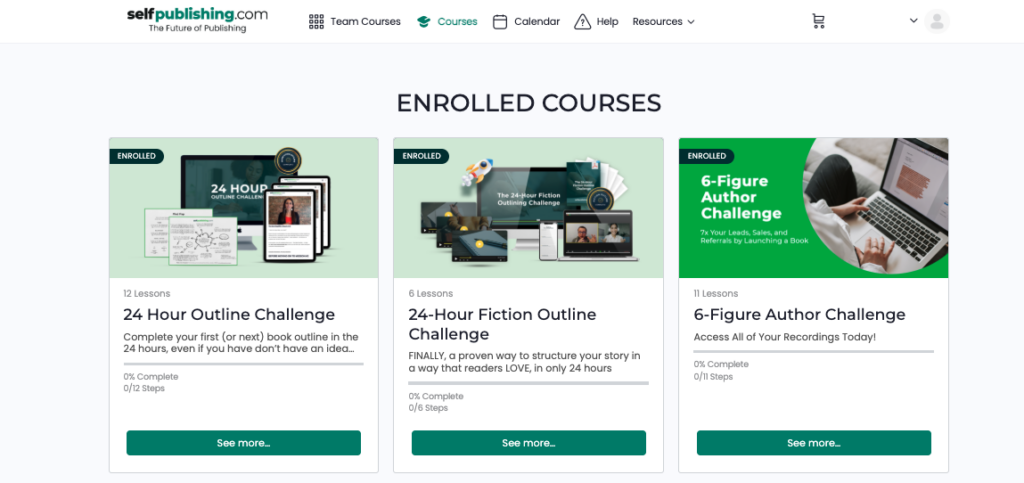
Selfpublishing.com offers in-depth courses for authors who want to move beyond the basics. Here’s a snapshot of some of the courses you gain access to through our author programs.
Digital tools that help writers
Technology has changed the way writers develop their craft. Online and offline tools have made it easier for writers to elevate their writing on their own terms. From writing software to productivity tools, having a successful writing career is within your reach. Consider these digital tools for writing support.
Writing software
Writing software offers writers structure and a seamless way to collaborate with others. Popular software programs for writing and formatting include:
Productivity tools
Keeping your research and writing organized when writing a book not only helps you to work faster, but it also allows you to work smarter. Several digital tools on the market are author-friendly, like these:
How to choose the right help
Before you can choose the right help, you have to know what you need. Authors are not a one-size-fits-all bunch. We have different writing styles, different perspectives, and different goals. Our tools should be tailored to what’s going to get us the result we want. Here are some questions to consider before spending your hard-earned $$.
- What stage of the writing process am I in? Just starting or finishing up?
- What is my level of expertise? Beginner, intermediate, or expert?
- Am I looking for emotion or technical support, or both?
- What is my budget for writing help?
- What type of feedback am I comfortable with? Private, one-on-one, or group?
- Do I prefer direct criticism or a softer approach?
- Would I benefit more from regular support or a flexible alternative?
- What are my publishing goals? Self-publishing? Traditional? Hybrid?
- Do I have a publishing deadline in mind?
Take the time to consider these questions and, based on your answers, find the writing help that best suits your current needs. Remember that you can mix and match. It doesn’t have to be all or none. If a writing retreat is on your list but you can’t afford it yet, try an online community first and then save up for it. If you’d like community support but are an introvert, consider a book coach or one accountability partner to see if you’d like to do more. The best writing support is what works for you.
Challenges to getting the help you need
So what are the challenges to getting help? For me, my biggest roadblock is c-r-i-t-i-c-i-s-m. I don’t like criticism. Do you? It’s kind of painful to have someone read what you wrote and find all of the glaring mistakes that you already know are there. It’s a huge ego crush, but I’ve learned that it’s necessary. First, because having an ego in writing is a sure setup for getting your feelings hurt, and secondly, there’s always someone who knows more, has experienced more, or is better at the thing than I am.
The trick with criticism is to be strategic in selecting who gives you that criticism, and try to get it before you hit publish and have anonymous reviewers leave it for you on Amazon. The best criticism (book critique) comes from someone who has your best interests in mind. Any of the publishing professionals and groups listed in this article can provide the support you need. Just do your research, look closely at the reviews, and ask yourself the questions in the previous section to make the best choice for you.
Do you need writing support?
There is a learning curve to writing, publishing, and building an author career. If you don’t have the support you need, you can still get it done, but it might be a long, difficult journey. Who’s got time for that? Why try to figure it out on your own when there are people, tools, and resources to get you to your end goal faster?
There are so many different ways for you to find support for your writing, from a one-on-one book coach to writing groups and accountability partners. There are also digital tools to keep you focused and help you stay on track.
You’ve gotten this far in the article, so it’s obvious that you’re serious about writing support. You’ve got this! Trust your instinct and follow the writing path that makes sense for you.
Book Outline Generator
Choose your Fiction or Nonfiction book type below to get your free chapter by chapter outline!
Book Outline Generator
Enter your details below and get your pre-formatted outline in your inbox and start writing today!
CONGRATULATIONS
Thanks for submitting! Check your email for your book outline template.
In the meantime, check out our Book Outline Challenge.