




















As with many genres, historical fiction is one comprised of diehards. These readers love what they love and stepping outside of those bounds—while tempting for the sake of creativity—can land you in hot water if you’re not careful. Therefore, learning how to write historical fiction is important so you know where you can blur the line while still maintaining reader expectations.
Because those expectations are kind of everything. They’re what genre is made of.
If you’re looking for a full guide on writing in this niche, stick around because I’m covering:


Book Outline Generator
Choose your Fiction or Nonfiction book type below to get your free chapter by chapter outline!
Book Outline Generator
Enter your details below and get your pre-formatted outline in your inbox and start writing today!
CONGRATULATIONS
Thanks for submitting! Check your email for your book outline template.
In the meantime, check out our Book Outline Challenge.

What are the types of historical fiction?
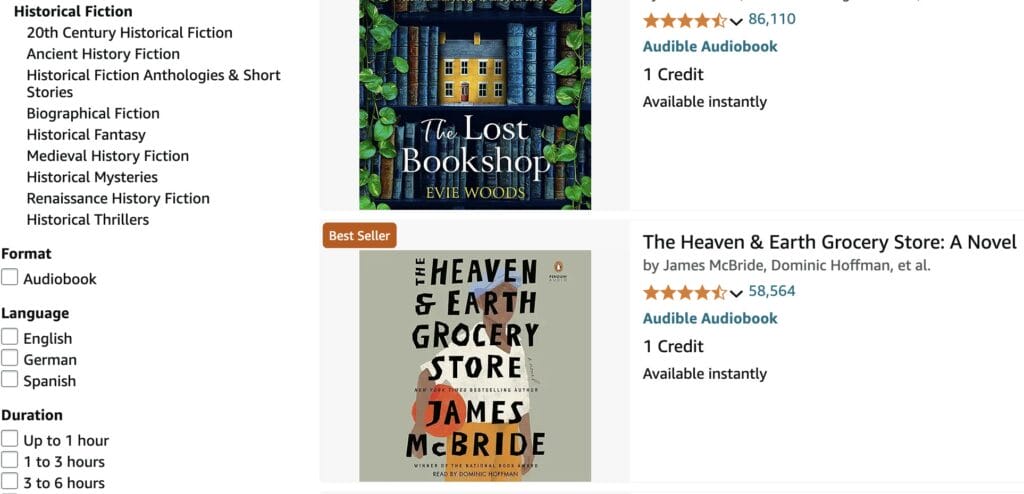
Writing historical fiction is not a one-size-fits-all approach. There are various categories and subgenres even further into the niche. In this example from Amazon, you can see 9 different historical fiction subgenres listed just in the core list. This doesn’t include the various other categories an author can choose from when listing their book.
So what are these different types and what do they all mean? Keep in mind, your book may have multiple types of historical fiction all in one. And that’s okay! Just make sure you’re not trying to do too many.
Historical fiction can be divided into the following categories:
- Biographical historical fiction: Focuses on the life of a real historical figure, blending factual history with fictionalized elements.
- Historical romance: Combines historical settings with romantic plots, where the historical context plays a crucial role in the storyline. Think Bridgerton. It’s a highly popular one you can learn to write here.
- Alternative history (or “What if?” Fiction): Explores what could have happened if key historical events had occurred differently. This would be Man in the High Tower and any other story that plays with events from history that may have gone a different way.
- Historical mystery/thriller: Integrates historical settings with mystery or thriller elements, often involving detectives, espionage, or crime-solving in a past era.
- War historical fiction: Concentrates on wars or military conflicts, providing detailed accounts of battles, strategies, and the human experience of war. Literally any war book from past conflicts counts.
- Historical fantasy: Blends elements of historical fiction with fantasy, introducing magical or supernatural elements into real historical settings.
- Epic historical fiction: Encompasses broad, sweeping narratives that cover significant historical events, often across multiple generations or characters.
- Social historical fiction: Focuses on the everyday lives of people in a particular historical period, highlighting social issues, customs, and cultural dynamics.
- Historical adventure: Features daring exploits and adventurous journeys set against a historical backdrop, often involving exploration, discovery, or treasure hunting.
- Historical saga: Typically follows the lives of a family or group of characters over an extended period, often across several generations, with the historical setting influencing their fortunes.
- Historical drama: Focuses on personal or political drama within a specific historical context, often dealing with power, betrayal, and human emotions.
- Historical fiction for young adults (YA): Tailored for younger readers, these novels incorporate historical settings with themes and plots that resonate with adolescent experiences.
- Christian Historical Romance: A subgenre that blends Christian values and faith in a time that’s long since passed.
What are the rules for historical fiction?
When it comes to writing historical fiction, you can’t just make up your own setting that feels like the past and call it “historical”. You might think to do that when writing in this genre, but that would make it something else entirely. Understanding what historical fiction is can set you up for success when writing it because the rules are fairly straightforward.
Here are some rules of writing to follow for this genre:
- Use narration to establish a time period: How the narrative sounds and the word choice you use does a lot to establish when it takes place. For example, using phrases like “make haste” or other terms that clearly belong in the past will create the proper tone and voice (more on this below).
- Do your research! Learning how to research historical fiction is crucial. Those die-hard fans? Well, they know their history, and if you skirt the rules too much in this genre, readers will be upset.
- Make your characters believable: They should have values and morals of the time, not ones that may be present in our day.
- Respect historical events—especially the more sensitive ones: For example, don’t make “fun” of the tragedy that is slavery in the United States. Do it justice, even if you want to make it your own.
- Consider time-specific ramifications of actions: It’s all too easy to have your characters react as if they are in our day and age. Remember that with the historical genre, characters live in that time and will have appropriate responses.
- Teach readers the history, but not too much: You need to balance exposition with story. Historical fiction readers love the genre because they get to learn within it. Find ways to naturally educate readers on the research you’ve done without a huge info dump.
These rules are fairly set in stone. If you want to break them, make sure you have a good reason and hit the other marks.
How to write historical fiction in 8 phases for a memorable read
Now you know the rules of writing historical fiction, it’s time to dig into the how. I’ve put together 8 phases to work through to take your book from idea to draft.
1. Choose the when
The first phase in writing historical fiction is deciding on the time period in which your story will take place. Are you fascinated by the grandeur of the Victorian era, the turbulence of the World Wars, or the mysteries of ancient civilizations? Your choice of when will shape the entire narrative, influencing everything from the characters’ behavior to the plot’s unfolding.
The entire tone and style of your book depends on when the story takes place. If you have an idea for a story, do a bit of research initially to understand when those events may have occurred. This will also give you a timeframe to extend your research for accuracy.
2. Compile research
Once you’ve settled on a period, it’s time to dive into research. Historical accuracy is essential in this genre, so immerse yourself in the details of the era. Read books, watch documentaries, explore primary sources like letters or diaries, and visit historical sites if possible.
Understanding the social, political, and cultural nuances of the time will help you create an authentic and believable setting. And you’ll want to make sure to save all of this research somewhere easily accessible for the writing process. Some writing software programs have designated places for this, but you can also create your own systems.
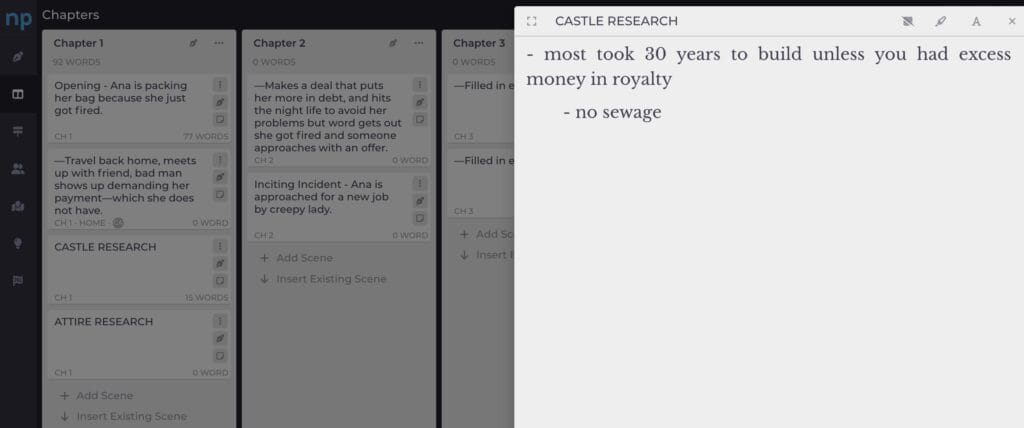
In NovelPad, I like to use the “chapters” section and just create “scenes” that are labeled with what the research is. It keeps it easily accessible when drafting.
3. Pick the story’s tone or subgenre
Out of the list above, determine what subgenre your story actually is. If it’s two or three, make sure to include them and identify which plot aspects make it so. Obviously, if the core plot focuses around a romance, you’ll choose that subgenre. But remember that you can have a historical romance that’s also adventure or mystery, or both!
You also want to understand the overall tone of that subgenre. For example, historical romances can be comedies, or they can be tragedies. Will your novel be a serious exploration of historical events, or will it take a lighter, more romantic approach? The tone you choose will guide the mood, pacing, and even the language of your narrative.
This is often a personal choice. Keep your audience in mind, though. Think about what you like to read and what your themes often include. This will help you place the tone along with the subgenre.
4. Practice the story’s voice
The voice and style you choose to write in will go a long way to establishing the time period of your story. For example, the Bridgerton books are full of language like “make haste,” “promenade,” and “rake”. The slang of the time is also important—add that to your research list!
If you try to write historical fiction using a modern-sounding narration, it won’t hit the same feel. That’s why this is listed as one of the rules above.
Experiment with different narrative styles and perspectives, too, since they drive the voice. Whether you choose first-person, third-person, or even an epistolary (diary entry) format, ensure the voice feels authentic to the era and engaging to the reader.
5. Develop characters
Characters are the heart of any novel, and in historical fiction, they must be grounded in the realities of their time. Your characters should think, speak, and behave in ways that are believable for the period. Consider their background, social status, and the historical events they might have witnessed.
However, avoid making them mere stereotypes of their time; they should be complex and relatable to modern readers. In fact, many of the most popular characters in historical fiction are those who don’t “fit in” with their society entirely. They want something more and beyond the norm.
This makes them:
- Interesting in their timeline;
- Create conflict with the plot and societal standards;
- More relatable to the modern reader.
Penelope Featherington and Eloise Bridgerton are great examples of this in the Bridgerton series. Both are women who want more than what is typically expected of a woman in their time.
Think about how to best balance this with your unique plot, because sometimes the story you want to tell is one more closely aligned with what was expected of the times.
6. Hone your plot
Your plot should seamlessly integrate historical facts with fictional elements. While history provides the backdrop, your characters and their conflicts drive the story forward. Whether you’re telling a love story, a mystery, or an adventure, ensure that the historical setting enhances rather than overshadows the plot.
In fact, the conflicts of your story should be conflicts of the time. An arranged marriage is a great example during regency time periods. Another would be tribal trials in ancient cultures.
The point is that whatever events transpire throughout your story, they shouldn’t be able to take place in our current world. That’s one of the reasons why readers want to escape to the historical fiction genre.
7. Outline if it’s for you
Some writers thrive on detailed outlines, while others prefer to discover the story as they write. If you’re an outliner, create a roadmap for your novel, detailing the major plot points, character arcs, and historical milestones. This will help you stay organized and focused as you write and will give you insight into what research you actually need—no need to over-research if you don’t have to. But, if you want to, go for it!
If outlining feels restrictive, start with a loose plan and allow the story to evolve organically. Make notes for when and where to research using a “TK” written next to elements. This is a research hack because there are very few words in the English language that use this letter combination. When ready, you can perform a quick “Command + F” or “Control + F” to search for it. Like this:

8. Write your novel!
With your research in hand, characters developed, and plot honed, it’s time to write! Don’t worry about getting everything perfect in the first draft—focus on getting your ideas down on paper. Historical fiction requires revision, especially to ensure accuracy and consistency (and especially if you’re a discovery writer), but that comes later.
For now, immerse yourself in the world you’ve created and let the story flow. This is the best way to actually finish a draft. Maintain momentum!
Note: The post-drafting phase is a doozy and includes self-editing, revisions, beta readers and the like. If you use beta readers, select those who like and read a lot of historical fiction. This will help ensure you’re hitting the right mark.
5 examples of historical fiction novels to learn from
As I always say, you’ll learn best by researching good reads. If you really want to learn how to write historical fiction that’ll satisfy readers, then pick up a copy of each of these and spend time learning the genre.
Bonus points if you read books within the subgenres you want to write in.
1. Biographical historical fiction: Wolf Hall by Hilary Mantel
Wolf Hall delves into the life of Thomas Cromwell, a key figure in the court of King Henry VIII during the 16th century. The novel offers a detailed and humanizing portrayal of Cromwell, often vilified in history, as he navigates the treacherous political landscape of Tudor England. Mantel brings to life the complex interplay of power, ambition, and religious upheaval that defined the era, crafting a vivid and introspective narrative.
2. Historical romance: Outlander by Diana Gabaldon
Outlander blends romance with historical fiction as it follows Claire Randall, a World War II nurse who is mysteriously transported back to 18th-century Scotland. There, she becomes entangled in the Jacobite risings and finds herself torn between two worlds—and two men. Gabaldon’s richly detailed depiction of Scottish history, combined with a passionate love story, has captivated readers and brought this tumultuous period to life.
3. Alternative history: The Plot Against America by Philip Roth
In The Plot Against America, Roth imagines an alternative history in which Charles Lindbergh, an aviation hero with pro-Nazi sympathies, defeats Franklin D. Roosevelt in the 1940 presidential election. The novel explores the rise of fascism in the United States through the eyes of a Jewish family in Newark, New Jersey. Roth weaves a chilling narrative that examines fear, prejudice, and the fragility of democracy in a world where history takes a dark turn.
4. Historical mystery/thriller: The Alienist by Caleb Carr
The Alienist is a gripping historical mystery set in 1896 New York City. The novel follows Dr. Laszlo Kreizler, a criminal psychologist, or “alienist,” as he teams up with journalist John Schuyler Moore and a group of investigators to track down a brutal serial killer preying on young boys. Carr meticulously recreates the atmosphere of Gilded Age New York, blending real historical figures and events with a dark, suspenseful plot that delves into the early days of forensic psychology.
5. Historical fantasy: Jonathan Strange & Mr Norrell by Susanna Clarke
Set during the Napoleonic Wars in an alternative version of 19th-century England, Jonathan Strange & Mr Norrell combines historical fiction with elements of fantasy. The novel explores a world where magic, long dormant, is revived by two very different magicians: the reclusive Mr. Norrell and the ambitious Jonathan Strange. Clarke’s narrative weaves together real historical events with an intricate magical system, creating a richly textured world where history and fantasy intertwine seamlessly.
Historical fiction is a very lucrative genre to learn to write in. These tips will get you most of the way there!
Book Outline Generator
Choose your Fiction or Nonfiction book type below to get your free chapter by chapter outline!
Book Outline Generator
Enter your details below and get your pre-formatted outline in your inbox and start writing today!
CONGRATULATIONS
Thanks for submitting! Check your email for your book outline template.
In the meantime, check out our Book Outline Challenge.